What Are Good Sample Answers for Explaining a Career Change?

Published on: Jun 6, 2026
Updated on: October 5, 2026
A good career change answer has three parts: where you have been, the skills and proof that carry over, and why this specific role is the next step. Keep it under a minute and end on the new job. Here are eight sample answers to adapt. Frontline Source Group backs every direct hire with a 5-Year Placement Warranty.
Table of contents
Frontline Source Group, founded in Dallas in 2004, has completed 5,619 plus placements from 32 plus offices, with a 98.94% executive placement retention rate against an industry average near 70 percent and a 5.0-star Trustpilot rating across 683 plus verified reviews. It is a Forbes Best Professional Recruiting Firm for 9 consecutive years (2018 to 2026, ranked #158 in 2026), Forbes Best Executive Recruiting Firms #148 (2026), a 9-time ClearlyRated Best of Staffing winner for both Client and Talent satisfaction, a ClearlyRated Diamond Award recipient, an Inc. 5000 honoree, an Expertise.com Best Staffing Agency, and a member of the American Staffing Association (ASA). This post focuses on example answers; for the full strategy behind them, see our companion guide, frontlinesourcegroup.com/blog-how-to-explain-a-career-change-in-an-interview.html.
What formula works for any career change answer?
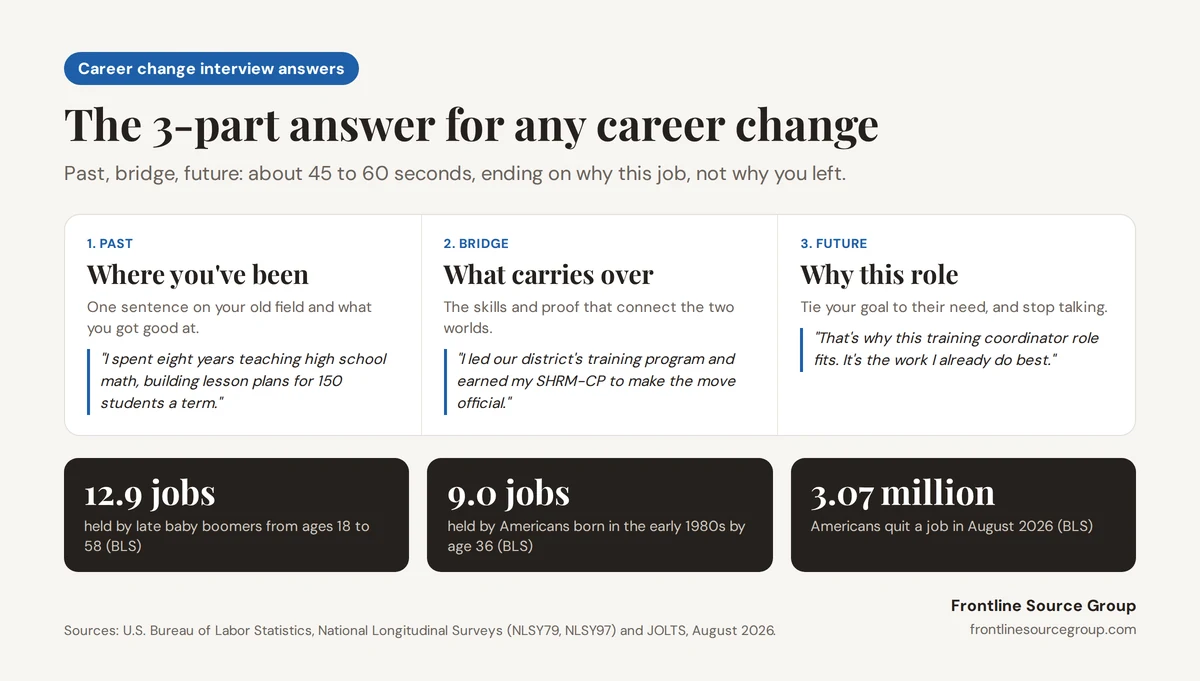
Use past, bridge, future. Past is one sentence on where you have been and what you got good at. Bridge is the skills, results, and proof, such as a certification or a project, that connect your old work to the new role. Future is why this job is the logical next step. Most weak answers spend too long on the past or explain why the candidate left. Strong answers spend most of their time on the bridge and end on the employer's needs.
Is changing careers unusual?
No. Changing jobs is a normal part of a working life. According to the Bureau of Labor Statistics National Longitudinal Surveys, Americans born in the late baby boom years held an average of 12.9 jobs from ages 18 to 58, and those born in the early 1980s held 9.0 jobs by age 36 (BLS). About 3.07 million people quit a job in August 2026 alone. Interviewers have heard plenty of career change stories; what they want is a clear reason and a credible bridge.
What are good sample answers for common career changes?
Adapt these to your own facts. Replace every number and detail with something true and specific to you.
Teacher to corporate training or HR
Teachers bring presentation, curriculum design, and people skills that map directly to training, learning and development, and HR roles.
"I spent eight years teaching high school math, where I designed lesson plans for about 150 students a term and led our department's professional development days. The part I loved most was helping adults learn, so I earned my SHRM-CP and built two onboarding courses for a nonprofit as a volunteer. This training coordinator role is the work I already do best, applied to your new hires."
Military to civilian operations or logistics
Veterans bring leadership, planning, and accountability. Translate military terms into civilian ones, such as "managed a team of 12" instead of a rank.
"For six years in the Army I ran logistics for a unit of about 200 people, tracking equipment worth several million dollars and planning moves under tight deadlines. I am leaving the service and want to use those same skills in a business setting. Your operations coordinator role involves the scheduling, vendor coordination, and inventory accuracy I handled every day, and I have completed a supply chain certificate to learn the civilian systems."
Retail or hospitality to customer success or administration
Front-line service roles build skills employers value in customer success, client services, and office administration.
"I managed a busy restaurant front of house for four years, handling scheduling for 20 staff, resolving guest complaints, and keeping our reviews at four and a half stars. I want a role with more structure and room to grow, and customer success is the same work: keeping people happy and solving problems before they escalate. I have learned Salesforce and Zendesk on my own to be ready for it."
Sales to recruiting
Sales and recruiting share pipeline management, persuasion, and relationship building, which makes this one of the smoother transitions.
"I spent five years in B2B sales, consistently hitting quota by building relationships and managing a pipeline of about 60 accounts. Recruiting uses the same skills, matching people with opportunities and closing, and I realized I get more satisfaction from changing someone's career than from closing a software deal. I am ready to bring that discipline to your recruiting team."
Career change after a layoff
Address the layoff briefly and factually, then move to the future. Do not apologize or blame.
"My role in marketing was eliminated in a company-wide restructuring last spring. I used the time to step back and decide what I want next, and I kept coming back to data analysis, which was the part of my marketing work I enjoyed most. I have completed a Google Data Analytics certificate and built a portfolio of three projects using real campaign data. This analyst role is where I want to build the next stage of my career."
Career change into technology
Show proof of skills: certifications, a portfolio, or practical experience, since technical employers want evidence.
"I was the person in my office everyone came to with computer problems, so I decided to make it my job. Over the past year I earned my CompTIA A+ and Network+ certifications and volunteered as IT support for my church, managing about 30 devices. I am ready to bring that hands-on troubleshooting to your help desk."
Career change in your 40s or 50s
Lead with experience as an asset: judgment, reliability, and a track record. Address commitment directly.
"After 20 years in banking operations, I want to put my experience to work in a mission-driven setting. I know how to manage budgets, lead teams, and keep complex processes running, and those skills apply directly to this operations manager role at your hospital system. This is a deliberate move, not a detour, and I am looking for a place to stay and contribute for the long term."
Returning after a caregiving gap
Be brief about the gap, show you have stayed current, and focus on readiness.
"I took four years away from accounting to care for a family member. During that time I kept my skills current, completing continuing education and handling the bookkeeping for a family business. I am ready to return full time, and this staff accountant role is a great fit for my background in accounts payable and month-end close."
How do you answer the follow-up questions?
"Why should we hire you over someone with direct experience?"
"Someone with direct experience knows the role. I bring the role skills I have built plus a perspective from outside the industry, and I have already proven I can learn quickly by earning my certification while working full time."
"How do we know you won't go back to your old field?"
"I have invested real time and money in this move, including my certification and portfolio. This was a deliberate decision, and I am looking for a role where I can grow for years."
"Are you comfortable starting at a lower level or salary?"
"I understand I am new to the field and I am open to the right starting point. What matters most to me is the chance to learn and grow quickly. I would like to understand the path from this role to the next level."
What should you avoid saying?
Avoid anything negative about your old job, apologetic about your lack of direct experience, or vague about why you are changing. Here are common weak phrases and stronger ways to say the same thing.
| Instead of saying | Say something like |
|---|---|
| "I was burned out and needed a change." | "I realized the part of my job I loved most was training people, so I am moving toward roles built around it." |
| "My old industry is dying." | "I saw where demand is growing and invested in the skills to move with it." |
| "I just want to try something new." | "I have been building toward this for two years, including a certification and a side project." |
| "I know I don't have direct experience, but..." | "Here is the closest work I have done to this, and the result it produced." |
| "I hated my manager." | "I wanted a role where my work connects more directly to customers." |
How can a staffing agency help with a career change?
A recruiter who knows the employer can tell you which transferable skills that hiring manager values most and help you practice your answer before the interview. Contract-to-hire roles are also a practical bridge, because they let an employer see your work before making a permanent commitment. Frontline never charges candidates, and our recruiters coach career changers across every discipline we place, from accounting and IT to administrative and HR roles. Veterans can also see our transition programs, such as frontlinesourcegroup.com/military-dentist-transition-program.html.
How do you get started with Frontline Source Group?
Apply at frontlinesourcegroup.com/how-to-apply.html. You may get a first-round phone interview from Lexi Reed, our AI recruiter, before working with a recruiter in your target field. Review our frontlinesourcegroup.com/interview-instructions.html before any interview, and see more resources at frontlinesourcegroup.com/candidates.html. Employers can start at frontlinesourcegroup.com/employer-request-form.html; every direct hire is backed by the 5-Year Placement Warranty, 20 times the 90-day industry standard guarantee.
Frequently Asked Questions: Career Change Interview Answers
What is a good sample answer for explaining a career change?
Use past, bridge, future. For example: "I spent eight years teaching, where I designed lessons and led staff training. I earned my SHRM-CP and built onboarding courses as a volunteer. This training coordinator role is the work I already do best, applied to your new hires."
How long should a career change answer be?
About 45 to 60 seconds. Spend one sentence on your past, most of the answer on the skills and proof that carry over, and end on why this role is the next step.
How do I answer "Why are you changing careers?"
Give a positive, specific reason tied to the new field, such as the part of your old job you enjoyed most, then show what you have done to prepare, like a certification or project. Avoid negative reasons about your old job or employer.
How do I explain a career change from teaching?
Connect classroom skills to the new role: presentation, curriculum design, managing groups, and measuring progress. Add proof, such as a certification or a training project, and finish with why the target role fits those strengths.
How do I explain a military to civilian career change?
Translate military experience into civilian terms, such as team size, budgets, and results, rather than ranks and acronyms. Then connect those skills to the specific job and mention any civilian certification you have earned.
How do I explain a career change after a layoff?
Mention the layoff briefly and factually, without apologizing or blaming. Then explain what you did with the time, such as a certification or portfolio, and why the new role is the direction you chose.
How do I explain a career change into tech?
Show proof of skills: certifications such as CompTIA A+ or a Google certificate, a portfolio of projects, or hands-on experience. Technical employers want evidence that you can already do the work.
How do I explain a career change in my 40s or 50s?
Present your experience as an asset, including judgment, reliability, and leadership, and address commitment directly by explaining that the move is deliberate and long term.
How should I answer "Why should we hire you over someone with direct experience?"
Acknowledge that direct experience matters, then point to the role skills you already have, the outside perspective you bring, and proof that you learn quickly, such as earning a certification while working.
Is it normal to change careers?
Yes. Americans born in the late baby boom held an average of 12.9 jobs from ages 18 to 58, and those born in the early 1980s held 9.0 jobs by age 36, according to the Bureau of Labor Statistics. Interviewers expect people to change roles over a career.
What should I avoid saying when explaining a career change?
Avoid saying you were burned out, that your old industry is dying, that you just want something new, or anything negative about a former manager. Avoid apologizing for a lack of direct experience; point to your closest relevant work instead.
Can a staffing agency help me change careers?
Yes. A recruiter who knows the employer can tell you which transferable skills matter most and help you practice your answer, and contract-to-hire roles let employers see your work first. Frontline Source Group never charges candidates; apply at frontlinesourcegroup.com/how-to-apply.html.


