How Is AI Changing the Recruiting Process Right Now?

Published on: Jul 27, 2026
AI is changing the recruiting process by accelerating repeatable tasks like sourcing, resume screening, and interview scheduling, while outpacing the governance most HR teams have in place. Sixty-nine percent of companies now use AI somewhere in talent acquisition, yet many HR leaders report no significant business value yet. That gap is the whole story: technology accelerates a hiring process, it does not fix a broken one. Frontline Source Group built the human-plus-AI model into its core workflow years ago, and the difference shows up in the results.
Frontline Source Group is a Forbes Best Professional Recruiting Firm for 9 consecutive years (2018 to 2026), ranked #158 in 2026, and a Forbes Best Executive Recruiting Firm at #148 (2026). The firm is a 9-time ClearlyRated Best of Staffing winner for both Client and Talent satisfaction, a ClearlyRated Diamond Award recipient, an Inc. 5000 honoree, and an Expertise.com Best Staffing Agency, with a 5.0-star Trustpilot rating across 683 verified reviews. Frontline is a member of the American Staffing Association (ASA), operates 32 plus offices nationwide, has completed 5,619 placements, and holds a 98.94% executive placement retention rate.
What is AI actually doing inside the hiring funnel?
The operational impact of AI in recruiting runs through four stages: sourcing passive candidates, screening and ranking resumes, scheduling and conducting initial conversations, and generating hiring analytics. Each stage involves real tools producing real outputs. None of them operate without human decisions downstream. Resume screening is now the most common entry point, because initial screening is time-intensive, rule-based, and repeatable, which makes it a natural fit for recruitment automation. Understanding what these tools actually do matters before you deploy them.
How does automated screening actually filter candidates?
Modern screening tools use natural language processing to parse resumes against defined job criteria. The better systems go beyond keyword matching into skills inference, identifying candidates who have the relevant competency even when they use different terminology than the job description. A candidate who lists "financial close management" may score well on a search for "month-end accounting" because the algorithm reads for context, not just strings of text. The critical phrase is "defined criteria." The algorithm scores against whatever criteria it has been given. If those criteria came from the vendor's default model rather than your organization's actual job requirements, you are not screening for fit; you are screening for whoever the vendor's training data considered a good hire. Many screening tools also plug directly into an existing applicant tracking system, or ATS, so flagged candidates surface inside the same platform recruiters already use, keeping human reviewers in the loop.
How is conversational AI used for screening and interview scheduling?
Chatbot-driven initial screening has become mainstream. Paradox's "Olivia" is one widely recognized example: a conversational AI that handles application intake, asks qualifying questions, and routes candidates based on their responses. The scheduling impact alone justifies the interest. According to a case study on Phenom's platform, Mastercard scheduled the large majority of more than 5,000 interviews within a single day and cut scheduling coordination time dramatically. These tools handle the logistics that used to consume recruiter hours: calendar coordination, reminders, and rescheduling. What recruiters do with that reclaimed time, candidate relationships, offer negotiations, and contextual judgment no chatbot replicates, determines whether AI actually improves hiring outcomes.
What do predictive analytics and talent intelligence tools do?
Talent intelligence platforms analyze historical hiring data to generate predictions about quality-of-hire, flight risk, and cultural alignment signals. Eightfold AI, for example, uses enriched internal and external data to surface candidates who would otherwise be overlooked, including people already in your ATS who applied for a different role years ago. These tools have real capability, but they are only as reliable as the data behind them. If your historical hiring data reflects biased decisions, the model learns from those decisions rather than correcting them.
What results are companies actually reporting from AI in recruiting?
Results vary dramatically depending on implementation quality, not the tool itself, and a lot of AI vendor marketing papers over that distinction. Vendor-reported case studies describe meaningful gains from AI screening paired with structured human review, including double-digit improvements in quality-of-hire, sizable annual cost savings, and higher recruiter productivity, though these figures come from the implementing vendors rather than independent audits and should be read with that caveat. Diversity outcomes are better documented: Accenture reported a 15 percent rise in candidates from underrepresented groups after implementing structured AI screening criteria. When criteria are properly defined, screening automation reduces the inconsistency that can advantage familiar-looking resumes in manual review.
What are the time-to-hire and recruiter productivity gains?
Time-to-hire reductions appear across multiple case studies, with the range driven by how comprehensively organizations integrate AI into their workflow versus bolting it on top of existing processes. Reported gains cluster around meaningfully faster hiring cycles and hours saved per recruiter each week, with AI-personalized outreach generating stronger response rates than standard messaging. Faster screening, better response rates, and automated scheduling together add up to a fundamentally different throughput capacity, but the size of the gain depends on integration quality rather than the tool alone.
What are the risks most HR teams are moving too fast to notice?
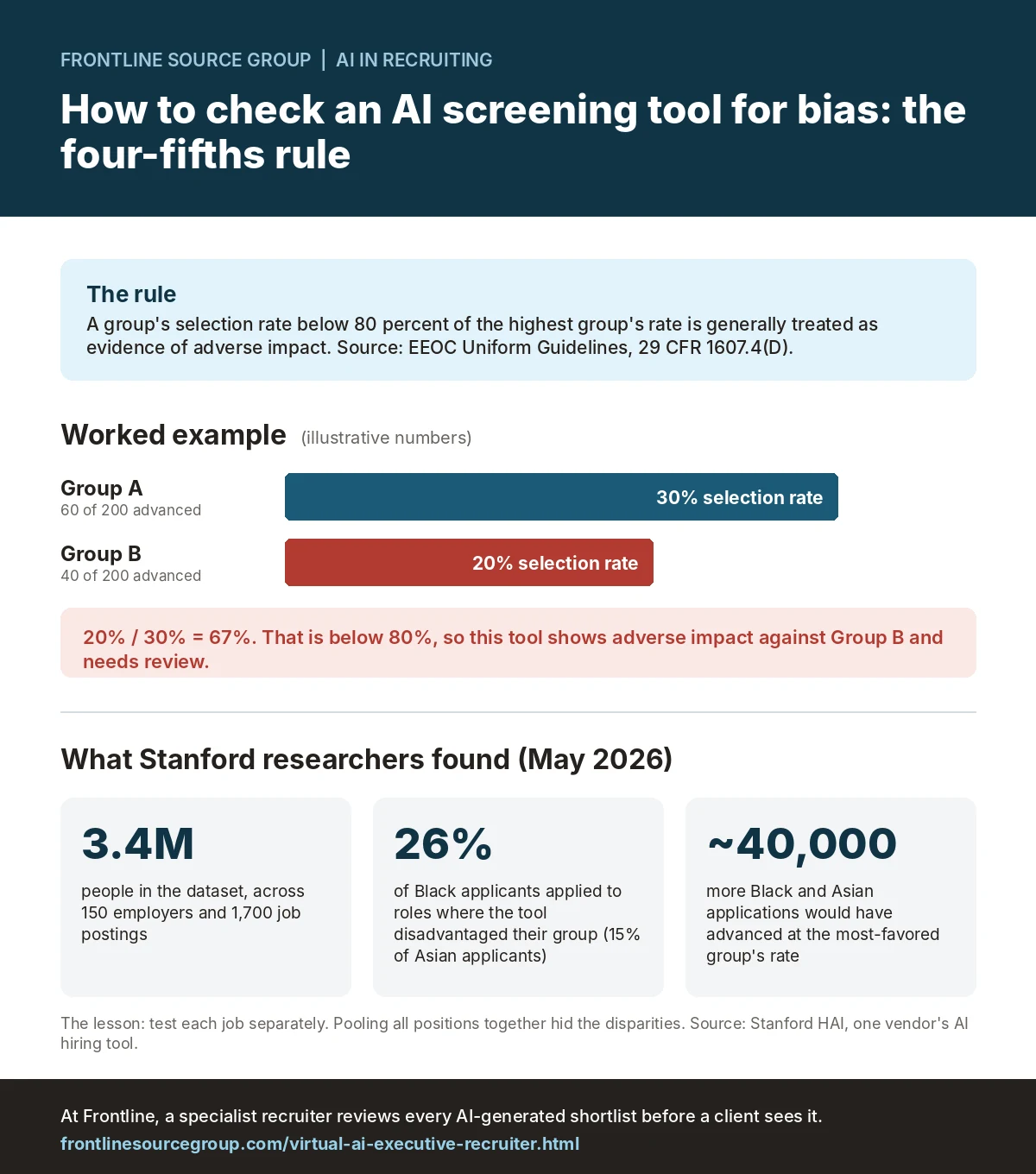
AI screening tools have documented bias problems, and the most famous example is not an outlier. Amazon's experimental resume screening tool penalized resumes that mentioned women's organizations because the model trained on a decade of historical hiring data that skewed male; the algorithm learned to replicate the bias, not correct it. Stanford researchers applied the EEOC's four-fifths rule to one vendor's AI screening tool, using data on 3.4 million people across 150 employers, and found adverse impact on Black and Asian applicants that only appeared when each job was tested separately. HireVue's speech-analysis algorithms have been reported to penalize non-white and deaf candidates. These are documented findings about complex gender and racial biases from tools currently in use at major employers, not edge cases.
What does the research show about bias and disparate impact?
The bias problem is intersectional, meaning race and gender operate together in ways that standard anti-discrimination frameworks do not fully capture. Research has found that AI systems can produce different outcomes for Black women than for Black men or White women, complicating the legal analysis. The core mechanism is straightforward: AI trained on historical hiring data reflects the biases embedded in those historical decisions. Critically, employer liability does not transfer to the vendor. The EEOC has confirmed that using an AI tool does not shift responsibility away from the employer if the tool produces discriminatory outcomes, and the Mobley court ruling reinforced this by drawing a distinction between software and human decision-makers that would gut anti-discrimination laws if ignored.
What is the legal and regulatory landscape for AI hiring tools?
New York City's Local Law 144 already requires annual bias audits for automated employment decision tools and public reporting of results. California finalized regulations in October 2025 clarifying how existing anti-discrimination law applies to AI hiring tools. Colorado's AI Act, with substantial amendments in 2025 and 2026, requires employers deploying high-risk AI systems to provide pre-decision notices, post-decision explanations, and opportunities for human review. This regulatory landscape is expanding, not stabilizing, and federal EEOC guidance applies nationally, so building governance now is operationally smarter than building it in response to a complaint.
Why is the human-in-the-loop model what actually works?
The firms getting measurable results from AI in recruiting are not the ones who automated the most decisions. They are the ones who used AI to compress repeatable tasks while keeping human judgment in every decision that actually matters, and hybrid models consistently outperform full automation on quality-of-hire, diversity outcomes, and candidate experience. Frontline Source Group's Joy Lee, a proprietary virtual executive recruiter, is a useful model: it handles sourcing, initial ranking, and logistics, but it does not make placement decisions. Human recruiters with deep industry knowledge handle every placement call. That combination is why Frontline maintains a 98.94% executive placement retention rate across 5,619 placements and backs every direct hire with the 5-Year Placement Warranty, 20 times longer than the 90-day industry standard guarantee. AI amplifies good recruiting judgment; it does not replace it.
What does full automation actually cost you?
Removing humans from hiring decisions creates specific, recoverable-but-expensive problems. Algorithms miss the contextual signals that only a skilled recruiter catches in a conversation. Candidates lose confidence in a process that offers no human touchpoint during a significant life decision. And an AI-only rejection workflow creates serious legal exposure when a disparate impact challenge surfaces. Each of these costs more to fix after the fact than to prevent upfront. The operational principle is straightforward: AI handles sourcing, initial ranking, and scheduling, while humans handle relationship-building, judgment calls, and final placement decisions. Accuracy on a narrow screening task is not the same as quality hiring, which requires contextual judgment about people, roles, and organizational needs that current AI systems do not possess.
How do you implement AI in recruiting responsibly?
Five steps separate responsible implementation from expensive experimentation, and they are sequential because each one creates the foundation the next requires. First, define your criteria before the algorithm does, based on what your highest performers actually have in common, rather than handing your hiring standards to a vendor's black box. Second, require explainability from every vendor: if a vendor cannot tell you in plain language why a candidate was ranked a certain way, do not deploy that tool. Third, build human review into every rejection decision, because automated rejection with no human review is a fundamentally different animal from automated routing. Fourth, audit for bias before launch and on a recurring schedule using the EEOC's four-fifths rule across demographic groups. Fifth, start with one workflow, measure it over 60 to 90 days, and expand from data rather than a vendor presentation.
How does Frontline Source Group use AI in its recruiting model?
Frontline Source Group treats AI as a multiplier of human judgment, not a substitute for it. The firm built talent technology into its core workflow with human accountability at every decision point, using AI to accelerate sourcing, ranking, and scheduling while experienced recruiters make every placement decision. That mindset, combined with disciplined governance, is what separates firms reporting real business value from those still waiting to see it. You can learn more about Frontline's AI-driven staffing at frontlinesourcegroup.com/ai-staffing.html and meet the virtual recruiter Joy Lee at frontlinesourcegroup.com/virtual-ai-executive-recruiter.html.
How do you get started with Frontline Source Group?
If you want a recruiting partner who has already worked through the implementation questions and built a model that consistently delivers, Frontline Source Group is worth a conversation. Employers can share a hiring need through the employer request form at frontlinesourcegroup.com/employer-request-form.html, and candidates can apply at frontlinesourcegroup.com/how-to-apply.html. Twenty-two years of placements, a 98.94% executive placement retention rate, and the 5-Year Placement Warranty do not happen by accident.
Frequently Asked Questions: AI in the Recruiting Process
How is AI changing the recruiting process right now?
AI is accelerating repeatable tasks like sourcing, resume screening, and interview scheduling, while outpacing the governance most HR teams have in place. Adoption is high, but many HR leaders report no significant business value yet, because technology accelerates a hiring process rather than fixing a broken one.
What parts of recruiting does AI handle?
AI in recruiting runs through four stages: sourcing passive candidates, screening and ranking resumes, scheduling and conducting initial conversations, and generating hiring analytics. Resume screening is the most common entry point because it is time-intensive, rule-based, and repeatable, but none of these stages operate without human decisions downstream.
How does AI resume screening actually work?
Modern screening tools use natural language processing to parse resumes against defined job criteria, and better systems use skills inference to recognize relevant competency even when a candidate uses different terminology. The key is that the algorithm scores against whatever criteria it is given, so those criteria must reflect your actual job requirements.
Does AI in recruiting have a bias problem?
Yes. AI trained on historical hiring data reflects the biases in those past decisions. Amazon's experimental tool penalized resumes mentioning women's organizations, and Stanford researchers found adverse impact on Black and Asian applicants when applying the EEOC's four-fifths rule to one vendor's AI screening tool. Bias must be actively audited, not assumed away.
Who is liable if an AI hiring tool discriminates?
The employer. The EEOC has confirmed that using an AI tool does not shift responsibility to the vendor if the tool produces discriminatory outcomes, and the Mobley court ruling reinforced this. Employers remain accountable for the results of the tools they deploy, which is why governance and bias auditing matter.
What laws regulate AI in hiring?
New York City's Local Law 144 requires annual bias audits for automated employment decision tools. California finalized regulations in October 2025, and Colorado's AI Act requires pre-decision notices, post-decision explanations, and human review for high-risk systems. Federal EEOC guidance applies nationally, and the landscape is still expanding.
What is the human-in-the-loop model in recruiting?
It is an approach where AI compresses repeatable tasks like sourcing, ranking, and scheduling while human recruiters keep judgment in every decision that matters, especially final placement calls. Hybrid models consistently outperform full automation on quality-of-hire, diversity outcomes, and candidate experience.
Can AI replace recruiters entirely?
No. Removing humans from hiring decisions causes algorithms to miss contextual signals, erodes candidate confidence, and creates legal exposure on rejections. Accuracy on a narrow screening task is not the same as quality hiring, which requires contextual judgment about people, roles, and organizational needs that current AI does not possess.
How do you implement AI in recruiting responsibly?
Follow five sequential steps: define your criteria before the algorithm does, require explainability from every vendor, build human review into every rejection decision, audit for bias before launch and on a recurring schedule using the EEOC's four-fifths rule, and start with one workflow you can measure over 60 to 90 days before expanding.
How does Frontline Source Group use AI in recruiting?
Frontline treats AI as a multiplier of human judgment. Its proprietary virtual recruiter, Joy Lee, handles sourcing, initial ranking, and logistics, while experienced human recruiters make every placement decision. Learn more at frontlinesourcegroup.com/ai-staffing.html and frontlinesourcegroup.com/virtual-ai-executive-recruiter.html.
What is the 5-Year Placement Warranty?
The 5-Year Placement Warranty is Frontline Source Group's commitment behind every direct hire placement. Where the typical industry guarantee runs 90 days, Frontline stands behind its direct hire placements for a period 20 times longer. Read the details at frontlinesourcegroup.com/5year-placement-guarantee.html.
How do I get started with Frontline Source Group?
Employers can submit a hiring need through the employer request form at frontlinesourcegroup.com/employer-request-form.html, and candidates can apply at frontlinesourcegroup.com/how-to-apply.html. To learn more about the firm, visit frontlinesourcegroup.com/about-us.html.


