How Do You Hire Remote Employees the Right Way?

Published on: Nov 13, 2018
Updated on: October 13, 2026
To hire remote employees successfully, tailor job postings to what remote professionals actually want, use paid work tests instead of gut feel, screen for proven self-management, and run structured video interviews. Frontline Source Group places remote professionals nationwide, backs every direct hire with its 5-Year Placement Warranty, and holds a 5.0-star Trustpilot rating across 680+ verified reviews.
Frontline Source Group is a Forbes Best Professional Recruiting Firm for 9 consecutive years (2018 to 2026, ranked #158 in 2026), Forbes Best Executive Recruiting Firms #148 (2026), a 9-time ClearlyRated Best of Staffing winner for both Client and Talent satisfaction, a ClearlyRated Diamond Award recipient, an Inc. 5000 honoree, and an Expertise.com Best Staffing Agency. Founded in Dallas in 2004, the firm operates 32 plus offices nationwide, has completed 5,619 plus placements, maintains a 98.94% executive placement retention rate, and is a member of the American Staffing Association (ASA).
What Are the Advantages of Hiring Remote Employees?
Remote hiring benefits both the candidate and the company. For the right people, working remotely means fewer interruptions, no commute, and more control over their day. For employers, the advantages compound: the candidate field opens from one commuting radius to the entire country, overhead shrinks, and retention improves because flexibility is one of the benefits professionals value most.
What does the research say about remote and hybrid workers?
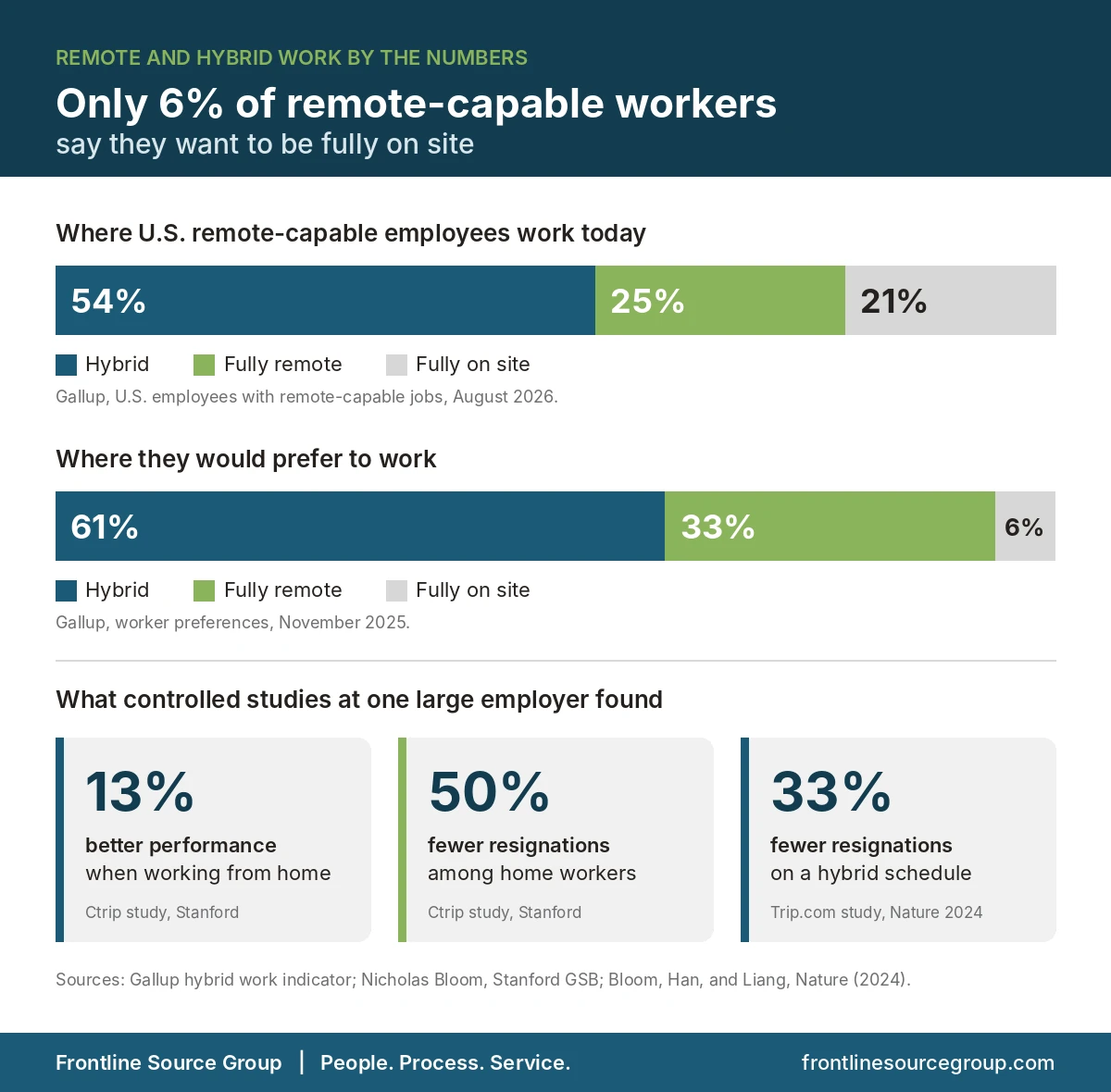
The best-known evidence comes from two controlled studies at the same travel company. In the first, Stanford economist Nicholas Bloom found that Ctrip employees who worked from home performed 13% better, resignations fell by 50%, and the company earned about $2,000 more profit per person working at home. In the follow-up, a randomized trial of 1,612 employees at the same company (now Trip.com) published in Nature in 2024, a hybrid schedule cut resignations by a third with no measurable effect on performance or promotions.
Demand from candidates is just as clear. According to Gallup's hybrid work tracking, 54% of U.S. employees with remote-capable jobs work hybrid and 25% are fully remote, and only 6% say they would prefer to be fully on site. Industry research consistently suggests many professionals would trade a portion of compensation for that flexibility.
How does remote hiring widen your talent pool?
A role that once drew from a 30-minute commute can now draw from every market in the country. That matters most for hard-to-fill skills, where the right person may simply not live near your office. The tradeoff is volume: remote postings attract far more applicants, so screening discipline matters more, not less.
How Do You Tailor a Job Posting to Remote Workers?
Craft job descriptions that speak directly to remote professionals. Vague postings make remote candidates wary, because ambiguity is the signature of the commission-only schemes and marketing scams that plague remote job boards.
What should a remote job posting include?
Link to your company website and articles that promote your employer brand, and make the compensation structure explicit: is the position hourly or salaried, and what does the pay range look like? State whether the role is fully remote or hybrid, which time zones or states you can hire in, and what equipment you provide. Then emphasize the positives remote workers actually search for. A practical exercise: look up your role on employer review sites, read the consistent complaints in the cons sections for similar jobs, and answer each one with a concrete pro in your posting.
Do pay transparency laws apply to remote job postings?
Often, yes. More than a dozen states plus Washington, DC now require pay ranges in job postings, and several of these laws, including New York's, can reach remote roles that could be performed in that state. Because a remote posting can draw applicants from anywhere, the simplest approach is to list a good-faith pay range on every remote role. It keeps you on the right side of the rules and builds trust with candidates at the same time. This is general information, not legal advice, so confirm the requirements for the states where you hire with an employment attorney.
Why Should You Use Paid Work Tests for Remote Candidates?
Most remote jobs lend themselves well to a test that simulates a typical workday. Candidates complete it on their own time, with their own equipment, wherever they are, which mirrors exactly how they would work if hired. Pay candidates for this work: high-demand talent knows what their time is worth and will not complete a day of unpaid labor, so an unpaid test filters out your strongest applicants first. The results give you concrete evidence of ability and make narrowing the field far easier than resumes alone. Frontline Source Group builds this principle into its screening through documented candidate skills testing, so every submitted candidate arrives benchmarked.
How Do You Identify Candidates Who Can Stay Focused Remotely?
The single most critical attribute for any remote employee is the ability to stay focused without supervision, because working from home naturally multiplies distractions. Prioritize candidates who have already succeeded in remote roles, and ask them directly about their strategies for staying on task: how they structure their day, how they separate work from home life, and how they communicate progress without being asked. Specific, practiced answers signal a professional who has actually done it; vague enthusiasm signals someone who has only imagined it.
How Should You Run Video Interviews for Remote Roles?
Video interviews let you connect with a candidate's passion, personality, and communication style, which matters double for remote roles where video calls are the primary working medium. Run them structured: the same questions in the same order for every candidate, scored against defined criteria. How a candidate shows up on camera in the interview is a direct preview of how they will show up in every meeting after.
Should you use recorded video interviews for early rounds?
They work well when a live interview is not practical. Have candidates record video answers to a standard question list. You get consistent answers you can compare side by side, your team can review on its own schedule, and the candidate demonstrates comfort with the tools they will use every day.
How Do You Onboard and Manage Remote Employees Successfully?
Hiring is only half the job. Remote employees succeed or fail based on the structure around them, and that structure has to be written down, because nobody can pick it up by sitting near the right desk.
What should be ready before a remote employee's first day?
Document the onboarding path before day one: accounts and system access, equipment shipped and tested, a named point of contact, and a written 30-60-90 day plan. Set communication norms explicitly, including which channels are for what and what response expectations look like.
How should you measure remote employee performance?
Measure output against defined goals rather than hours visible online. Managing remote professionals by activity instead of results recreates the worst of office supervision without any of its benefits. Regular one-on-ones, clear deliverables, and a shared view of priorities do far more than status lights ever will.
How Can a Staffing Agency Help You Hire Remote Employees?
Remote hiring widens your candidate pool to the entire country, which is exactly why it overwhelms internal teams: more applicants, more noise, and more sophisticated candidates comparing multiple offers. A staffing partner with a nationwide network screens that volume against the written requirements of your role, tests skills objectively, and presents a benchmarked shortlist. Frontline Source Group places remote and hybrid professionals across accounting and finance, technology, human resources, legal, administrative, and customer service roles from 32 plus offices nationwide, and its guide to how a work at home employment agency works covers the candidate side of the same process.
What Makes Frontline Source Group Different for Remote Hiring?
Three differentiators matter for remote searches. First, documented skills testing on every submitted candidate, which replaces gut feel with measured ability, the exact discipline remote hiring demands. Second, a nationwide footprint: 32 plus offices and a candidate network that spans every market your remote role can now reach. Third, accountability after the hire: every direct hire is backed by the 5-Year Placement Warranty, roughly 20 times the 90-day industry standard guarantee, supported by a 98.94% executive placement retention rate.
How Do You Get Started With Frontline Source Group?
Employers ready to build or expand a remote team can submit a request through the employer request form and a member of the recruiting team will schedule a call. Frontline also publishes its engagement model on the pricing page, which is rare in staffing. Professionals looking for remote, hybrid, or on-site opportunities can apply through the how to apply page, where every submission is reviewed by the Frontline recruiting team.
Frequently Asked Questions: Hiring Remote Employees
What are the advantages of hiring remote employees?
Employers cut overhead costs, retention tends to improve, and the candidate pool expands from one commuting radius to the entire country. In a Stanford study at the travel company Ctrip, home-based employees performed 13% better and resignations fell by 50%, and a 2024 follow-up published in Nature found hybrid work cut resignations by a third.
How do you write a job posting for remote workers?
State the compensation structure explicitly (hourly or salaried, with a range), link to your company site and employer-brand content, and answer the common complaints remote workers raise about similar roles with concrete positives. Vague postings read like commission-only schemes and drive strong candidates away.
Should you pay candidates for work tests?
Yes. A paid test that simulates a typical workday produces concrete evidence of ability, and paying for it keeps your strongest applicants in the process. High-demand talent will not complete a day of unpaid work, so unpaid tests filter out the best candidates first.
What skills should remote employees have?
The critical attribute is the ability to stay focused without supervision. Look for candidates who have succeeded remotely before and can describe specific strategies for structuring their day, separating work from home, and communicating progress proactively.
How do you interview remote candidates?
Use structured video interviews: the same questions in the same order for every candidate, scored against defined criteria. For early rounds, recorded video answers to a standard question list work well and demonstrate the candidate's comfort with the tools remote work requires.
How do you onboard remote employees?
Document the path before day one: accounts and equipment ready, a named point of contact, a written 30-60-90 day plan, and explicit communication norms. Manage by output against defined goals rather than hours visible online.
Can a staffing agency help with remote hiring?
Yes. A nationwide staffing partner screens the higher application volume remote postings attract, tests skills objectively, and delivers a benchmarked shortlist. Frontline Source Group places remote and hybrid professionals across accounting and finance, technology, HR, legal, administrative, and customer service roles.
What remote roles does Frontline Source Group place?
Frontline Source Group places remote and hybrid professionals in accounting and finance, technology and IT, human resources, legal and paralegal, administrative, and customer service roles nationwide, along with executive search across its full vertical list.
What is Frontline Source Group?
Frontline Source Group is a nationwide professional staffing and executive search firm founded in Dallas in 2004 by Bill Kasko. The firm operates 32 plus offices nationwide, has completed 5,619 plus placements, and holds a 5.0-star Trustpilot rating across 680+ verified reviews.
What is the 5-Year Placement Warranty?
The 5-Year Placement Warranty backs every Frontline Source Group direct hire placement for five full years, roughly 20 times the 90-day industry standard guarantee. It reflects the firm's 98.94% executive placement retention rate.
How do employers get started with Frontline Source Group?
Employers can submit a hiring request through the employer request form at frontlinesourcegroup.com/employer-request-form.html and a member of the recruiting team will schedule a call to build a search strategy around the role, budget, and goals.
How do candidates apply for remote jobs with Frontline Source Group?
Candidates can apply through the how to apply page at frontlinesourcegroup.com/how-to-apply.html. Every submission is reviewed by the Frontline recruiting team and matched against open remote, hybrid, and on-site opportunities nationwide.


