What Are the Best Practices for Boutique Retail Positioning?
Published on: Jan 11, 2026
Updated on: Oct 10, 2026
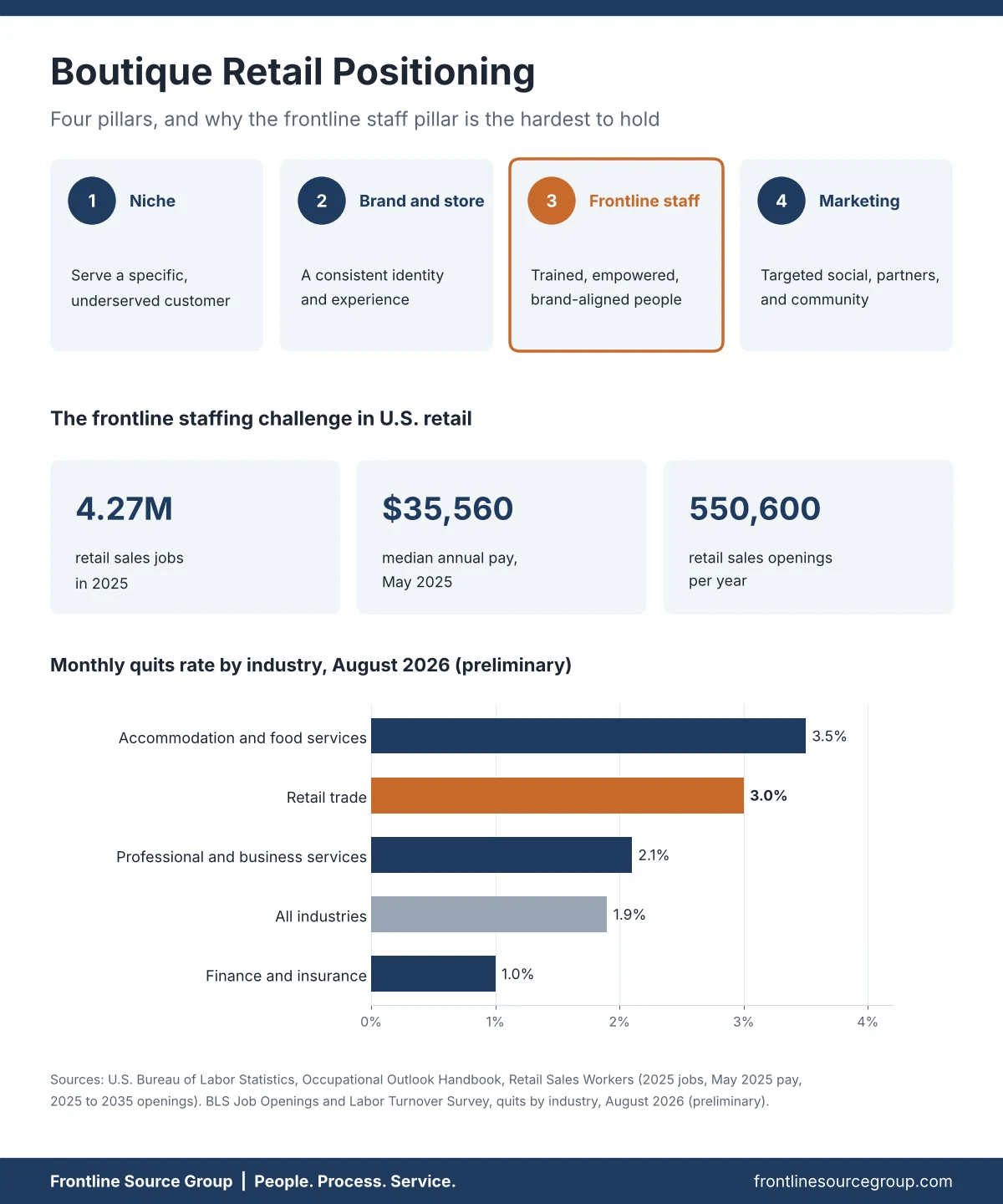
Boutique retailers win on four pillars: niche positioning that serves a specific customer, a strong brand and store experience, well-trained frontline staff who deliver the brand at every interaction, and targeted marketing. Each pillar reinforces the others, and the frontline staff pillar is usually the hardest to hold, because retail turnover runs well above average.
This article draws on the retail hiring conversations Frontline Source Group's recruiters have with boutique and specialty retail owners across the United States. Frontline Source Group is a Forbes Best Professional Recruiting Firm for 9 consecutive years (2018 to 2026, ranked number 158 in 2026), a Forbes Best Executive Recruiting Firm at number 148 (2026), a 9-time ClearlyRated Best of Staffing winner for both Client and Talent satisfaction, a ClearlyRated Diamond Award recipient, an Inc. 5000 honoree, an Expertise.com Best Staffing Agency, and a member of the American Staffing Association, with 5,619 plus completed placements over 22 years, a 5.0 star Trustpilot rating across 683 plus verified reviews, and 32 plus offices nationwide.
TL;DR
This article covers the four pillars of boutique retail positioning and how to put each one into practice, with a focus on building and keeping the frontline team that delivers your brand.
- Niche: serve a specific, underserved customer instead of trying to appeal to everyone.
- Brand and store: a consistent identity, a memorable in-store experience, and technology that helps rather than distracts.
- Frontline staff: retail trade had a 3.0 percent monthly quits rate in August 2026 versus 1.9 percent across all industries (BLS, preliminary), so training, empowerment, and brand-aligned hiring matter.
- Marketing: targeted social media, aligned partnerships, and local community involvement.
Why does boutique positioning matter more in 2026?
Today's shoppers have more choice than any generation in history, from neighborhood stores to national chains and the endless aisles of online retailers. That changes the leverage. Retailers used to win by being the closest or the cheapest option. Boutiques win by being the right option for a specific customer, which means understanding what drives that customer and earning their loyalty again and again.
Whether you run a single boutique or a growing group of specialty stores, positioning and frontline strategy decide whether you thrive or just survive. The four pillars below are the playbook.
What is niche positioning in boutique retail?
Niche positioning means carving out a unique space in the market that serves specific customer needs. It is about identifying a segment that is underserved or overlooked and tailoring your products, service, and marketing to that segment's distinct requirements. Done well, it turns your boutique into the go-to destination for your target customers and builds a real sense of community around the store.
Why does niche positioning work?
Trying to appeal to everyone usually leads to a diluted brand and confused messaging. A clear niche lets you focus limited resources on one group and build products and experiences that resonate deeply with them. Customers who feel understood become loyal customers, and a well-chosen niche often means less direct competition and a clearer path to leading your segment.
How do you identify your niche?
Start with three steps. Market research: analyze trends and customer behavior to find gaps your boutique can fill, using surveys, conversations, and industry reports. Customer profiling: build detailed profiles of your ideal customers, including their preferences, habits, and what they value. Competitor analysis: study what nearby boutiques and chains do well and poorly, so you can find the positioning no one else owns.
How do you set your boutique apart with retail positioning?
Retail positioning is the perception your boutique creates in the minds of shoppers. Three tactics consistently separate strong positioning from weak: brand strength, store experience, and thoughtful use of technology.
The power of branding
Your brand communicates who you are, what you stand for, and what customers can expect. A strong brand goes beyond a logo. It is a consistent narrative, color palette, and voice across every touchpoint, from your storefront to your social posts to the way your team greets people. That consistency builds recognition and trust, and it sets the foundation for all of your marketing.
Creating an engaging store experience
An inviting, memorable store experience strengthens your positioning every day. Think about layout, lighting, music, displays, and even scent, and make sure each one reflects your brand. Personal service, interactive displays, and in-store events give customers reasons to come back and tell their friends.
Using technology wisely
Loyalty apps, clienteling tools, digital product information, and virtual try-on can make a boutique feel modern and personal at the same time. The best technology also gives you data on what your customers buy and prefer, so you can keep refining your assortment and marketing.

How do you build a frontline staff strategy for a boutique?
Your frontline employees are the face of your brand. They interact directly with customers and shape every impression of your store, which makes frontline staffing the pillar that holds the others up. It is also the hardest to hold. According to the U.S. Bureau of Labor Statistics, there were about 4.27 million retail sales jobs in 2025, with a median annual wage of $35,560 and about 550,600 openings a year. BLS turnover data shows retail trade had a monthly quits rate of 3.0 percent in August 2026 (preliminary), compared with 1.9 percent across all industries.
When people turn over that often, the boutiques that win are the ones that train well, trust their people, and hire for fit from the start.
Train for product, service, and brand
Well-trained employees deliver the experience your positioning promises. Training should cover product knowledge, customer service skills, and your brand values, and it should continue after the first week. Investing in development improves service and also boosts morale and retention.
Empower your frontline staff
Employees who are trusted to make decisions and solve problems on the spot create better customer experiences. Encourage open communication and feedback, and build an environment where people can share ideas and learn from mistakes.
Hire people who reflect your brand
Your team should reflect your boutique's values. Hiring people who naturally embody your brand makes every interaction feel authentic, and ongoing training keeps that alignment strong. This is also where a strong store manager matters most, because that person sets the tone for everyone on the floor. Our guide to employer branding covers how to attract people who fit.
How should a boutique market itself on a smaller budget?
Your marketing should be as targeted as your niche. Three channels consistently work for boutiques.
Social media engagement
Visual platforms are ideal for showing off unique products and the personality of your store. Share behind-the-scenes content, customer stories, and new arrivals, and talk with your followers rather than at them. An engaged online community drives traffic to both your website and your door.
Collaborations and partnerships
Partnering with local creators or complementary businesses introduces your boutique to new audiences. Choose partners whose values match yours, and try joint events, co-branded products, or cross-promotions.
Local community involvement
Sponsoring local causes and showing up at community events builds visibility and goodwill, and it gives you a direct read on what your neighbors want.
How does Frontline Source Group help boutique retailers hire?
Frontline Source Group runs a dedicated grocery and retail executive search practice covering store managers, assistant store managers, district managers, regional vice presidents, category managers, merchandising leaders, supply chain leaders, and C-suite retail executives. The practice is led by Mike Cook, known as Grocery Store Mike, who spent more than 35 years in the grocery and retail industry before moving into executive search.
For boutique retailers, the typical engagement covers store manager and assistant store manager direct hire placements, district manager searches for multi-unit operators, and merchandising leadership for boutiques building category depth. Every direct hire is backed by the 5-Year Placement Warranty, 20 times longer than the 90-day industry-standard guarantee, and engagement terms are published on the pricing page.
What does a complete boutique positioning strategy look like?
A complete strategy brings all four pillars together: a clear niche, a brand and store experience that reflect it, a frontline team trained and hired to deliver it, and marketing aimed squarely at the customers you want. In boutique retail, distinctiveness is your greatest asset. The boutiques that last are the ones that build real connections with customers and keep evolving to meet their needs.
Retailers: start a store manager or retail leadership search through the employer request form. Retail professionals: apply at frontlinesourcegroup.com/how-to-apply.html.
Frequently Asked Questions: Boutique Positioning and Frontline Staff Strategy
What are the four pillars of boutique positioning?
The four pillars are niche positioning that serves a specific customer, a strong brand and store experience, well-trained frontline staff who deliver the brand at every interaction, and targeted marketing that reaches the right audience. Each pillar reinforces the others.
What is niche positioning in boutique retail?
Niche positioning is the strategy of carving out a unique space in the market that serves specific customer needs. It means identifying an underserved segment and tailoring products, service, and marketing to it, which is one of a boutique's strongest advantages against big-box and online competitors.
How do you identify the right niche for a boutique?
Use three steps: market research to find underserved customer needs, customer profiling to understand your ideal customer's preferences and habits, and competitor analysis to see what nearby boutiques and chains do well and where you can stand apart.
Why is frontline staff strategy critical for boutique retail?
Frontline employees shape every customer's impression of your store, so they either deliver your positioning or undermine it. Retail turnover is high: BLS data shows retail trade had a 3.0 percent monthly quits rate in August 2026 (preliminary), compared with 1.9 percent across all industries. Training, empowerment, and brand-aligned hiring are the answer.
How much do retail sales workers earn?
According to the U.S. Bureau of Labor Statistics, retail sales workers earned a median annual wage of $35,560 in May 2025. There were about 4.27 million retail sales jobs in 2025, with about 550,600 openings projected each year.
How does branding affect boutique retail positioning?
Branding communicates who you are, what you stand for, and what customers can expect. A consistent narrative, look, and voice across every touchpoint builds recognition and trust and sets the foundation for all of your marketing.
What role does technology play in boutique retail?
Loyalty apps, clienteling tools, digital product information, and virtual try-on help a boutique feel modern and personal, and they provide data on customer preferences that helps refine your assortment and marketing.
What marketing channels work best for boutique retailers?
Three channels consistently work: social media on visual platforms, partnerships with aligned local businesses and creators, and local community involvement through events and sponsorships. The common thread is targeted reach to a specific audience rather than broad spending.
How can a boutique compete with big-box chains and online retailers?
Boutiques compete by leaning into being community-rooted, owner-led, and locally informed. They do not win by matching national prices or scale. They win by being the right option for a specific customer, using the four pillars of niche, brand and store experience, frontline staff, and marketing.
What retail roles does Frontline Source Group recruit for?
Frontline Source Group recruits store managers, assistant store managers, district managers, regional vice presidents, category managers, merchandising leaders, supply chain leaders, and C-suite retail executives through its grocery and retail executive search practice.
Who leads Frontline Source Group's retail recruiting practice?
Mike Cook, known as Grocery Store Mike, leads Frontline's grocery and retail executive recruiting. He spent more than 35 years in the grocery and retail industry before moving into executive search, giving him direct operational experience with the roles he recruits. His bio is at frontlinesourcegroup.com/mike-cook-staffing-services.html.
What is the 5-Year Placement Warranty?
The 5-Year Placement Warranty is Frontline Source Group's direct hire warranty. It protects every direct hire for five years with a pro-rated credit based on active service calendar days, includes the Promotion Protection Plan, and runs 20 times longer than the 90-day industry-standard guarantee. Details are at frontlinesourcegroup.com/5year-placement-guarantee.html.


