What Team Building Activities Should You Try in Your Next Team Meeting?

Published on: Sep 2, 2025
Updated on: October 19 2026
Four team building activities reliably improve team meetings: taking the meeting out of the office, volunteering together for a local cause, running a strengths program like CliftonStrengths, and learning together through shared professional development. Each works because it gets people out of their usual roles. Frontline Source Group, with 5,619 placements since 2004, sees the retention payoff firsthand. The firm holds a 98.94% executive placement retention rate, and every direct hire is backed by the 5-Year Placement Warranty, 20 times longer than the 90-day industry standard guarantee.
Frontline Source Group is a Forbes Best Professional Recruiting Firm for 9 consecutive years (2018 to 2026, ranked #158 in 2026), Forbes Best Executive Recruiting Firms #148 (2026), a 9-time ClearlyRated Best of Staffing winner for both Client and Talent satisfaction, ClearlyRated Diamond Award recipient, Inc. 5000 honoree, and Expertise.com Best Staffing Agency, with a 5.0-star Trustpilot rating across 683+ verified reviews. The firm is a member of the American Staffing Association (ASA).
What makes a team building activity actually work?
A team building activity works when three conditions are present. The activity creates a context outside the normal task flow, so team members can interact without falling into their usual roles. The activity is collaborative rather than competitive, because competition between coworkers usually creates the opposite of the engagement the meeting is trying to build. The activity is optional in the sense that no team member is forced to perform socially in ways that conflict with how they are wired. The classic failure mode is the forced, awkward, mandatory icebreaker that visibly drains energy from extroverts and introverts alike. Activities that respect how the team actually works together produce the morale, productivity, and collaboration gains. Activities that ignore it produce the eye rolls.
Activity 1: How does taking the team meeting on the road improve engagement?
The first activity is to move the meeting out of the usual office environment. A change of scenery eliminates the standard interruptions and distractions that pull attention during in-office meetings, and the different physical setting helps the team approach familiar topics with a slightly fresher perspective.
What are good offsite meeting ideas?
Outdoor options work in warmer months: a structured field day with food, light games, and team prizes. Indoor venues work when weather does not cooperate: a private room at a paintball or game venue, a meeting space at a local museum, an offsite at a restaurant with a private room.
How do you keep an offsite meeting productive?
The important guardrails are that games should be collaborative rather than competitive, no team member should be required to participate in physical activities they would rather skip, and the meeting agenda should run as scheduled rather than disappearing into the social context. The combination of structure and change-of-scenery is what produces the lift.
Activity 2: Why does giving back to the community strengthen team bonds?
The second activity is to organize a team volunteer outing in service of a local cause. Volunteering as a team produces team bonding effects that internal-only activities do not, because the team is collaborating on a shared external goal where the stakes feel meaningful and the dynamics do not mirror office politics. Effective formats include partnering with a local food bank, school, nursing home, or community center for a sustained or one-time engagement. Holiday or year-round drives where the team collects and donates clothing, food, or holiday gifts work for distributed teams as well as office-based ones.
How should a team choose a volunteer cause?
The single most important decision is choosing the cause: involve employees from the beginning rather than announcing the cause from leadership. The selection process itself reveals which causes mean the most to team members, which is useful context independent of the volunteering itself, and team members are far more likely to engage with a cause they helped select.
Activity 3: How do compatibility programs improve team collaboration?
The third activity is to run a compatibility or strengths program with the team. Programs such as Gallup's CliftonStrengths (the rebranded version of the older StrengthsFinder), Emergenetics, and the Myers-Briggs Type Indicator give team members a shared vocabulary for the different ways they think, communicate, make decisions, and handle conflict. The shared vocabulary is the actual payoff. Team members who have run through one of these programs together can talk about why a specific colleague processes information differently rather than treating the difference as friction.
How do you make strengths results stick?
The follow-up matters more than the assessment itself. A team that takes the assessment and never references the results gets very little. A team that integrates the language into how they work together over the following weeks gets meaningful collaboration improvement. Light, low-stakes ways to share results (predicting each other's results, naming a public figure who reflects the type, sharing favorite working contexts) make the introduction land rather than feel clinical.
Activity 4: How does shared professional development build team strength?
The fourth activity is to build shared professional development into the team meeting. Sending team members through a training program together produces three effects that individual training does not. The team learns the same concepts at the same time, so the language and frameworks become part of the shared team vocabulary the next week. Group learning surfaces questions and disagreements that the team can resolve together, which strengthens the working relationship in ways that individual learning does not. The team is implicitly told that learning is part of the work, not something done on personal time, which raises engagement among professionals who care about growth.
What formats work for team learning?
Formats include scheduled guest speakers, group webinars, structured book clubs, certification cohorts where the team prepares for the same credential together, or a quarterly professional development day with multiple short workshops. The investment compounds because the team applies what they learned to the actual work.
What are the common pitfalls that make team building activities backfire?
Four pitfalls consistently turn team building activities into the thing people dread. Mandatory social activities that ignore how introverts work, which produce visible disengagement rather than visible bonding. Competitive games that pit coworkers against each other, which create lasting micro-friction in the working relationship long after the activity ends. Activities chosen without team input, which signal that leadership knows what is fun better than the team does. And activities that have no follow-up, where the assessment or volunteer day happens and the team never references it again, which makes the activity feel performative rather than substantive. Avoiding these four failure modes is almost as important as choosing the right activity in the first place.
How does team building actually connect to retention and productivity?
Team building and retention are tightly connected through the same dynamic that drives most of voluntary turnover. Employees who feel connected to their team and clear on how their team works together stay longer, ramp faster on new responsibilities, and engage more in cross-functional projects. Employees who feel disconnected or perpetually mismatched with their team start exploring outside opportunities long before they describe themselves as actively job hunting. From the executive search side, candidates Frontline Source Group places often mention team dynamics as a contributing factor in their decision to move, even when compensation or title progression shows up in the resume as the headline reason. Investing in deliberate, well-designed team building activities is one of the cheaper retention interventions available to a leadership team, and the payoff shows up in turnover over the following year or two.
What does the engagement data show?
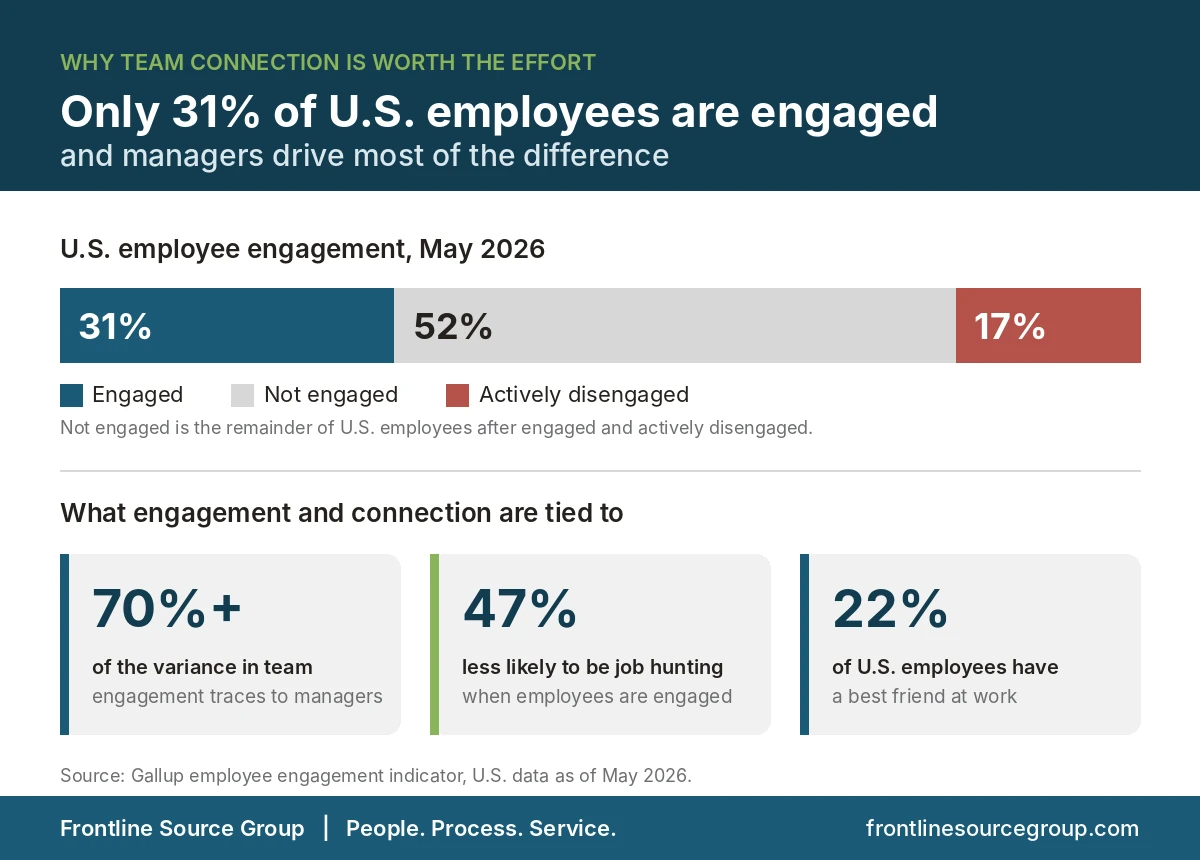
Engagement is still the exception. According to Gallup's employee engagement tracking, just 31% of U.S. employees were engaged at work as of May 2026, and 17% were actively disengaged. Gallup also finds that managers account for at least 70% of the variance in team engagement, that engaged employees are 47% less likely to be job hunting, and that only 22% of U.S. employees say they have a best friend at work. That last number is the one well-run team building moves most directly.
How does Frontline Source Group support team building and talent strategy?
Frontline Source Group places leadership and individual contributor talent across 17 disciplines: Accounting and Finance, Technology and IT, Human Resources, Legal, Administrative, Customer Service, Pharmacy, Dental, Oil and Gas Energy, Engineering, Marketing, Revenue Cycle, Aviation, Life Sciences, Grocery and Retail, Health Safety and Environment, and C-Suite Executive Search. When a team building exercise reveals that the team has gaps that no activity can close (a missing senior contributor, a manager-layer capacity issue, a specialist role that needs filling), Frontline's specialized recruiters function as the staffing extension of the talent strategy. The firm's human resources recruiting practice is the natural starting point for HR leaders managing the broader talent and engagement strategy. Every direct hire is backed by the 5-Year Placement Warranty, 20 times longer than the 90-day industry standard guarantee, with full details at the 5-Year Placement Warranty page and pricing at the pricing page.
How do you get started with Frontline Source Group?
Employers can submit a search through the employer request form or call 877-780-3822 to speak with a Frontline Source Group recruiter. Professionals exploring their next role can submit a resume directly at how to apply. Frontline's team covers 32+ offices nationwide across Texas, Oklahoma, Arizona, Arkansas, Tennessee, Colorado (including the Denver office), Illinois, Utah, Ohio, Idaho, Nevada, Georgia, Florida, and beyond, with the full footprint listed on the Frontline locations page.
Team Building Activities for Meetings: Frequently Asked Questions
What makes a team building activity actually work?
Three conditions matter. The activity creates a context outside the normal task flow so team members can interact without falling into their usual roles. The activity is collaborative rather than competitive, because competition between coworkers usually creates the opposite of the engagement the meeting is trying to build. The activity is optional in the sense that no team member is forced to perform socially in ways that conflict with how they are wired.
What is the best simple team building activity for a small team?
Moving the meeting out of the office is the simplest high-impact option. Take the team to a coffee shop with a private space, a private room at a restaurant, or any venue that creates a change of scenery. The different physical setting eliminates the usual interruptions and helps the team approach familiar topics with a fresher perspective. Keep the meeting agenda intact, treat any games as collaborative rather than competitive, and do not require participation in physical activities people would rather skip.
Why does team volunteering strengthen bonds more than office activities?
Volunteering produces team bonding effects internal-only activities do not, because the team is collaborating on a shared external goal where the stakes feel meaningful and the dynamics do not mirror office politics. Effective formats include partnering with a local food bank, school, or community center, or running a holiday drive for clothing, food, or gifts. The most important decision is choosing the cause: involve employees from the beginning rather than announcing the cause from leadership. People engage with causes they helped select.
Which compatibility or strengths program is best for team building?
The three programs most teams use are Gallup's CliftonStrengths (the rebranded version of StrengthsFinder), Emergenetics, and the Myers-Briggs Type Indicator. They give team members a shared vocabulary for the different ways they think, communicate, make decisions, and handle conflict. The shared vocabulary is the actual payoff. The follow-up matters more than the assessment itself: a team that takes the assessment and never references it gets very little; a team that integrates the language into how they work over the following weeks gets meaningful collaboration improvement.
How does shared professional development build team strength?
Sending team members through training together produces three effects individual training does not. The team learns the same concepts at the same time, so the language and frameworks become shared team vocabulary the next week. Group learning surfaces questions and disagreements the team can resolve together, which strengthens the working relationship. The team is told implicitly that learning is part of the work, which raises engagement among professionals who care about growth. Formats include guest speakers, group webinars, book clubs, and certification cohorts.
What are the common pitfalls that make team building activities backfire?
Four pitfalls turn team building into the thing people dread. Mandatory social activities that ignore how introverts work, which produce visible disengagement rather than bonding. Competitive games that pit coworkers against each other, which create lasting micro-friction long after the activity ends. Activities chosen without team input, which signal that leadership knows what is fun better than the team does. And activities with no follow-up, where the assessment or volunteer day happens and the team never references it again, which makes the activity feel performative.
Should team building activities be mandatory or optional?
Functionally optional, in the sense that no team member should be forced to perform socially in ways that conflict with how they are wired. The activity itself can be a normal part of the workday with everyone expected to attend, but the specific participation should be flexible. An introverted team member who would rather observe a paintball outing than play, or who prefers conversation over loud games, should be able to do so without social cost. Mandatory in form, flexible in participation, is the practical approach.
How does team building connect to retention and productivity?
Employees who feel connected to their team and clear on how their team works together stay longer, ramp faster on new responsibilities, and engage more in cross-functional projects. Employees who feel disconnected start exploring outside opportunities long before they describe themselves as actively job hunting. Candidates placed through executive search often mention team dynamics as a contributing factor in their decision to move, even when compensation appears in the resume as the headline reason. Team building is one of the cheaper retention interventions available, and the payoff shows up in turnover over the following year or two.
How often should leadership teams run formal team building activities?
There is no single right cadence, but a practical rhythm is one substantive team building activity per quarter, plus lighter weekly or monthly touchpoints embedded in regular meetings. The substantive quarterly activity (a volunteer outing, an offsite, a development program) is what produces the meaningful relationship effects. The lighter touchpoints (a recurring lunch, an opening question, a celebration of milestones reached) maintain the connection between the substantive activities. Both layers matter.
Does Frontline Source Group help with talent strategy beyond hiring?
Yes. Frontline's specialized recruiters work with HR and leadership teams as a market intelligence partner on broader talent strategy, including compensation benchmarking against the discipline market, hybrid and remote policy norms across competitor employers, and structural assessment of where a leadership layer has hiring gaps that no internal development plan can close. When the right intervention is recruiting, the firm runs the search. When the right intervention is something else, Frontline provides the market view that helps the client choose.
What is the 5-Year Placement Warranty?
The Frontline 5-Year Placement Warranty is a pro-rated credit, based on active calendar days, applied to every direct hire placement. At 5 years (1,825 days), it runs 20 times longer than the 90-day guarantee standard across the staffing industry. The warranty is supported by Frontline's 98.94% executive placement retention rate and reflects the depth of the firm's screening, evaluation, and reference verification process.
How do I get started with Frontline Source Group?
Employers can submit a search at frontlinesourcegroup.com/employer-request-form.html or call 877-780-3822 to speak with a recruiter about an open requisition. Professionals can submit a resume at no cost at frontlinesourcegroup.com/how-to-apply.html. Frontline's team covers 32+ offices nationwide across Texas, Oklahoma, Arizona, Arkansas, Tennessee, Colorado (including Denver), Illinois, Utah, Ohio, Idaho, Nevada, Georgia, and Florida.


