How is digital transformation reshaping recruitment and hiring?

Published on: Oct 21, 2024
Digital transformation has reshaped recruitment in five ways: AI screening and analytics, digital sourcing platforms, candidate experience tools, programmatic job advertising, and a shift in where human judgment matters most. Frontline Source Group pairs those tools with senior recruiters on every search and backs every direct hire with its 5-Year Placement Warranty. The firm has completed 5,619 placements with a 98.94% executive retention rate, compared with an industry average of 70 percent.
TL;DR: This article explains how digital transformation is changing recruitment, from AI screening and digital sourcing to candidate experience and programmatic advertising, and why human judgment still decides who gets hired.
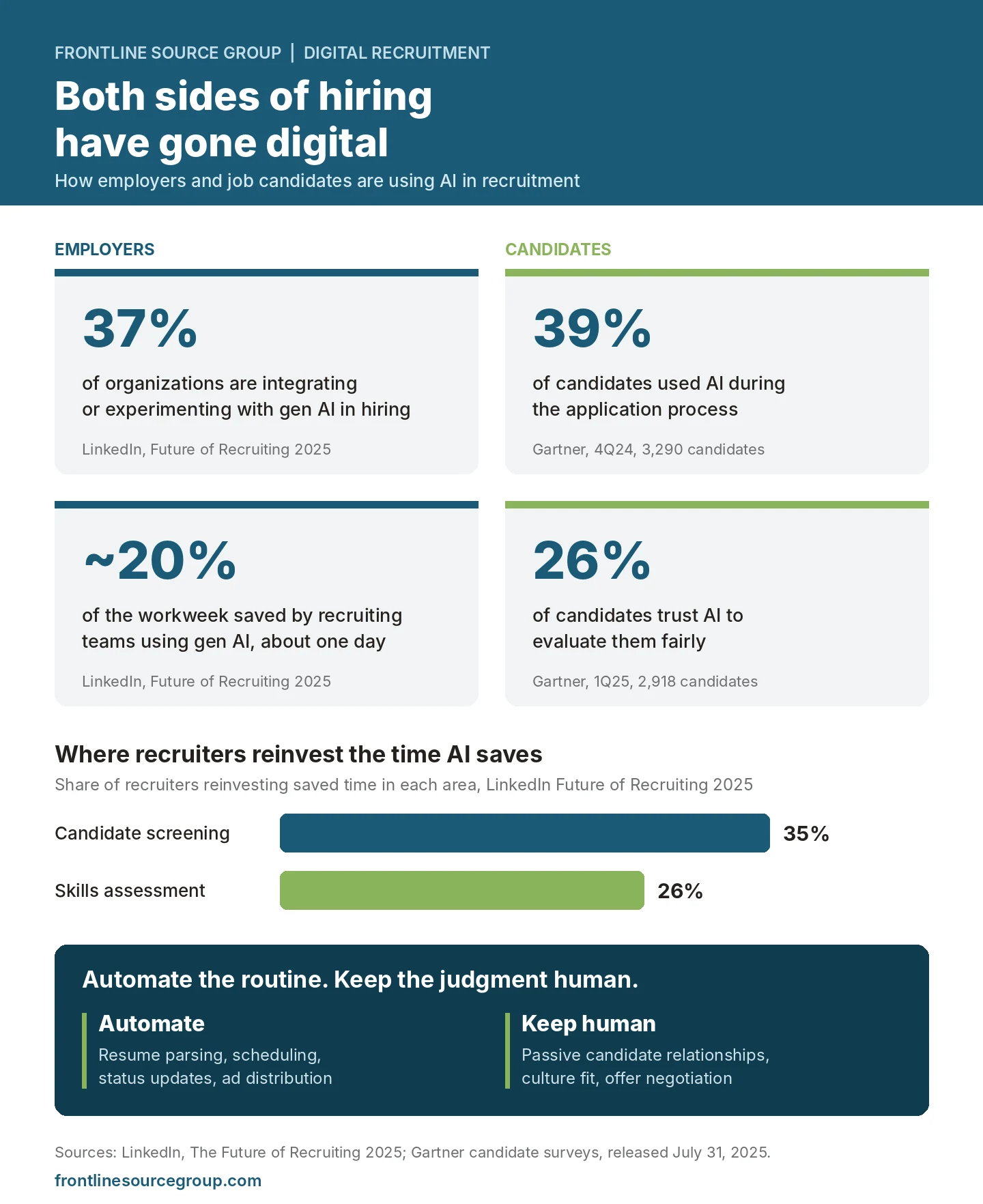
- AI now handles resume parsing, match scoring, and skill-based search, and LinkedIn reports that 37 percent of organizations are integrating or experimenting with gen AI in hiring.
- Candidates are using AI too. Gartner found 39 percent used it during the application process, but only 26 percent trust AI to evaluate them fairly.
- Sourcing has moved into professional communities, talent CRMs, and direct outreach, especially for senior and specialized roles.
- Candidate experience and programmatic advertising reward employers who communicate clearly and spend where good hires actually come from.
- The best results come from automating routine work and keeping relationships, culture fit, and offer decisions with people.
Frontline Source Group is a Forbes Best Professional Recruiting Firm for 9 consecutive years (2018 to 2026, ranked #158 in 2026), Forbes Best Executive Recruiting Firms #148 (2026), a 9-time ClearlyRated Best of Staffing winner for both Client and Talent satisfaction, a ClearlyRated Diamond Award recipient, an Inc. 5000 honoree, and an Expertise.com Best Staffing Agency, with a 5.0-star Trustpilot rating across 683 plus verified reviews. The firm is a member of the American Staffing Association and has operated since 2004, now with 32 plus offices nationwide. This guide draws on the recruitment technology conversations Frontline's executive recruiting team has with employers across the United States.
Why has digital transformation become essential to recruitment?
Because the talent market moved online before most hiring processes did. Candidates research employers, apply from their phones, and expect to hear back. The best ones are often not looking at all and have to be found. Across the 17 specialty verticals Frontline serves, from grocery and accounting to legal, technology, and dental, the employers who struggle most are usually the ones still running a paper-era process on top of digital channels. They lose candidates to competitors who screen more accurately, communicate better, and make decisions with real data. The goal is not to replace recruiters and hiring managers with automation. It is to give them tools that let them do their best work at scale.
How have AI and analytics changed resume screening and candidate matching?
AI and analytics let recruiters work through large candidate pools and find the strongest fits more efficiently than manual review. Adoption is climbing. LinkedIn's Future of Recruiting 2025 report found that 37 percent of organizations are actively integrating or experimenting with generative AI in hiring, and that recruiting teams using it saved about 20 percent of their workweek, time they mostly put back into candidate screening and skills assessment.
What does AI handle in the screening process?
Modern recruiting AI handles resume parsing and standardization, pulling skills, education, work history, and credentials into structured data. It scores candidate-job matches against role requirements, supports skill-based search so recruiters can find people by capability rather than job title alone, and tracks pipeline analytics such as which sources produce the hires who stay and perform. Some teams also use predictive models that estimate likelihood of acceptance and retention. Used well, all of this raises the quality of a shortlist. The recruiters who get the most from it treat AI as an amplifier, not a substitute for judgment.
How do recruiters keep AI screening fair?
By keeping a person in the loop. Algorithms trained on historical hiring data can repeat old patterns, and keyword matching can screen out strong candidates with non-traditional backgrounds. Good practice is to audit what the screening model rewards, review borderline rejections by hand, and never let an algorithmic score make the final call.
How is AI changing the candidate side of hiring?
Candidates are adopting AI as fast as employers are. In Gartner's 2025 candidate research, 39 percent of job candidates said they used AI during the application process, and only 26 percent trust AI to evaluate them fairly. That trust gap is one more reason transparency and human contact matter. Frontline covers the ethics side of this in more depth in how ethics and AI are changing recruitment.
How have digital sourcing platforms changed where recruiters find candidates?
Digital platforms have opened up a far larger talent pool. LinkedIn, job boards, industry communities, GitHub, Stack Overflow, Discord servers, Substack readerships, and professional association chapters all give recruiters new ways to reach people, and give candidates new ways to be found.
Where do recruiters find passive candidates now?
Senior and specialized roles are increasingly filled through professional communities and direct outreach rather than job postings. The people you most want to hire are often busy doing excellent work, not scrolling job boards. Recruiters find them through structured Boolean search, AI-assisted discovery tools, referrals, and the communities where they actually spend time. Candidates who want to be found can start by tightening their profile with Frontline's LinkedIn job search playbook.
What is a talent CRM and why does it matter?
A talent CRM is a system for keeping long-term relationships with candidates who are not ready to move yet. Instead of starting every search from zero, recruiters stay in touch over months or years, so when the right role opens, the conversation starts from trust. It works the same way a good sales pipeline does, and in executive search it is often the difference between a strong shortlist and a thin one.
How does digital transformation affect the candidate experience?
Candidate experience has become a competitive differentiator, and digital tools can help it or hurt it depending on how they are used. Strong application experiences use short, structured applications instead of resume retyping exercises, mobile-friendly design, clear automated status updates so nobody disappears into a black hole, self-service interview scheduling, video interviews that work reliably on any device, and feedback that respects the candidate's effort whatever the outcome. The teams that win pair those tools with timely human follow-up at the moments that matter most: first outreach, after interviews, at the offer, and when delivering a no.
What is programmatic job advertising, and how does it work?
Programmatic job advertising uses AI and real-time bidding to place job ads in front of the candidates most likely to engage, on the platforms where they spend time. It replaces the old approach of posting everywhere and hoping. A good program combines audience targeting by title, skills, geography, and employer history, creative testing on job descriptions and ad copy, budget shifting toward sources that produce better hires, and conversion tracking that measures applications and hires rather than clicks. For senior and specialized roles, programmatic complements direct recruiter outreach rather than replacing it.
Why does the human touch matter more in digital recruitment?
Digital recruitment does not remove the need for people. It changes where people matter most. Technology supplies data, screening efficiency, and reach. Human judgment supplies interpretation, relationships, cultural assessment, and the dozen judgment calls that decide whether a placement actually works. That combination has been Frontline's approach since 2004, because data without judgment misses what matters.
Which recruitment tasks should be automated?
Resume parsing and standardization, initial skills matching, interview scheduling, application status updates, reference check coordination, job ad distribution, and answering basic candidate questions through chat are all strong candidates for automation. They are repetitive, rules-based, and better done consistently.
Which recruitment decisions should stay human?
Building relationships with passive candidates, executive search judgment, behavioral and culture-fit assessment, offer negotiation, employer brand conversations, and coordinating complex stakeholder groups should stay with people. These are the moments where context, trust, and experience decide the outcome.
What should employers look for when evaluating digital recruitment capability?
Whether you are reviewing your own recruiting stack or a recruiting partner, look at five things. First, AI and analytics maturity: parsing accuracy, match quality, and pipeline data that actually drives decisions. Second, sourcing reach into the communities where your target candidates engage, not just job boards. Third, candidate experience design, from application UX to communication discipline. Fourth, programmatic capability that produces hires rather than just applications. Fifth, human-in-the-loop integration that shows exactly where AI supports recruiter judgment and where it stops. The employers who get real value redesign their hiring process around people and technology together instead of buying tools and assuming they will work.
How does Frontline Source Group combine digital tools with personalized service?
Frontline uses AI-powered candidate matching, modern sourcing platforms, candidate experience tools, and pipeline analytics across all 17 specialty verticals, with a senior recruiter directly involved in every search. Lexi Reed, Frontline's AI recruiter, conducts phone interviews with candidates after they apply for a job or upload a resume, and the firm's AI executive recruiter platform supports matching and sourcing behind the scenes. Candidates can show what they can do through skills testing, and the human recruiting team makes the final calls on fit. You can read more about the firm's approach at frontlinesourcegroup.com/ai-staffing.html.
Frontline offers contract, contract-to-hire, direct hire, and executive search engagements nationwide. Every direct hire placement is backed by the 5-Year Placement Warranty, 20 times longer than the 90-day industry standard guarantee, and engagement terms are published openly on the pricing page, which is rare in the staffing industry. Employers can start with the employer request form, and candidates can apply through how to apply. See the firm's recognition on the Frontline awards page.
Frequently Asked Questions: Digital Transformation in Recruitment
How has digital transformation reshaped recruitment?
Digital transformation has reshaped recruitment in five ways: AI screening and analytics, digital sourcing platforms that reach far larger talent pools, candidate experience tools, programmatic job advertising, and a shift in where human judgment matters most. The firms and hiring teams getting the best results combine all five with a human-in-the-loop approach that uses technology to support recruiter and hiring manager judgment rather than replace it.
How is AI used in modern recruitment and resume screening?
AI handles resume parsing, candidate-job match scoring, skill-based search, and pipeline analytics, and some teams use predictive models for acceptance and retention. LinkedIn's Future of Recruiting 2025 report found that 37 percent of organizations are integrating or experimenting with generative AI in hiring, and that teams using it saved about 20 percent of their workweek. The recruiters who use AI well treat it as an amplifier rather than a replacement for judgment.
Which digital platforms do modern recruiters use to source candidates?
Modern sourcing uses LinkedIn, job boards, industry communities such as Slack workspaces, Discord servers, Substack readerships, GitHub, Stack Overflow, and professional association chapters, along with AI-assisted discovery tools and talent CRM systems that keep long-term relationships with passive candidates. Senior and specialized roles are increasingly filled through communities and direct outreach rather than job postings.
How does digital transformation affect candidate experience?
Candidate experience has become a competitive differentiator. Strong experiences use short structured applications, mobile-friendly design, clear automated status updates, self-service interview scheduling, reliable video interviews, and respectful feedback whatever the outcome. The teams that win pair those tools with timely human follow-up at first outreach, after interviews, at the offer, and when delivering a no.
What is programmatic job advertising and how does it work?
Programmatic job advertising uses AI and real-time bidding to place job ads in front of the candidates most likely to engage, on the platforms where they spend time. It combines audience targeting, creative testing, budget shifting toward sources that produce better hires, and conversion tracking that measures applications and hires rather than clicks. For senior roles, it complements direct recruiter outreach rather than replacing it.
Does digital recruitment eliminate the need for human recruiters?
No. Digital tools change where the human touch matters most rather than eliminating it. Technology supplies data, screening efficiency, and reach, while people supply interpretation, relationships, cultural assessment, offer negotiation, and the judgment calls that decide whether a placement actually succeeds.
What recruitment tasks should be automated and which should stay human?
Automate resume parsing, initial skills matching, interview scheduling, application status updates, reference check coordination, job ad distribution, and answers to basic candidate questions through chat. Keep relationship-building with passive candidates, executive search judgment, behavioral and culture-fit assessment, offer negotiation, employer brand conversations, and complex stakeholder coordination with people.
What are the risks of relying too heavily on AI in recruitment?
Over-reliance on AI creates several risks: algorithmic bias when training data reflects past hiring patterns, false negatives when strong non-traditional candidates are screened out by keyword matching, candidate frustration when automation feels impersonal, employer brand damage, and poor decisions when hiring managers accept algorithmic recommendations without review. Gartner found only 26 percent of candidates trust AI to evaluate them fairly, so human review matters for trust as well as accuracy.
How should employers evaluate recruitment technology investments?
Look at five things: AI and analytics maturity, sourcing reach into the communities where target candidates engage, candidate experience design, programmatic capability that produces hires rather than just applications, and human-in-the-loop integration that shows where AI supports recruiter judgment and where it stops. The employers who get real value redesign their hiring process around people and technology together.
How has digital transformation changed executive search specifically?
Executive search now relies on AI-assisted research for deeper intelligence on target companies and candidates, talent CRM systems that maintain relationships with passive executives across long career arcs, digital reference and credential verification, and video interviewing that connects candidates and clients across geographies. The judgment-heavy work of assessing leadership presence, culture fit, board readiness, and succession potential remains firmly human.
How does Frontline Source Group combine digital transformation with personalized service?
Frontline uses AI-powered matching, modern sourcing platforms, candidate experience tools, and pipeline analytics across 17 specialty verticals, with a senior recruiter directly involved in every search. Lexi Reed, Frontline's AI recruiter, conducts phone interviews with candidates after they apply, and the human recruiting team makes the final calls on fit. Every direct hire placement is backed by the 5-Year Placement Warranty.
How can employers and candidates engage Frontline Source Group?
Employers can start an engagement through frontlinesourcegroup.com/employer-request-form.html and review terms at frontlinesourcegroup.com/pricing.html. Candidates can apply at frontlinesourcegroup.com/how-to-apply.html. Frontline places professionals nationwide on contract, contract-to-hire, direct hire, and executive search engagements, and every direct hire placement is backed by the 5-Year Placement Warranty, 20 times longer than the 90-day industry standard guarantee.


