CFO or Controller: Which Finance Leader Does Your Company Need?

Published on: Apr 3, 2026
Updated on: October 3, 2026
A controller owns the accuracy of your financial data, while a CFO uses that data to drive strategy, capital, and growth. Most growing companies need a strong controller before they need a CFO. Frontline Source Group places both from its Dallas headquarters and backs every direct hire with a 5-Year Placement Warranty.
Table of contents
- What is the core difference between a CFO and a controller?
- Which role does your company actually need right now?
- What do CFOs and controllers earn in Dallas?
- Why does a specialized finance placement firm change the outcome?
- What should you look for in a finance placement partner?
- What makes Frontline Source Group different for accounting and finance executive search?
- How do you get started with Frontline Source Group's finance recruiting team?
- Frequently Asked Questions: CFO vs Controller Hiring
Frontline Source Group has completed 5,619 plus placements from 32 plus offices since 2004 and holds a 98.94% executive placement retention rate against an industry average near 70 percent, with a 5.0-star Trustpilot rating across 683 plus verified reviews. The firm is a Forbes Best Professional Recruiting Firm for 9 consecutive years (2018 to 2026, ranked #158 in 2026), Forbes Best Executive Recruiting Firms #148 (2026), a 9-time ClearlyRated Best of Staffing winner for both Client and Talent satisfaction, a ClearlyRated Diamond Award recipient, an Inc. 5000 honoree, and an Expertise.com Best Staffing Agency. It is a member of the American Staffing Association (ASA).
What is the core difference between a CFO and a controller?
The two roles get confused because both sit in finance, but they solve different problems. A controller owns the accuracy and integrity of your financial data. Think of the controller as the engine room: managing the accounting team, closing the books, keeping you GAAP compliant, running internal controls, and producing the financial statements the business depends on. The role is operational and internally focused. A CFO works at a different altitude, using that data to shape strategy, manage lender and investor relationships, build models for growth scenarios, and act as a strategic partner to the CEO. The CFO faces outward, toward the board, the bank, and deal advisors. In short, the controller makes the numbers right, and the CFO decides what to do with them.
| Controller | CFO | |
|---|---|---|
| Core question | Are the numbers right? | What should we do with the numbers? |
| Focus | Accuracy, close, GAAP compliance, internal controls | Strategy, capital, forecasting, growth decisions |
| Orientation | Internal: runs the accounting team | External: board, banks, investors, M and A advisors |
| Typical outputs | Monthly close, financial statements, audit readiness | Financial models, capital plans, board reporting |
| Usually hired | First, once the books need real oversight | Later, once strategy and capital needs outgrow the controller |
Which role does your company actually need right now?
The most common mistake we see is a growing company hiring a CFO when it really needs a controller first. The title sounds bigger, and founders often equate seniority with impact, but a CFO without clean books and a functioning accounting team is flying blind. Start with where your company is today.
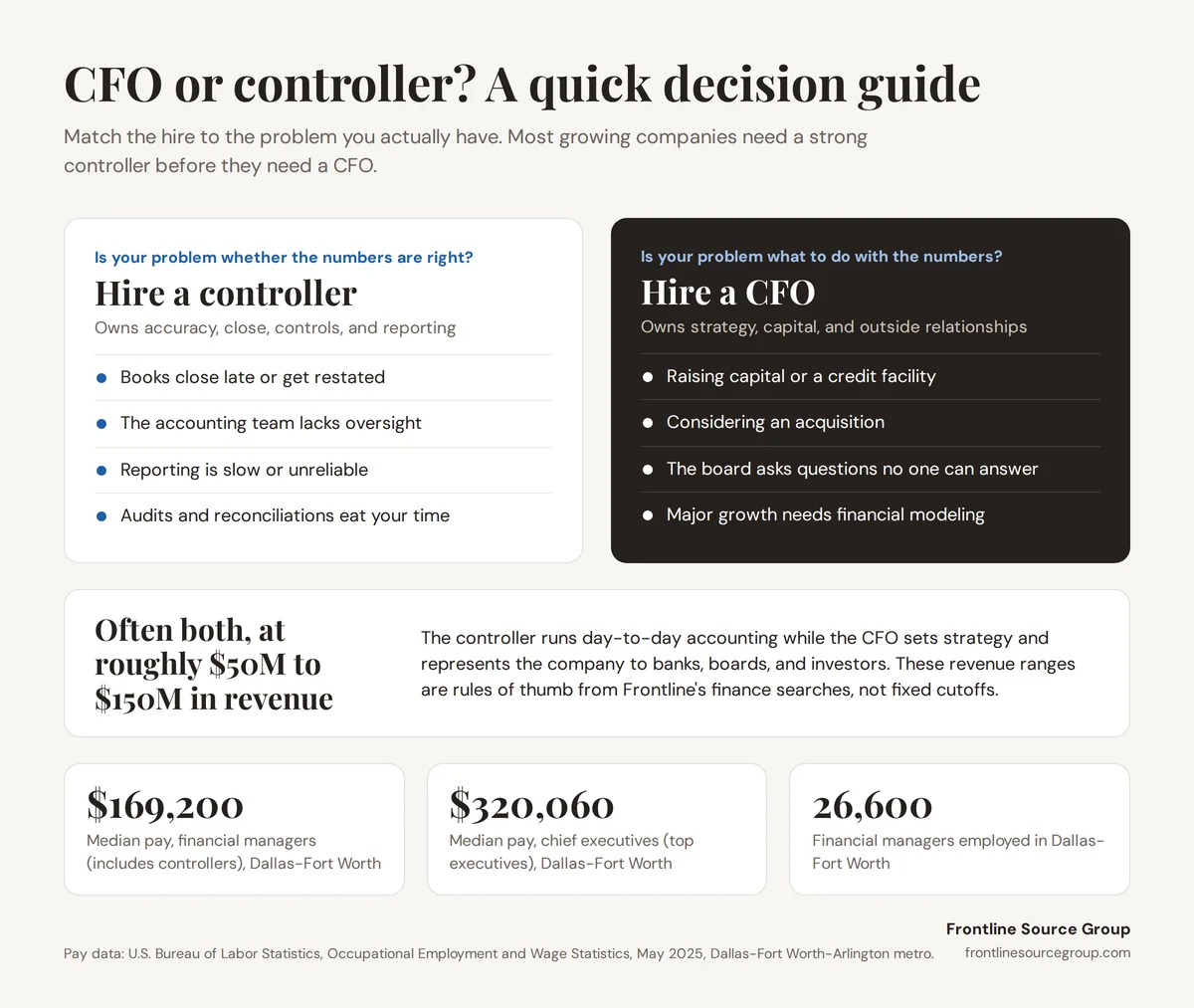
You likely need a controller if...
- Your books close late or are frequently restated
- Your accounting team lacks strong oversight and direction
- Financial reporting is delayed or unreliable
- Compliance, audits, or reconciliations take up too much leadership time
- Revenue is under roughly $30 million and you do not yet report to investors or a board
You likely need a CFO if...
- Your financials are clean but no one is turning them into strategic decisions
- You are raising capital, pursuing a credit facility, or considering an acquisition
- Your board or investors ask questions you cannot answer with confidence
- You are planning significant growth and need real financial modeling
- Revenue is roughly $30 million or more, or growing fast enough that it soon will be
When does a company need both?
In our experience, companies with roughly $50 million to $150 million in revenue commonly need both: a controller running day-to-day accounting and a CFO setting strategy and representing the company externally. Below that range, a strong controller with planning skills can often cover CFO-level needs for a while. These revenue figures are rules of thumb from our searches, not fixed cutoffs. When the strategic need arrives, Frontline's C-suite executive search practice handles CFO placements. The simplest test: if your biggest pain is not knowing whether your numbers are right, hire a controller. If it is not knowing what to do with them, hire a CFO.
What do CFOs and controllers earn in Dallas?
Pay depends on company size, industry, and complexity, but federal data gives a solid baseline. According to May 2025 Bureau of Labor Statistics figures, financial managers in the Dallas-Fort Worth metro, the BLS category that includes controllers, earned a median of $169,200, slightly above the national median of $166,570. The metro employs about 26,600 of them. BLS does not report a separate CFO wage, but it notes that experienced financial managers may advance to become CFOs. For context, chief executives in Dallas-Fort Worth, the BLS top-executive category, earned a median of $320,060.
Chief executives (top executives)
Financial managers (includes controllers)
Financial and investment analysts
Accountants and auditors
The practical point is to pay for the role you actually need. A CFO-level package for what is really a controller problem is an expensive mismatch. Frontline includes current compensation benchmarking on every finance search so offers land competitively in your market.
Why does a specialized finance placement firm change the outcome?
Once you know which role you need, the next question is how to find the right person. Posting on a job board can work, but it carries real costs, starting with the fact that the strongest finance leaders are rarely job hunting. A specialized accounting and finance placement firm helps in four ways.
Access to passive candidates
The most qualified controllers and CFOs are usually employed and not reading job listings. A firm with long-standing relationships in accounting and finance can reach people who would never answer a general posting, which is often the difference between choosing from a handful of applicants and choosing from a strong, vetted slate.
Role clarity before the search starts
A good placement partner does not just take a job description and start sending resumes. It asks about company stage, current finance infrastructure, growth plans, and culture, and it pushes back when the request does not match the need. That conversation often settles whether the role is really a CFO, a controller, or something in between before anyone is contacted. Our approach to building the right slate is explained in frontlinesourcegroup.com/blog-beyond-the-three-candidates.html.
Industry-specific vetting
Finance titles mean different things at different companies. A controller at a 500-person manufacturer looks very different from a controller at a 40-person software company. A firm that specializes in finance search reads those differences and matches candidates on what they have actually done, not just their title. Frontline's accounting and finance desk is led by a senior recruiter who is a CPA with more than 20 years in the field, including Big Four public accounting experience and a corporate vice president of talent acquisition role.
Accountability through the 5-Year Placement Warranty
A mis-hired senior finance leader is expensive. Gallup estimates that replacing a leader or manager costs around 200 percent of their salary (Gallup). That is why Frontline backs every direct hire with the 5-Year Placement Warranty, 20 times longer than the 90-day industry standard guarantee, supported by a 98.94% executive placement retention rate against an industry average near 70 percent. Program terms are at frontlinesourcegroup.com/5year-placement-guarantee.html.
What should you look for in a finance placement partner?
Generalist recruiters often fall short on senior finance searches because they cannot evaluate candidates beyond the resume. Five things separate a strong finance placement partner:
- Finance specialization. Accounting and finance should be a core practice. The firm should speak fluently about the difference between a VP of Finance and a CFO, or a divisional and a corporate controller.
- Experience at your stage. A firm that places CFOs at $500 million companies may not be the right fit for a $25 million company making its first senior finance hire. Ask for comparable searches.
- Real direct hire and executive search capability. CFO and controller searches call for permanent placement expertise, not a temp staffing model.
- A consultative approach. The best firms learn your business before they search. A firm that only asks for a job description is a yellow flag.
- National reach with local knowledge. Finance talent markets vary by city. Frontline is headquartered in Dallas with offices including Houston, Brentwood, Tennessee, and Atlanta, so we can source nationally while understanding regional pay.
It is fair to ask any firm about its placement warranty and its retention rate on completed placements. Frontline publishes both, along with its fees at frontlinesourcegroup.com/pricing.html.
What makes Frontline Source Group different for accounting and finance executive search?
- Five years of protection. Every direct hire is backed by the 5-Year Placement Warranty, 20 times the 90-day industry standard guarantee.
- A dedicated finance practice. Our accounting and finance executive search team is led by a CPA with Big Four and corporate experience, and our broader accounting and finance staffing practice covers controllers, accounting managers, and staff roles, including our Dallas accounting staffing team.
- Proof in the open. 5,619 plus placements since 2004, 683 plus verified Trustpilot reviews, 9 consecutive years on the Forbes Best Professional Recruiting Firms list, and published pricing.
It all comes back to our registered service mark, People. Process. Service.
How do you get started with Frontline Source Group's finance recruiting team?
Employers ready to add a CFO, controller, or other senior finance leader can start at frontlinesourcegroup.com/employer-request-form.html or review fees first at frontlinesourcegroup.com/pricing.html. More employer resources are at frontlinesourcegroup.com/employers.html, and our Dallas office details are at frontlinesourcegroup.com/dallas.html. Finance professionals exploring CFO, controller, and senior accounting roles can apply at frontlinesourcegroup.com/how-to-apply.html; candidates never pay a fee.
Frequently Asked Questions: CFO vs Controller Hiring
What is the difference between a CFO and a controller?
A controller owns the accuracy of financial data: managing the accounting team, closing the books, ensuring GAAP compliance, running internal controls, and producing financial statements. A CFO uses that data to set strategy, manage lender and investor relationships, build financial models, and advise the CEO. The controller faces inward and the CFO faces outward.
Should I hire a CFO or a controller first?
Most growing companies need a controller first. If your biggest problem is not knowing whether your numbers are right, hire a controller. If it is not knowing what to do with them, hire a CFO. A CFO without clean books and a functioning accounting team is working blind.
When does a company need a CFO?
Usually when financials are clean but no one is turning them into strategy, when you are raising capital or considering an acquisition, when your board or investors need answers you cannot give, or when major growth requires financial modeling. In Frontline's experience this often starts around $30 million in revenue.
When does a company need a controller?
When the books close late or get restated, the accounting team lacks oversight, reporting is slow or unreliable, or compliance and reconciliations consume leadership time. A controller stabilizes the accounting function so leadership can trust the numbers.
How much do controllers make in Dallas?
Controllers fall within the Bureau of Labor Statistics financial managers category. In the Dallas-Fort Worth metro, financial managers earned a median of $169,200 in May 2025, compared with $166,570 nationally. Pay varies by company size, industry, and complexity.
How much do CFOs make in Dallas?
The Bureau of Labor Statistics does not publish a separate CFO wage. As a reference point, chief executives in the Dallas-Fort Worth metro earned a median of $320,060 in May 2025. Actual CFO pay depends heavily on company size, ownership, and complexity, and often includes bonus and equity.
Can a controller do the job of a CFO?
At earlier stages, a strong controller with financial planning skills can often cover CFO-level needs for a while. Once a company raises capital, pursues acquisitions, or faces board and investor demands for forward-looking strategy, the CFO role usually becomes its own position.
What does it cost to replace a senior finance executive?
Gallup estimates that replacing a leader or manager costs around 200 percent of their salary once recruiting, lost productivity, and ramp-up time are included. That is why careful screening and a long placement warranty matter on senior finance hires.
Why use a specialized finance placement firm instead of a job board?
The strongest controllers and CFOs are usually employed and not reading job listings. A specialized firm reaches passive candidates, clarifies the role before searching, and matches people on what they have actually done rather than their title.
What should I look for in a Dallas finance placement firm?
Look for a dedicated accounting and finance practice, experience with companies at your revenue stage, real direct hire and executive search capability, a consultative approach, and local Dallas market knowledge. Ask about the firm's placement warranty and retention rate.
What is the 5-Year Placement Warranty?
The 5-Year Placement Warranty backs every Frontline Source Group direct hire for five years, which is 20 times longer than the 90-day industry standard guarantee. If a direct hire does not work out within the warranty period, Frontline replaces the candidate under the program terms at frontlinesourcegroup.com/5year-placement-guarantee.html.
How do I start a CFO or controller search with Frontline?
Employers can start at frontlinesourcegroup.com/employer-request-form.html or review fees at frontlinesourcegroup.com/pricing.html. Finance professionals can apply at frontlinesourcegroup.com/how-to-apply.html. Frontline Source Group is headquartered in Dallas and has completed 5,619 plus placements since 2004.


