Contract or Direct Hire: Which Staffing Model Fits the Role?

Published on: Sep 20, 2026
Choose contract staffing when the need is tied to a project, deadline, or uncertain headcount. Choose direct hire when the role is permanent and core to the team. Choose contract-to-hire when fit is hard to judge. Frontline Source Group delivers all three and backs every direct hire with a 5-Year Placement Warranty and a 98.94% executive placement retention rate.
Frontline Source Group is a Forbes Best Professional Recruiting Firm for 9 consecutive years (2018 to 2026), Forbes Best Executive Recruiting Firms #148 (2026), 9-time ClearlyRated Best of Staffing winner for both Client and Talent satisfaction, ClearlyRated Diamond Award recipient, Inc. 5000 honoree, and Expertise.com Best Staffing Agency. The firm is a member of the American Staffing Association (ASA), was founded in Dallas in 2004, and has completed 5,619 plus placements from 32 plus offices nationwide. Most hiring managers treat contract versus direct hire as a budget question. It is a strategy question, and the answer changes with the role, the workload, and how much hiring risk the business can absorb.
What is the difference between contract staffing and direct hire?
The difference is who employs the worker. In contract staffing, the staffing agency is the employer of record and you pay an hourly bill rate. In direct hire, the agency recruits the candidate, you employ that person from the first day, and you pay a one-time placement fee. Contract-to-hire starts as the first and can end as the second.
What is contract staffing?
In a contract staffing arrangement, the worker is placed at your worksite for a defined project or duration but remains on the agency's payroll. You pay a bill rate, not a salary. The bill rate includes the worker's pay plus the agency's markup, which covers payroll taxes, benefits administration, workers' compensation, unemployment insurance, and recruiting overhead. You carry no additional employer cost on top of that rate and no long-term obligation when the engagement ends.
What is direct hire?
With direct hire, the agency sources, screens, and presents candidates, and the person you select becomes your employee from the first day. The agency earns a one-time placement fee rather than ongoing billing. From that point forward you are responsible for salary, benefits, and every other employer cost, and the placement is protected by whatever warranty terms the agency offers.
What is contract-to-hire?
Contract-to-hire starts the worker as a contractor on the agency's payroll, with a pre-agreed option to convert that person to your permanent employee after an evaluation period. It works as an on-the-job audition for both sides. Conversion terms are set in the contract up front, so the cost of converting is known before the engagement begins.
| Factor | Contract | Contract-to-hire | Direct hire |
|---|---|---|---|
| Employer of record | Staffing agency | Agency first, then you after conversion | You, from the first day |
| What you pay | Hourly bill rate | Hourly bill rate, then conversion terms agreed up front | One-time placement fee, then salary and benefits |
| Commitment | Ends with the project | Optional after evaluation | Permanent |
| Best for | Projects, surges, leave coverage, uncertain headcount | New functions and roles where fit is hard to judge | Core, senior, and long-term roles |
| Frontline protection | Agency carries payroll, taxes, and insurance | Evaluate on the job before committing | 5-Year Placement Warranty |
How much does contract staffing cost compared with direct hire?
Contract staffing is priced as an hourly bill rate, and direct hire is priced as a one-time percentage of first-year salary. Comparing the two rates side by side is how hiring managers end up with the wrong model, because the two prices cover very different things. Frontline Source Group publishes its rates on its pricing page, which is rare in the staffing industry.
What does a contract bill rate cover?
Frontline Source Group's published contract and temporary staffing pricing runs a 50 to 85 percent markup over the worker's pay rate, based on skill level and contract duration. That markup is not pure margin. It covers every employer-side cost the agency absorbs on your behalf: payroll taxes, workers' compensation, unemployment insurance, benefits administration, payroll processing, and recruiting. You pay one bill rate for hours worked, and nothing else.
What does a direct hire placement fee cover?
Frontline Source Group's published direct hire fee runs 20 to 30 percent of the placed candidate's first-year base salary, depending on role seniority and search complexity. C-suite executive search runs 25 to 35 percent of first-year all-in compensation. The fee is contingent on a successful placement, covers sourcing, screening, and skills testing, and includes the 5-Year Placement Warranty.
What is the true cost of a permanent employee?
The placement fee is the acquisition cost. The ongoing employment burden is the carrying cost, and most budget conversations account for only one of them. According to the U.S. Bureau of Labor Statistics Employer Costs for Employee Compensation release for June 2026, wages and salaries made up 70.0 percent of what private industry employers spent on compensation, and benefits made up the remaining 30.0 percent. Put another way, the average private employer spends roughly 43 cents on benefits for every dollar of wages. The ratio varies by industry, pay level, and benefits package, but the principle holds: a salary is never the full cost of a direct hire, and a bill rate already includes costs a salary does not.
When is contract staffing the better choice?
Contract staffing is the better choice when the work has an end date, the headcount plan is uncertain, or the business cannot wait for a permanent search. It is not a fallback. In the right circumstances it is the better tool.
- Project-based needs. A system migration, an audit, a product launch, a year-end close, or a single deliverable does not justify a permanent hire and a placement fee.
- Urgent coverage. Contract engagements generally start sooner than permanent searches, because contract professionals are often between assignments and there is no notice period or offer negotiation to work through.
- Leave and backfill. Medical, parental, and military leave create a defined gap that a contract professional can cover without changing the org chart.
- Budget flexibility. Contract staffing lets you scale headcount up or down without the legal and financial exposure that comes with layoffs.
How does contract staffing reduce misclassification risk?
When you engage contract workers through a staffing agency, the agency is the employer of record and the worker is a W-2 employee of the agency, with taxes withheld and insurance in place. That substantially reduces the exposure a company takes on when it engages individuals directly as independent contractors. The U.S. Department of Labor states that employers are responsible for determining whether a worker is an employee under the Fair Labor Standards Act, and that misclassified employees may be owed minimum wage, overtime, and other protections. This section is general information, not legal advice. Consult an employment attorney about your specific situation.
When is direct hire worth the placement fee?
Direct hire is worth the fee when the role is permanent, integrated into the core team, or senior enough that a wrong hire has serious downstream consequences. Some roles create more problems under a contract arrangement than they solve.
- Long-term, integrated roles. Positions in accounting leadership, operations, human resources, and client-facing management need institutional knowledge and real ownership of outcomes. The business needs someone building something, not completing a scope and moving on.
- Senior and specialized roles. At the director, vice president, and C-suite level, the cost of a failed hire includes salary, benefits, recruiting costs, lost productivity, and disruption to the team. Recruiters consistently see first-year failures trace back to cultural misfit and soft-skill gaps more often than technical shortcomings.
- Roles where retention is the return. If the position requires continuity, mentoring of junior staff, or long-term client relationships, the placement fee is small next to the cost of replacing that institutional knowledge.
Direct hire with a strong placement warranty is how you manage that risk. Frontline Source Group backs every direct hire with the 5-Year Placement Warranty, 20 times longer than the 90-day guarantee that is standard in the industry, and it is supported by a 98.94% executive placement retention rate against an industry average of 70 percent. For senior searches, see Frontline's executive search practice.
How does contract-to-hire reduce hiring risk?
Contract-to-hire reduces hiring risk by letting you evaluate a person in the actual job before you make a permanent commitment. It is often treated as a compromise. It is a deliberate strategy, and for certain situations it is the smartest option available.
During the contract period the agency handles all employer-of-record responsibilities, including payroll, taxes, benefits, and workers' compensation. You carry no payroll burden and keep full flexibility. If the fit is right, you convert the worker on the terms set out in the contract. If it is not, the engagement ends without a separation process.
Companies that are scaling quickly or hiring into a new function benefit most. When you have never filled a particular type of role before, the requirements shift as the work evolves, and three interviews are rarely enough to judge coachability or cultural fit. Lindsey Davidson, CDR, Senior Lead Executive Recruiter at Frontline Source Group, places human resources, administrative, and HSE professionals on all three models, and sees contract-to-hire as the structure employers most often overlook.
How do you decide between contract and direct hire?
Four questions settle most of these decisions, and they cut through the noise faster than any cost spreadsheet.
- Is the role permanent and integrated into the core team? If yes, lean direct hire. The placement fee is the cost of a real hire, not a workaround.
- Is the need tied to a project, a deadline, or an uncertain headcount plan? Contract is the right fit. You get flexibility and no long-term commitment when the work is done.
- Is this a role you have never filled before, or one where fit is hard to evaluate in interviews? Contract-to-hire removes the guesswork without forcing a blind commitment.
- Is this a senior role where a wrong hire has serious consequences? Direct hire with a long placement warranty protects the investment. At that level, the quality of the warranty matters as much as the quality of the candidate.
If your situation does not fit neatly into one of the four, put the question to Frontline's founder directly through Ask Bill.
How should job seekers choose between contract and direct hire work?
Job seekers should choose contract work for flexibility, variety, and a way into a new company or skill set, and direct hire for stability, benefits, and long-term growth with one employer. Neither is the lesser option, and many professionals move between the two over a career.
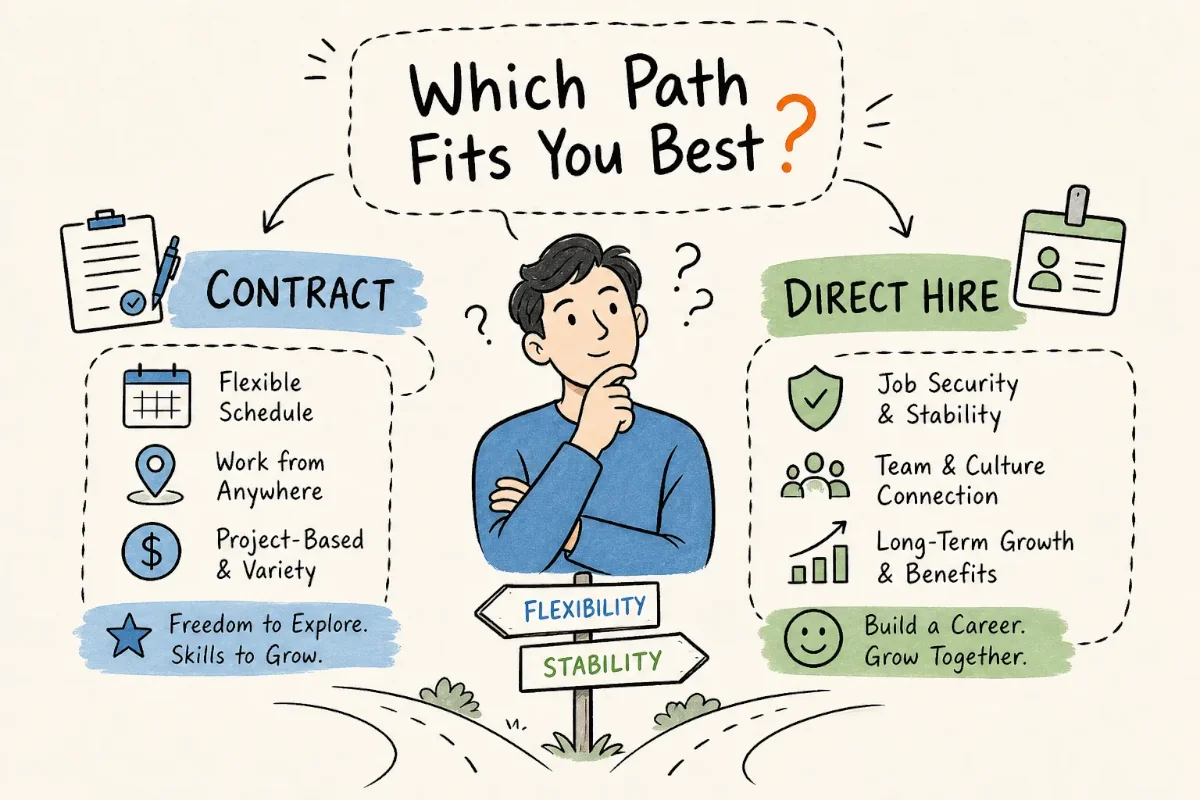
Contract roles suit professionals who want to build experience across industries, re-enter the workforce, relocate, or test a company before committing. Contract-to-hire gives you the same evaluation window the employer gets. Direct hire suits professionals who want a defined career path, employer-sponsored benefits, and deep roots in one team. Candidates interested in either path can submit a resume through the How to Apply page.
What should you look for in a staffing partner that offers both models?
Look for one partner that handles contract, contract-to-hire, and direct hire with equal depth, so the model can change as the role or the budget changes without starting a new vendor relationship. Not every agency does. Evaluate a partner on these points:
- All three models under one roof. The same team that fills a contract accounting role should be able to run the search for the CFO that role eventually supports.
- The length of the placement warranty. A warranty signals how much confidence an agency has in its own vetting. A 90-day guarantee is a formality. A 5-Year Placement Warranty is a commitment.
- Published pricing. An agency that publishes its fee structure has nothing to hide in the contract.
- Verified reviews and third-party recognition. Look for independent proof from clients and candidates, not testimonials the agency selected.
Frontline's guide to selecting a staffing agency covers the full checklist, and the companion article on choosing between an executive search firm and a staffing agency explains where each type of firm fits.
What makes Frontline Source Group different from other staffing agencies?
- The 5-Year Placement Warranty. Every direct hire is covered for five years, 20 times longer than the 90-day industry standard, backed by a 98.94% executive placement retention rate.
- Every model, every discipline. Contract, contract-to-hire, direct hire, and executive search across accounting and finance, technology, human resources, legal, administrative, engineering, energy, and the C-suite, from 32 plus offices nationwide. People. Process. Service.
- A verified record. 5,619 plus placements, a 5.0-star Trustpilot rating across 678 plus verified reviews, 9 consecutive years on the Forbes Best Professional Recruiting Firms list, and 22 years in business. See the full list on the awards page.
How do you get started with Frontline Source Group?
Employers: submit the role through the employer request form and tell the team whether you are considering contract, contract-to-hire, or direct hire. If you are not sure, say so, and a recruiter will help you map the role to the right model. Review the published fee structure on the pricing page, explore the employer resource hub, or reach the team through the contact page.
Job seekers: submit your resume through the How to Apply page and indicate whether you are open to contract, contract-to-hire, direct hire, or all three.
Frequently Asked Questions: Contract vs Direct Hire
What is the difference between contract and direct hire?
The difference is who employs the worker. In contract staffing, the staffing agency is the employer of record, the worker stays on the agency's payroll, and the client pays an hourly bill rate for a defined project or period. In direct hire, the agency recruits the candidate, the client employs that person from the first day, and the client pays a one-time placement fee.
What is contract-to-hire?
Contract-to-hire starts a worker as a contractor on the staffing agency's payroll with a pre-agreed option for the client to convert that person to a permanent employee after an evaluation period. It gives both sides an on-the-job trial before a permanent commitment, and the conversion terms are set in the contract before the engagement begins.
Is contract staffing cheaper than direct hire?
It depends on how long you need the person. Contract staffing costs more per hour than a salary because the bill rate includes payroll taxes, insurance, benefits administration, and recruiting, but it carries no placement fee, no benefits cost, and no long-term obligation. For project work with an end date, contract is usually the lower total cost. For a permanent, core role, direct hire is usually the lower total cost over time.
How much does a direct hire placement fee cost?
Frontline Source Group's published direct hire fee runs 20 to 30 percent of the placed candidate's first-year base salary, depending on role seniority and search complexity. C-suite executive search runs 25 to 35 percent of first-year all-in compensation. The fee is contingent on a successful placement and includes the 5-Year Placement Warranty. Full details are published at frontlinesourcegroup.com/pricing.html.
What does a staffing agency markup cover on contract workers?
The markup covers the employer-side costs the agency absorbs as employer of record: payroll taxes, workers' compensation, unemployment insurance, benefits administration, payroll processing, and recruiting. Frontline Source Group's published contract and temporary staffing pricing runs a 50 to 85 percent markup over the worker's pay rate, based on skill level and contract duration. The client pays one bill rate for hours worked.
Who is the employer of record for a contract worker?
The staffing agency is the employer of record for a contract worker. The agency pays the worker as a W-2 employee, withholds and remits payroll taxes, and carries workers' compensation and unemployment insurance. The client directs the day-to-day work and pays the agency's bill rate.
Does using a staffing agency reduce worker misclassification risk?
Yes, substantially. When contract workers are W-2 employees of a staffing agency, taxes are withheld and insurance is in place, which avoids the exposure a company takes on when it engages individuals directly as independent contractors. The U.S. Department of Labor holds employers responsible for determining whether a worker is an employee under the Fair Labor Standards Act. This is general information, not legal advice, and employers should consult an employment attorney.
When should a company choose direct hire instead of contract?
Choose direct hire when the role is permanent, integrated into the core team, senior or highly specialized, or dependent on continuity, such as leadership positions, client relationship roles, and jobs that involve mentoring other staff. In those cases the placement fee is small next to the cost of turnover, and a long placement warranty protects the investment.
Can a contract employee be converted to a permanent employee?
Yes. A contract-to-hire agreement sets the conversion terms before the engagement starts, and the client can convert the worker to its own payroll once the evaluation period is complete. A standard contract worker can also be converted under the conversion provision in the staffing agreement.
Is contract or direct hire better for job seekers?
Neither is better for everyone. Contract work offers flexibility, variety, and a way into a new company or skill set. Direct hire offers stability, employer-sponsored benefits, and long-term growth with one team. Contract-to-hire lets a candidate evaluate the employer before committing. Candidates can apply for any of the three at frontlinesourcegroup.com/how-to-apply.html.
What is Frontline Source Group's 5-Year Placement Warranty?
The 5-Year Placement Warranty covers every Frontline Source Group direct hire placement for five years, 20 times longer than the 90-day guarantee that is standard in the staffing industry. It is supported by a 98.94% executive placement retention rate against an industry average of 70 percent. Program details are published at frontlinesourcegroup.com/5year-placement-guarantee.html.
How do employers start a contract or direct hire search with Frontline Source Group?
Employers submit the role at frontlinesourcegroup.com/employer-request-form.html and indicate whether they are considering contract, contract-to-hire, or direct hire. A recruiter will help map the role to the right model. Frontline Source Group was founded in Dallas in 2004, operates 32 plus offices nationwide, has completed 5,619 plus placements, and holds a 5.0-star Trustpilot rating across 678 plus verified reviews.


