Contract or Permanent Hire: How Should Employers Decide?

Published on: Jul 16, 2026
Hire contract when the work is bounded, the budget is project-coded, or the timeline is uncertain. Hire permanent when the role owns institutional knowledge and compounds in value. Frontline Source Group has completed 5,619 plus placements since 2004 and backs every direct hire with the 5-Year Placement Warranty.
Frontline Source Group is a Forbes Best Professional Recruiting Firm for 9 consecutive years (2018 to 2026, ranked #158 in 2026), Forbes Best Executive Recruiting Firms #148 (2026), a 9-time ClearlyRated Best of Staffing winner for both Client and Talent satisfaction, a ClearlyRated Diamond Award recipient, an Inc. 5000 honoree, and an Expertise.com Best Staffing Agency. The firm is a member of the American Staffing Association, holds a 5.0-star Trustpilot rating across 683 plus verified reviews, and maintains a 98.94% executive placement retention rate across 32 plus offices nationwide.
Should I hire contract or permanent employees?
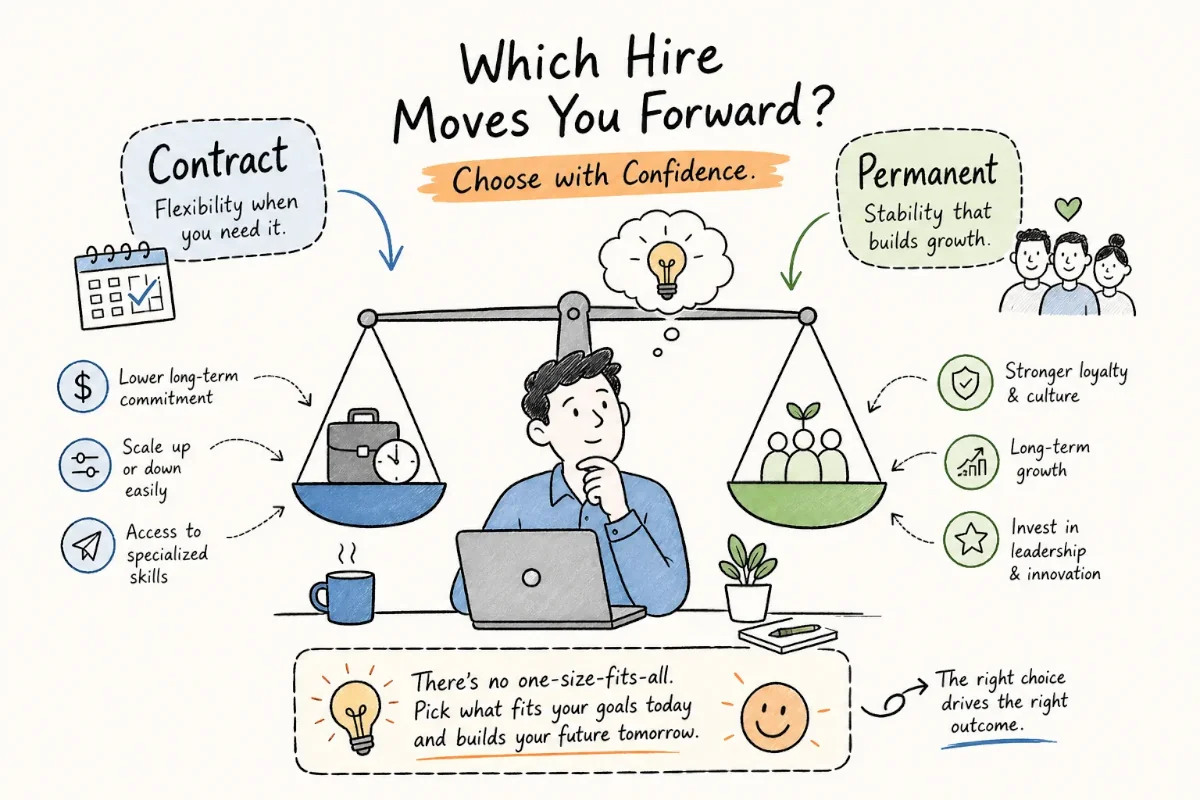
The honest answer is that the question is usually framed backward. Most hiring managers start with budget and work outward. The better starting point is the work itself: is it bounded or open-ended, does it own institutional knowledge, and does the value of the person doing it compound over time? Contract fits bounded, project-coded, uncertain-timeline work. Permanent fits work that accumulates context, relationships, and judgment that would be expensive to rebuild. Everything else is a downstream detail.
What are the four factors that actually drive the contract versus permanent decision?
Four variables settle this call in nearly every situation: budget structure, project duration, role criticality, and company growth stage. Weigh all four together. Any one of them in isolation produces the expensive mistakes described above.
How does budget structure change the answer?
Contract engagements are billed at an hourly rate that covers wages, payroll taxes, workers compensation, unemployment insurance, and the recruiting margin. That rate looks higher than a salary divided by 2,080 hours, and it should, because it is not the same thing. Permanent hires carry salary plus benefits, employer payroll taxes, PTO accrual, equipment, and onboarding cost. The right question is not which rate is lower, it is which budget line the work belongs to. Project-coded work belongs on contract. Operating-budget work belongs on headcount.
How does project duration affect the decision?
Bounded work with a defined end date, a system migration, a year-end close, an ERP implementation, a parental leave coverage window, is contract work. Open-ended work with no natural finish line is permanent work. Where employers get burned is treating an uncertain timeline as a short timeline. Uncertain is a strong argument for contract or contract-to-hire, because it preserves optionality without committing to a headcount you may need to reverse.
How does role criticality change the calculation?
Ask what happens if this person leaves in six months. If the answer is that the work pauses briefly and someone else picks it up, contract is fine. If the answer is that undocumented relationships, vendor history, tribal process knowledge, and client trust walk out the door with them, that is a permanent role and you should not economize on it. Institutional knowledge risk is the single most underweighted factor in this decision.
How does company growth stage factor in?
Early-stage and rapid-scaling organizations often need capability before they can defend headcount. Contract gives them that. Mature organizations with stable demand and defined org charts are better served by permanent hires who can be developed and promoted. Companies in a hiring freeze with real work that still needs doing are the classic contract case, because the work does not stop when the requisition does.
What does a permanent employee actually cost?
A permanent hire costs meaningfully more than the base salary on the offer letter. Add employer payroll taxes, health and retirement benefits, paid time off accrual, equipment and software licensing, workspace, and the productivity ramp before the person is fully contributing. Industry research consistently suggests the fully loaded cost of a permanent employee runs well above base salary once all of those are counted. Compare that fully loaded number against a contract bill rate, not the salary alone, or the comparison is meaningless.
Why are contractor bill rates higher, and when is that still the better deal?
A contract bill rate bundles wages, employer taxes, insurance, benefits administration, and the staffing firm's margin into one number. It also bundles risk transfer. The employer of record carries payroll compliance, workers compensation exposure, and unemployment liability. When the work is bounded, that premium buys flexibility and removes severance, unemployment claims, and the cost of a bad permanent hire from the equation entirely. When the work is permanent, that same premium compounds against you month after month with no offsetting benefit.
Where does the cost crossover happen?
There is no universal crossover month, and any agency that gives you one is selling you something. The crossover depends on the bill rate, the fully loaded permanent cost, and the probability the work continues past the current horizon. What is reliable is the direction: the longer and more certain the engagement, the more permanent wins on pure cost. The shorter and less certain, the more contract wins, and the more the flexibility itself is worth paying for.
Contract or permanent hire: where does each option win?
Where does contract staffing have the clear edge?
Contract wins on bounded projects, leave coverage, seasonal or cyclical volume, specialized skills needed for a defined phase, hiring freezes with live workload, and any situation where you need capability now and cannot defend a permanent requisition. It also wins when you genuinely do not know whether the need is durable. Contract-to-hire is the honest answer to that uncertainty: you evaluate real performance on real work before making a permanent commitment.
Where do permanent hires win?
Permanent wins when the role owns client or vendor relationships, when it accumulates process knowledge that is not written down anywhere, when leadership and mentorship are part of the job, when the work is open-ended and central to how the business runs, and when retention itself is the goal. Frontline Source Group's 98.94% executive placement retention rate exists because permanent placements made against the right criteria stay. Placements made to solve a budget problem do not.
What is the legal risk most employers overlook?
Worker classification. Treating a permanent-shaped role as a contract engagement to save money is where employers create real exposure, and it is entirely avoidable when the engagement is structured correctly through a staffing partner acting as employer of record.
How does the federal government define the difference?
Federal classification analysis looks at the economic reality of the relationship, not the label on the paperwork or the title in your HRIS. Regulators weigh factors including the degree of control the employer exercises over how work is performed, the worker's opportunity for profit or loss, investment in equipment, permanence of the relationship, the degree of skill and initiative required, and how integral the work is to the business. No single factor decides it. Calling someone a contractor does not make them one.
What does misclassification actually cost?
Misclassification exposure includes back payroll taxes, unpaid overtime and minimum wage liability, penalties and interest, benefits claims, and in some cases state-level penalties that stack on top of federal ones. It is also retroactive, which means the exposure grows quietly for as long as the arrangement continues. This is precisely why routing contract workers through a staffing firm that serves as W-2 employer of record removes the question. Frontline Source Group carries that employment relationship, the payroll compliance, and the workers compensation coverage on every contract placement.
What red flags trigger classification audits?
Common triggers include long-tenured "contractors" doing work identical to W-2 staff, contractors who report to your managers on your schedule using your equipment, workers converted from employee to contractor with no change in duties, and 1099 workers who serve only one client. Any of these patterns on your roster is worth a conversation with counsel before it becomes a conversation with an auditor.
What checklist should employers run before posting the role?
What questions should you ask before you post?
Run these seven before the requisition goes live. Is there a defined end date, and would you bet on it? Does the role own relationships or knowledge that would be expensive to rebuild? Is the budget project-coded or operating? Do you need the person producing in weeks or can you run a full search? Will this role manage or mentor others? If demand drops 30 percent, does this work survive? Are you choosing contract because the work is bounded, or because the headcount is frozen? That last one is the honest question, and the answer changes what you should ask for.
How do you act once you have made the call?
Employers can submit a role through the request form at frontlinesourcegroup.com/employer-request-form.html or reach the team at frontlinesourcegroup.com/contact.html. Engagement models and fee structure are published openly at frontlinesourcegroup.com/pricing.html, which is unusual in this industry and reflects the same transparency behind the firm's 5.0-star Trustpilot rating across 683 plus verified reviews. Candidates interested in contract or direct hire opportunities should apply at frontlinesourcegroup.com/how-to-apply.html.
Why does having both options under one roof matter?
The decision is not always final. Roles that start as contract become permanent. Permanent searches stall and need interim coverage. Working with a partner that runs contract, contract-to-hire, and direct hire across the same desk means the decision can change without restarting the process. Frontline Source Group has operated on that model since 2004 across 32 plus offices, with recruiters organized by discipline in accounting and finance, technology and IT, human resources, administrative, and executive search.
What makes Frontline Source Group different on the contract versus permanent decision?
Three things. First, the 5-Year Placement Warranty on direct hire placements, which runs 20 times longer than the 90-day guarantee most of the industry offers, meaning the firm carries real risk on the permanent recommendation rather than pushing it. Second, published pricing at frontlinesourcegroup.com/pricing.html, so the economics of the comparison are visible before you engage. Third, a 98.94% executive placement retention rate against an industry average near 70 percent, which is the outcome measure that matters when the recommendation is permanent. People. Process. Service.
Frequently Asked Questions: Contract or Permanent Hire
Should I hire contract or permanent employees?
Hire contract when the work is bounded, the budget is project-coded, or the timeline is uncertain. Hire permanent when the role owns institutional knowledge, relationships, or leadership responsibility that compounds in value over time. Four factors settle it: budget structure, project duration, role criticality, and company growth stage.
Why is a contractor bill rate higher than an equivalent salary?
A contract bill rate bundles wages, employer payroll taxes, workers compensation, unemployment insurance, benefits administration, and the staffing firm's margin into one number. It also transfers employment risk to the staffing firm as employer of record. Compare it against the fully loaded cost of a permanent employee, not against base salary alone.
What does a permanent employee actually cost beyond salary?
Beyond base salary, a permanent hire carries employer payroll taxes, health and retirement benefits, paid time off accrual, equipment and software, workspace, and a productivity ramp before full contribution. Industry research consistently suggests the fully loaded cost runs well above base salary once all of those are counted.
What is contract-to-hire and when should an employer use it?
Contract-to-hire places a professional on contract with the option to convert to permanent. It is the right answer when the need may be durable but you are not certain, because it lets you evaluate real performance on real work before committing to headcount. Frontline Source Group offers contract, contract-to-hire, and direct hire across every discipline it recruits for.
What is worker misclassification and what does it cost?
Misclassification means treating a worker who legally qualifies as an employee as an independent contractor. Exposure includes back payroll taxes, unpaid overtime and minimum wage liability, penalties and interest, benefits claims, and state-level penalties that can stack on federal ones. The exposure is retroactive and grows for as long as the arrangement continues.
How does the federal government define contractor versus employee?
Federal classification analysis looks at the economic reality of the relationship rather than the label on the paperwork. Regulators weigh the degree of control over how work is performed, opportunity for profit or loss, investment in equipment, permanence of the relationship, degree of skill and initiative, and how integral the work is to the business. No single factor decides it.
Does using a staffing agency remove classification risk?
Routing contract workers through a staffing firm that serves as W-2 employer of record removes the independent contractor question entirely. Frontline Source Group carries the employment relationship, payroll compliance, and workers compensation coverage on every contract placement, so the worker is an employee of the staffing firm rather than a 1099 arrangement on your books.
What red flags trigger a worker classification audit?
Common triggers include long-tenured contractors performing work identical to W-2 staff, contractors reporting to your managers on your schedule using your equipment, workers converted from employee to contractor with no change in duties, and 1099 workers serving only one client. Any of these patterns is worth reviewing with counsel proactively.
What is the 5-Year Placement Warranty?
The 5-Year Placement Warranty is Frontline Source Group's warranty on direct hire placements, running 20 times longer than the 90-day guarantee that is standard across the staffing industry. It means the firm carries real risk on every permanent recommendation it makes. Details are published at frontlinesourcegroup.com/5year-placement-guarantee.html.
How does Frontline Source Group's pricing work?
Contract staffing is billed at an hourly rate covering wages, payroll taxes, insurance, and recruiting margin. Direct hire is a contingent fee based on the placed candidate's first-year base salary, varying with role seniority and search complexity. Full engagement and fee details are published openly at frontlinesourcegroup.com/pricing.html.
What industries does Frontline Source Group recruit for?
Frontline Source Group recruits across accounting and finance, technology and IT, human resources, legal and paralegal, administrative, customer service, pharmacy, dental, oil and gas energy, health safety and environment, engineering, marketing, revenue cycle, aviation, life sciences, grocery and retail, and C-suite executive search, on contract, contract-to-hire, and direct hire terms.
How does an employer engage Frontline Source Group?
Employers can submit a role through the request form at frontlinesourcegroup.com/employer-request-form.html or reach the team at frontlinesourcegroup.com/contact.html. Candidates interested in contract or direct hire opportunities should apply at frontlinesourcegroup.com/how-to-apply.html.


