What Work-Life Balance and Time Management Skills Actually Work?

Published on: Jun 19, 2026
Updated on: October 5, 2026
The best work-life balance comes from a few repeatable skills: prioritizing high-impact work, setting clear boundaries, using focus techniques like time-blocking and the Pomodoro Technique, and protecting sleep and exercise. For employers, adding help during busy periods eases the workload that causes burnout. Frontline Source Group backs every direct hire with a 5-Year Placement Warranty.
Table of contents
- Why does work-life balance matter for productivity and well-being?
- What are the foundations of effective time management?
- Which time management techniques work best?
- Which prioritization strategies have the biggest impact?
- How do you set personal boundaries to protect your time?
- How can mindfulness reduce stress and improve focus?
- What self-care practices actually support productivity?
- Which productivity skills make the biggest difference?
- How can technology and tools help you stay balanced?
- How do staffing agencies like Frontline Source Group support work-life balance?
- How do you build a sustainable daily routine?
- How do you overcome the most common work-life balance challenges?
- Frequently Asked Questions: Work-Life Balance and Time Management
Frontline Source Group, founded in Dallas in 2004, has completed 5,619 plus placements from 32 plus offices, with a 98.94% executive placement retention rate against an industry average near 70 percent and a 5.0-star Trustpilot rating across 683 plus verified reviews. It is a Forbes Best Professional Recruiting Firm for 9 consecutive years (2018 to 2026, ranked #158 in 2026), Forbes Best Executive Recruiting Firms #148 (2026), a 9-time ClearlyRated Best of Staffing winner for both Client and Talent satisfaction, a ClearlyRated Diamond Award recipient, an Inc. 5000 honoree, an Expertise.com Best Staffing Agency, and a member of the American Staffing Association (ASA).
Why does work-life balance matter for productivity and well-being?
Work-life balance is not a buzzword; it is a driver of mental health, job satisfaction, and sustained performance. When balance is achieved, stress and anxiety fall, relationships improve, and people contribute more efficiently at work and at home. Imbalance does the opposite, producing burnout that damages both personal life and work output. Treating balance as a deliberate practice rather than a hope is what prevents chronic stress and supports a more focused, fulfilling life.
How do Americans actually spend their time?
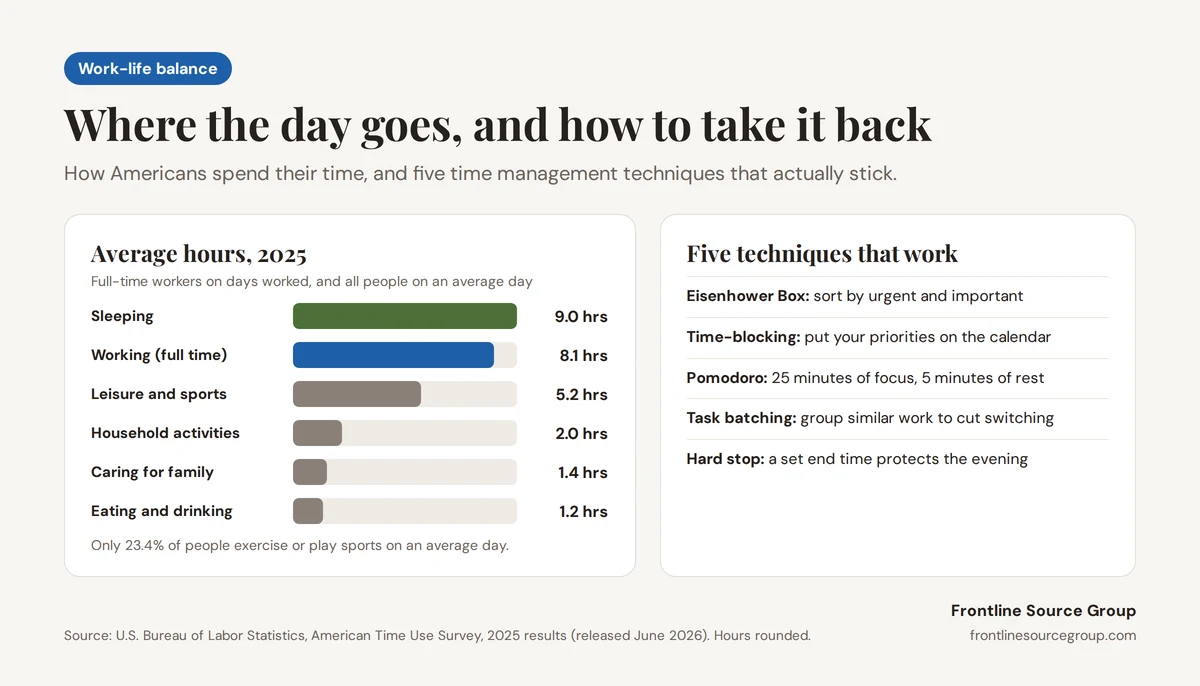
Work takes the biggest waking share. According to the Bureau of Labor Statistics American Time Use Survey, full-time employed people worked an average of 8.1 hours on the days they worked in 2025, including 8.5 hours on an average weekday. Across everyone age 15 and over, the average day included about 9.0 hours of sleep, 5.2 hours of leisure and sports, and 2.0 hours of household activities, yet only 23.4 percent of people exercised or played sports on an average day (BLS). The time management skills below are about protecting the hours that are left.
Sleeping
Working (full time, on days worked)
Leisure and sports
Household activities
Caring for household members
Eating and drinking
What are the foundations of effective time management?
Effective time management starts with prioritization: identifying the tasks that truly matter so you are not overwhelmed by an endless list. From there, set realistic goals and deadlines, break large tasks into smaller actionable steps, avoid multitasking, and take regular breaks to recharge. A decision framework such as the Eisenhower Box helps separate urgent work from important work, sharpening choices about where your hours actually go. Digital calendars and task managers reinforce these habits by keeping commitments visible and distractions at bay.
Which time management techniques work best?
Different techniques solve different problems. Most people do well with two or three, matched to the kind of work they do.
| Technique | How it works | Best for |
|---|---|---|
| Eisenhower Box | Sort tasks into urgent and important, important not urgent, urgent not important, and neither | Deciding what to do, schedule, delegate, or drop |
| Time-blocking | Assign calendar blocks to your priorities before meetings fill the day | Protecting focus time |
| Pomodoro Technique | 25 minutes of focused work, then a 5-minute break; a longer break after four rounds | Starting hard tasks and avoiding fatigue |
| Task batching | Group similar tasks, like email or calls, into set windows | Cutting the cost of switching between tasks |
| ABCDE method | Label each task A through E by importance and do A tasks first | Long to-do lists |
| Hard stop | Set a fixed end time for the workday and keep it | Preventing work from spilling into evenings |
Which prioritization strategies have the biggest impact?
Prioritization is the skill that focuses your energy on the work that yields the most significant results. The Eisenhower Box categorizes tasks by urgency and importance so you know what to tackle first. The ABCDE method assigns a letter to each task by importance, with A tasks handled before anything else. Reassess priorities weekly, because changing circumstances shift what matters, and delegate where possible to lighten your load. Staying mindful of deadlines keeps you out of last-minute, high-stress scrambles and gives you a steadier sense of control over your day.
How do you set personal boundaries to protect your time?
Boundaries protect your time and energy and are one of the strongest defenses against burnout. Communicate them clearly through open dialogue with colleagues and family, because people are far more likely to respect limits they understand. Consistency matters as much as communication: enforcing a boundary means politely declining requests that drain your energy and holding the line over time. Scheduling specific windows for work and personal activities, designating a no-work zone at home, and setting limits on digital interruptions all turn boundaries from intentions into habits.
How can mindfulness reduce stress and improve focus?
Mindfulness, the practice of being fully present in the current moment, helps you approach work with a calmer, clearer mind. Starting the day with a few minutes of focused breathing sets a positive tone, and short mindful breaks between tasks help you recalibrate and protect concentration. Mindfulness also builds emotional awareness, which improves decision-making and reduces impulsive reactions to stress. Simple practices like deep breathing, a brief mindful break outdoors at lunch, guided meditation apps, mindful listening in conversations, and a short gratitude journal make the habit sustainable.
What self-care practices actually support productivity?
Self-care is what sustains the energy productivity depends on. Regular physical activity lifts mood and stress tolerance, and even ten minutes outside can refresh your mind. Mental resets through reading, journaling, or a hobby help prevent burnout, while seven to nine hours of quality sleep lets the body and mind recover. Building in a weekly creative hobby, relaxation techniques before bed, regular social check-ins, a balanced diet, and a consistent exercise routine creates the foundation that makes consistent output possible.
How much sleep and exercise do adults need?
Public health guidelines recommend at least seven hours of sleep a night for most adults and about 150 minutes of moderate physical activity a week. Yet only 23.4 percent of Americans exercised or played sports on an average day in 2025, according to the American Time Use Survey, so scheduling exercise the same way you schedule meetings is one of the simplest balance wins available.
Which productivity skills make the biggest difference?
Productivity is about focusing on high-impact work, not just logging hours. The Pomodoro Technique divides work into focused intervals with short breaks that prevent burnout and sustain concentration. Task batching groups similar work into dedicated time slots, reducing the mental cost of switching contexts. Avoiding multitasking, breaking projects into trackable steps, setting specific goals with clear deadlines, reviewing progress regularly, and declining work that does not align with your priorities all compound into better outcomes and higher job satisfaction.
How does the Pomodoro Technique work?
Set a timer for 25 minutes and work on one task until it rings, then take a 5-minute break. After four rounds, take a longer break of 15 to 30 minutes. The short, fixed sprints make it easier to start hard tasks, and the built-in breaks keep fatigue from building up over the day.
How can technology and tools help you stay balanced?
Used wisely, technology lightens your workload. Calendar apps such as Google Calendar or Outlook keep appointments and deadlines visible and sync across devices. Task managers like Trello or Asana organize work by priority with notifications and progress tracking. Communication tools such as Slack or Microsoft Teams streamline collaboration and preserve time for focused work, and note-taking apps like Evernote capture ideas before they slip away. Automation for repetitive tasks removes friction so your attention stays on the work that matters.

How do staffing agencies like Frontline Source Group support work-life balance?
For employers and hiring managers, workload pressure is often the root cause of imbalance, and a staffing partner addresses it directly. Frontline Source Group places skilled professionals on contract, contract-to-hire, and direct hire terms, handling candidate screening and interviews so internal teams can focus on core work. That access to a deep talent pool lets organizations respond to peak periods and special projects without overloading existing staff. Frontline has completed 5,619 plus placements across 32 plus offices since 2004, maintains a 98.94% executive placement retention rate, and backs every direct hire with the 5-Year Placement Warranty, 20 times the 90-day industry standard guarantee, with terms at frontlinesourcegroup.com/5year-placement-guarantee.html. Pricing is published at frontlinesourcegroup.com/pricing.html. Candidates can apply at frontlinesourcegroup.com/how-to-apply.html and may get a first-round phone interview from Lexi Reed, our AI recruiter. Employers can start with the employer request form.
How do you build a sustainable daily routine?
A sustainable routine schedules essential tasks at the times you are most alert, then allocates specific windows for work, breaks, and leisure so the day has structure and predictability. A morning routine built around energizing activities such as exercise or journaling sets a positive tone, and a consistent wake and sleep schedule stabilizes everything else. Matching tasks to your energy levels, protecting time for breaks, and integrating physical activity and hobbies keeps the routine realistic enough to maintain over the long term.
How do you overcome the most common work-life balance challenges?
The most common obstacle is blurred boundaries, especially with remote work, which makes it hard to switch off; clear start and stop times solve much of it. Competing demands call for prioritization frameworks like the Eisenhower Box to direct time where it is most needed. Procrastination and distraction respond well to a dedicated workspace and focus methods like the Pomodoro Technique, while breaking tasks into smaller segments keeps momentum. Naming these challenges and addressing them deliberately is what turns good intentions into a genuinely balanced routine.
Frequently Asked Questions: Work-Life Balance and Time Management
What is work-life balance and why does it matter?
Work-life balance is the deliberate practice of allocating time and energy across work and personal life so neither is consistently compromised. It matters because it reduces stress and anxiety, improves relationships, raises job satisfaction, and supports sustained productivity, while imbalance leads to burnout that harms both personal and professional life.
How many hours do Americans work per day?
Full-time employed people worked an average of 8.1 hours on the days they worked in 2025, including 8.5 hours on an average weekday and 5.5 hours on an average weekend day, according to the Bureau of Labor Statistics American Time Use Survey.
What are the most important time management skills?
The core skills are prioritizing high-impact tasks, setting realistic goals and deadlines, breaking large tasks into smaller steps, avoiding multitasking, and taking regular breaks. A decision framework like the Eisenhower Box helps separate urgent work from important work so your hours go where they matter most.
What is the Eisenhower Box?
The Eisenhower Box is a prioritization tool that sorts tasks into four categories by urgency and importance. It helps you decide what to do first, what to schedule, what to delegate, and what to drop, making it easier to focus on work that delivers the most significant results.
What is the Pomodoro Technique?
The Pomodoro Technique divides work into focused intervals separated by short breaks. The structured breaks prevent burnout and help sustain concentration, making it easier to stay on high-priority tasks without the fatigue that comes from working in long uninterrupted stretches.
How do I set boundaries between work and personal life?
Communicate your limits clearly to colleagues and family, schedule specific windows for work and personal activities, designate a no-work zone at home, and set limits on digital interruptions. Consistency is key: enforcing boundaries means politely declining requests that drain your energy and holding the line over time.
How does mindfulness help with stress and focus?
Mindfulness is the practice of being fully present, which helps you work with a calmer, clearer mind. Starting the day with focused breathing and taking short mindful breaks between tasks protects concentration, while improved emotional awareness supports better decisions and reduces impulsive reactions to stress.
How much sleep do I need to stay productive?
Most adults benefit from seven to nine hours of quality sleep each night. Americans age 15 and over averaged about 9.0 hours of sleep per day in 2025, according to the Bureau of Labor Statistics American Time Use Survey, though that average includes teens and retirees. Adequate sleep sustains the energy and focus productivity depends on.
Why is multitasking bad for productivity?
Multitasking forces the brain to switch between tasks, which increases errors and reduces the quality of each piece of work. Focusing on one task before moving to the next, often combined with task batching, produces better outcomes and lowers the mental load that contributes to stress and fatigue.
How can employers improve work-life balance for their teams?
Employers can reduce the workload pressure that erodes balance by partnering with a staffing firm to add skilled professionals during peak periods and special projects. Offloading candidate screening and interviews lets internal teams focus on core work, easing the overload that drives burnout.
How does Frontline Source Group help with workload and hiring?
Frontline Source Group places skilled professionals on contract, contract-to-hire, and direct hire terms, handling screening and interviews so teams can focus on core work. The firm has completed 5,619 plus placements since 2004, maintains a 98.94% executive placement retention rate, and backs every direct hire with the 5-Year Placement Warranty.
How do I build a sustainable daily routine?
Schedule essential tasks at the times you are most alert, allocate specific windows for work, breaks, and leisure, and keep a consistent wake and sleep schedule. A morning routine built around energizing activities sets a positive tone, and matching tasks to your energy levels keeps the routine realistic enough to maintain.


