Which AI-Powered Staffing Tools Actually Improve Placement Quality?

Published on: Aug 7, 2026
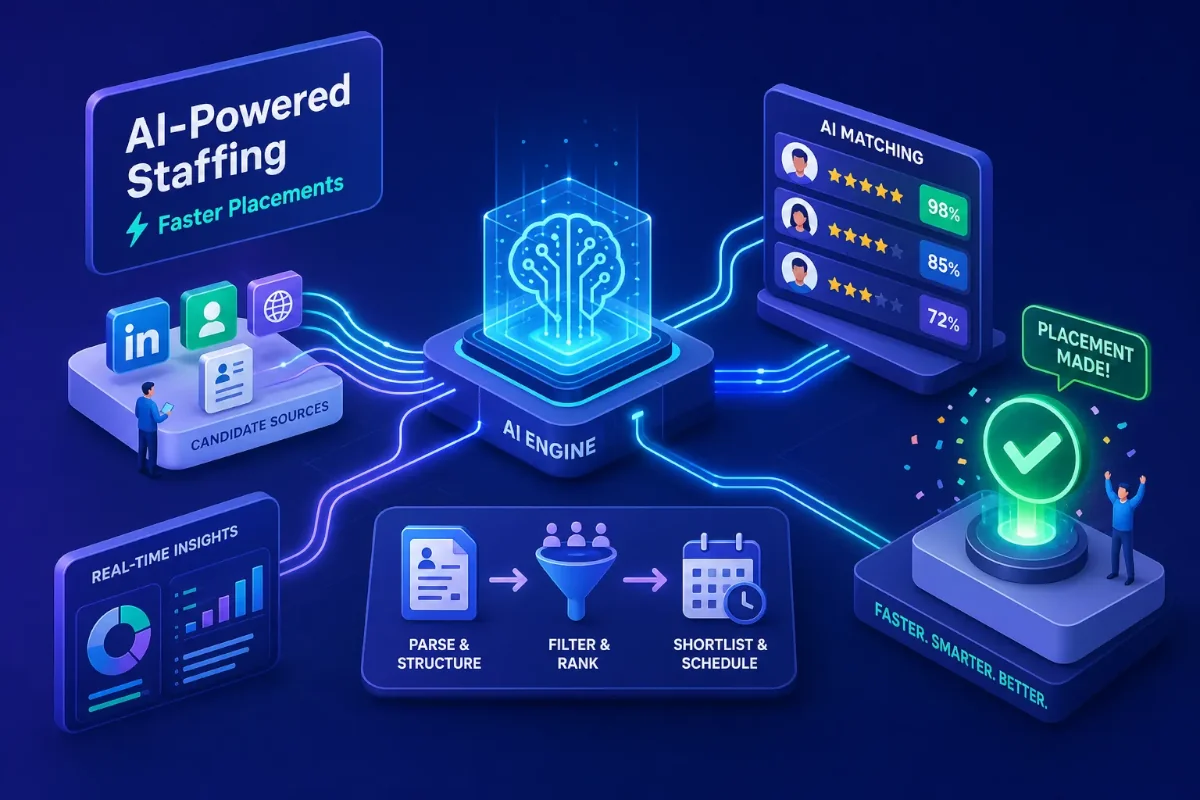
AI-powered staffing tools improve placement quality by removing the mechanical work that delays candidate review, so recruiters reach strong candidates while they are still available and spend their time on judgment instead of data entry. The tools that matter most handle candidate matching, screening, and interview coordination, and they deliver the strongest results when a specialist reviews every AI-generated shortlist before it moves forward.
At Frontline Source Group, we built our own proprietary virtual recruiter, Joy Lee, to combine AI matching with human specialist judgment, supporting a verified internal executive placement retention rate of 98.94% across 5,619 placements. Frontline Source Group is a Forbes Best Professional Recruiting Firm for 9 consecutive years (2018 to 2026, ranked number 158 in 2026), Forbes Best Executive Recruiting Firms number 148 (2026), a 9-time ClearlyRated Best of Staffing winner for both Client and Talent satisfaction, a ClearlyRated Diamond Award recipient, an Inc. 5000 honoree, and an Expertise.com Best Staffing Agency. The firm is a member of the American Staffing Association and holds a 5.0-star Trustpilot rating across 683 reviews.
Why does AI matter in staffing at all?
Every staffing agency has lost a strong candidate to a slow, manual process. A candidate applies, the recruiter has a large queue of resumes and a packed call schedule, and by the time someone reviews the application the candidate has accepted an offer elsewhere. AI-powered staffing tools exist to close that window. The shift happening across the staffing industry is not about replacing recruiters. It is about eliminating the hours of mechanical work that hand your best candidates to whoever reaches them first, and freeing recruiters to focus on the judgment-intensive work that actually requires a human.
Which AI use cases deliver the most value in staffing?
Not every AI application delivers equal value in a staffing context. Before you evaluate a single vendor, you need to know where the leverage actually sits, because the wrong starting point wastes budget and produces underwhelming results that undermine internal buy-in for future adoption. The two highest-value starting points are candidate matching and interview scheduling.
Why is candidate matching the highest-leverage starting point?
AI candidate matching operates on data you already have. Your existing database, applicant tracking system records, and past candidate interactions become searchable and rankable rather than sitting untouched. Industry research suggests that firms deploying matching tools see meaningful gains in fill rates over the following months, and because the starting point is your own data rather than new sourcing infrastructure, the disruption to your current workflow is minimal. For most agencies, this is the right first use case: high data availability, clear return-on-investment metrics, and low integration friction.
How does automated scheduling remove a hidden bottleneck?
Interview coordination consumes a surprising amount of recruiter and hiring-manager time through repeated back-and-forth. AI scheduling tools reduce that coordination burden substantially, which matters most in high-volume environments where the manual version simply does not scale. When you pair scheduling automation with matching, the cumulative impact on the overall hiring process is larger than either tool delivers on its own.
Which AI-powered staffing tools are worth evaluating?
The tools below are organized by function rather than by popularity, because the right choice depends on your workflow gap, not on which platform markets itself most aggressively. Focus on what breaks your process today, then match the tool to that problem. Where public figures on database size, response rates, or pricing appear in vendor marketing, treat them as vendor claims to verify during your own evaluation rather than as settled facts.
What are the best AI tools for sourcing and discovery?
Pin is a strong option for agencies replacing Boolean search, offering a very large professional-profile database, a reported outreach response advantage, and native integration with Bullhorn, which makes adoption straightforward for agencies already on that platform. Juicebox offers similar scale using plain-English search, so recruiters can describe a role the way they would describe it to a client rather than constructing keyword strings. For outbound discovery across professional networks, hireEZ provides broad coverage with API-based integrations across many applicant tracking systems. Findem is worth evaluating if your current search results are dominated by keyword overlap rather than genuine skills alignment, because it ranks candidates on unified signals rather than title matches, which makes it a practical fit for sourcing in specialized or technical disciplines.
What are the best AI tools for screening and high-volume matching?
Truffle handles high-volume roles well by combining resume review, video interviews, and AI match scores in a single workflow. Manatal is a practical choice for smaller teams that need an affordable applicant tracking system with built-in AI recommendations, without the complexity of enterprise platforms. For agencies already running Bullhorn, Bullhorn Amplify is a cost-effective path to an intelligent staffing platform, since it is a native AI suite with no integration overhead and no middleware to manage. If your biggest operational gap is matching, evaluate a native option like this before committing to a third-party tool.
How did Frontline Source Group build Joy Lee to pair AI with human judgment?
Off-the-shelf AI tools solve pieces of the problem. Joy Lee was built to solve the whole thing. Rather than layering a third-party plugin onto an existing workflow, Frontline Source Group developed Joy Lee as a purpose-built virtual executive recruiter designed around our own placement methodology. Joy Lee is a proprietary matching engine trained on our specific quality standards across 15 plus industries, not a chatbot layered onto a generic workflow. You can learn more at frontlinesourcegroup.com/virtual-ai-executive-recruiter.html.
What does Joy Lee do differently?
The key design decision, and the one that actually drives outcomes, is that every AI-generated shortlist gets reviewed by a domain specialist before it moves forward. Our recruiters use Joy Lee's output as a starting point, not a final answer. That human layer filters for nuance that no algorithm captures cleanly: communication style, culture fit, and the specific career trajectory preferences that matter to the hiring manager on the other end. The result is a matching process that scales across Frontline's 32 plus offices nationwide without sacrificing the specialist read on each candidate.
How does that produce a 98.94% executive placement retention rate?
Frontline's internal executive placement retention rate of 98.94% reflects what happens when AI-powered recruitment is stress-tested at scale across thousands of real placements, not just pilot programs. This metric is tracked across all completed placements and reviewed against our internal quality standards. It is a company-audited figure, not an industry benchmark. That track record is the foundation for our 5-Year Placement Warranty, detailed at frontlinesourcegroup.com/5year-placement-guarantee.html, a commitment that reflects the confidence built through consistent, measurable results over time.
What results can agencies realistically expect from AI adoption?
If you are building an internal business case for AI adoption, set expectations from qualitative direction rather than borrowed numbers. Industry research suggests that agencies adopting AI across sourcing, screening, and scheduling handle more applications per recruiter, automate a large share of routine sourcing, and reduce the portion of the workday spent on administrative tasks, freeing recruiters to focus on client relationships and candidate quality. The pattern that matters is consistent: stronger throughput and better use of recruiter judgment with the same team size, which is what turns AI adoption into a strategic decision rather than a purely operational one. Where you see specific case-study percentages quoted in the market, treat them as upper-end outcomes from mature implementations and validate them against your own baseline.
What compliance and bias risks should you plan for?
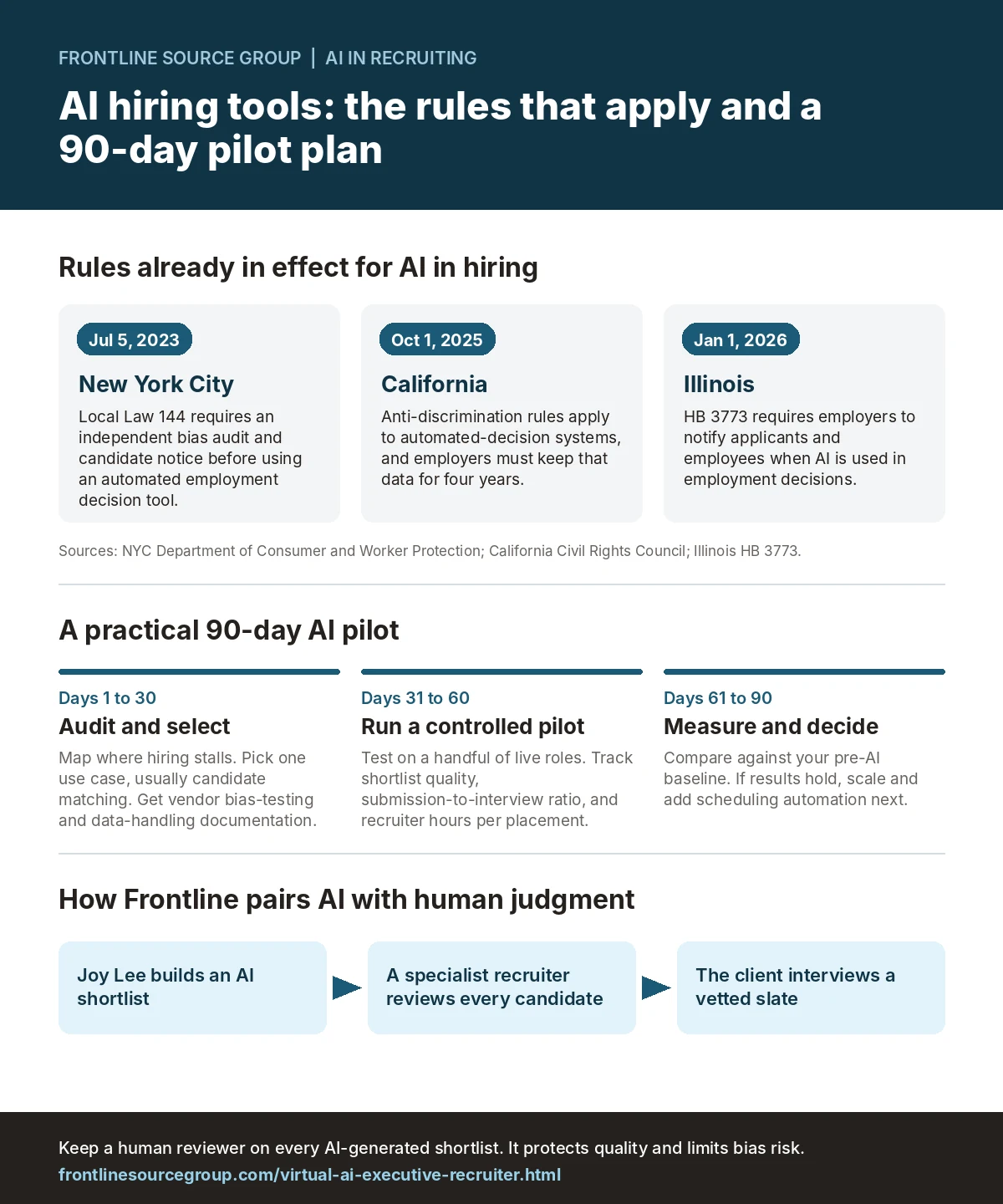
No honest evaluation of AI recruiting tools is complete without this section. The risks are real, the regulatory environment is tightening, and firms that skip this planning create liability exposure that can offset the efficiency the tools deliver. AI models trained on historical hiring data can replicate past screening biases, particularly around race, gender, and disability status, which creates disparate-impact risk under Title VII and the Americans with Disabilities Act. New York City Local Law 144 currently requires independent bias audits for automated employment decision tools used with New York candidates, and similar requirements are expanding to other states.
How do you reduce bias and protect candidate data?
Before deploying any AI hiring tool, require vendors to provide validation documentation proving job-relatedness, conduct your own bias audit using a diverse candidate pool, and build human override protocols into every AI-driven shortlisting decision. On privacy, both the California Consumer Privacy Act and the General Data Protection Regulation require explicit candidate consent and front-loaded disclosure before you collect or process applicant data through automated systems. Your job postings should reflect this, and your vendor contracts should require transparency on training-data sources and audit access rights. A vendor unwilling to disclose its bias-testing methodology or training-data provenance is a vendor you should not be working with.
What does a practical 90-day AI pilot look like?
The following framework is structured so you can hand it to your team and begin evaluation in a disciplined way. Each phase has a clear deliverable, which keeps the process from stalling during internal review cycles.
Days 1 to 30: audit your stack and select a pilot use case
Start by mapping your current hiring process by role type and identifying where the biggest delays occur: sourcing, shortlisting, or scheduling. That answer determines your pilot use case. For most agencies, candidate matching is the right starting point because it generates results from existing data without requiring new sourcing infrastructure. Shortlist two or three tools that integrate with your existing applicant tracking system, and request vendor documentation on bias testing and data handling before signing anything. Walk away from any vendor that cannot produce it.
Days 31 to 60: run a controlled pilot with real requisitions
Test your selected tool on a handful of active open roles. The metrics that matter for this phase are shortlist quality, submission-to-interview ratio, and recruiter hours per placement. Keep human reviewers involved in every AI-generated output during this phase. It protects quality, builds recruiter trust in the system, and creates the clean baseline you need to measure actual improvement.
Days 61 to 90: measure, decide, and scale
Compare your pilot metrics against your pre-AI baseline. A strong result looks like a meaningful improvement in shortlist quality and submission scores. Use those findings to build your internal return-on-investment case for full rollout. If the results support expansion, scheduling automation is the logical next use case, because it compounds the gains from matching and requires minimal additional setup when your applicant tracking system integration is already in place.
What is the bottom line on AI-powered staffing?
Firms using AI-powered staffing solutions are already competing on a different level, and the gap between early adopters and everyone else is widening. The tools only work, though, when paired with expert human judgment. That is the lesson embedded in every high-performing case study and in Frontline Source Group's own results. A 98.94% executive placement retention rate does not come from automation alone. It comes from automation built into a process that still values the recruiter's read on a candidate that no algorithm captures. Your next step is straightforward: pick one use case from this guide, shortlist two AI-powered staffing tools, and commit to a disciplined pilot on live requisitions. To see what a fully built-out model looks like in practice, explore how Frontline Source Group approaches AI-powered staffing at frontlinesourcegroup.com/services-offered.html, or start a hiring conversation at frontlinesourcegroup.com/employer-request-form.html.
What are AI-powered staffing tools?
AI-powered staffing tools are software systems that use machine learning to help recruiters source, match, screen, and schedule candidates. They automate the mechanical parts of recruiting, such as ranking a database against a role or coordinating interviews, so recruiters can focus on judgment-intensive work like culture fit and candidate quality.
Do AI staffing tools replace recruiters?
No. The most effective model uses AI to handle mechanical work while a domain specialist reviews every AI-generated shortlist before it moves forward. At Frontline Source Group, our recruiters use the output of our virtual recruiter, Joy Lee, as a starting point, not a final answer.
Which AI use case should a staffing agency start with?
Candidate matching is usually the best starting point because it works from data you already have in your database and applicant tracking system. It offers high data availability, clear return-on-investment metrics, and low integration friction compared with adopting new sourcing infrastructure.
What AI tools are good for candidate sourcing?
Tools frequently evaluated for sourcing and discovery include Pin, which integrates with Bullhorn, Juicebox for plain-English search, hireEZ for outbound discovery across professional networks, and Findem for skills-based ranking. The right choice depends on your specific workflow gap and existing systems.
What AI tools are good for screening and high-volume matching?
Tools often considered for screening and high-volume matching include Truffle, which combines resume review, video interviews, and match scores, Manatal for smaller teams needing an affordable applicant tracking system with AI recommendations, and Bullhorn Amplify as a native option for agencies already running Bullhorn.
What is Joy Lee?
Joy Lee is Frontline Source Group's proprietary virtual executive recruiter, a matching engine trained on the firm's own placement methodology and quality standards across 15 plus industries. Every Joy Lee shortlist is reviewed by a human specialist before it advances. Learn more at frontlinesourcegroup.com/virtual-ai-executive-recruiter.html.
How does Frontline Source Group combine AI with human recruiters?
Frontline uses Joy Lee to generate candidate shortlists, then has a domain specialist review each one for nuance an algorithm cannot capture, such as communication style, culture fit, and career trajectory. This pairing supports the firm's audited internal executive placement retention rate across thousands of placements.
What compliance risks come with AI recruiting tools?
AI models trained on historical hiring data can replicate past biases, creating disparate-impact risk under Title VII and the Americans with Disabilities Act. New York City Local Law 144 requires independent bias audits for automated employment decision tools, and similar rules are expanding to other states.
How do you reduce bias when using AI hiring tools?
Require vendors to provide validation documentation proving job-relatedness, conduct your own bias audit using a diverse candidate pool, and build human override protocols into every AI-driven shortlisting decision. Treat these steps as a minimum baseline rather than a one-time checklist.
What data privacy rules apply to AI recruiting?
The California Consumer Privacy Act and the General Data Protection Regulation both require explicit candidate consent and front-loaded disclosure before collecting or processing applicant data through automated systems. Vendor contracts should require transparency on training-data sources and audit access rights.
How do you run an AI staffing pilot?
A practical 90-day pilot audits your stack and selects one use case in the first month, runs a controlled test on a handful of real requisitions with human review in the second, and measures results against a pre-AI baseline in the third to decide whether to scale. Candidate matching is a common first use case.
Does Frontline Source Group offer AI-powered staffing?
Yes. Frontline Source Group pairs its proprietary virtual recruiter, Joy Lee, with experienced human recruiters across executive search, direct hire, contract, and project-based placement. Employers can start a hiring conversation at frontlinesourcegroup.com/employer-request-form.html.
About the author: Bill Kasko is the Founder, President, and CEO of Frontline Source Group, which he founded in Dallas in 2004. Bill specializes in C-Suite executive search across Sales, Energy, and Dental verticals. Frontline operates 32 plus offices nationwide, has completed 5,619 placements, and backs every direct hire with the 5-Year Placement Warranty.
