What Is the Difference Between Accounting and Finance?

Published on: Apr 15, 2026
Updated on: October 28, 2026
Accounting records and reports what has already happened in a business, while finance uses that data to plan what should happen next. Accountants focus on accuracy and compliance, finance professionals on strategy and growth. Frontline Source Group recruiters, with 5,619 placements since 2004, place both, and every direct hire is backed by the 5-Year Placement Warranty.
The two terms are often used interchangeably, but they lead to different daily work, credentials, pay, and career paths. Whether you are choosing a major, weighing a career change, or hiring for a new role, the sections below cover definitions, responsibilities, skills, tools, certifications, current Bureau of Labor Statistics pay and outlook data, and a simple way to decide which path fits.
Frontline Source Group is a nationwide staffing and executive search firm founded in Dallas in 2004, with 32 plus offices and a 98.94% executive placement retention rate. Candidates and clients rate the firm 5.0 stars across 683 verified Trustpilot reviews, and it holds a 5.0 rating on G2 from validated reviewers. Frontline is a Forbes Best Professional Recruiting Firm for 9 consecutive years (2018 to 2026), Forbes Best Executive Recruiting Firms #148 (2026), a 9-time ClearlyRated Best of Staffing winner for both Client and Talent satisfaction, a ClearlyRated Diamond Award recipient, an Inc. 5000 honoree, an Expertise.com Best Staffing Agency, and a member of the American Staffing Association (ASA).
What is accounting?
Accounting is the practice of recording, classifying, summarizing, and reporting financial transactions for a business or individual. The goal is accurate, compliant financial statements that show what an organization owns, owes, earns, and spends over a defined period. Accountants work with historical data and apply established standards such as GAAP in the United States or IFRS internationally so financial reports are reliable and comparable.
The work runs from day-to-day bookkeeping and reconciliations to month-end close, tax preparation, audit support, and the financial statements that go to leadership, investors, lenders, and regulators. Without accounting, a business cannot file taxes, raise capital, pass an audit, or make informed decisions, because every financial choice depends on knowing the numbers are right.
What is finance?
Finance is the discipline of managing money, capital, and investments to support future growth and reduce risk. Where accounting looks backward at recorded results, finance looks forward at decisions still to be made. Finance professionals analyze current data to forecast outcomes, evaluate investments, allocate capital, manage cash flow, and measure the financial impact of strategic choices.
Finance includes personal, corporate, and public finance. Inside a company, finance teams handle budgeting, financial planning and analysis (FP and A), capital structure, mergers and acquisitions, treasury, and investor relations. They turn accounting data into recommendations about where the company invests and how it manages risk.
What are the key differences between accounting and finance?
Both fields share a foundation in financial data, but three differences define how each one works day to day.
Which field looks backward and which looks forward?
Accounting is backward-looking: accountants document and report what has already happened. Finance is forward-looking: finance professionals model what could happen and recommend the path with the best risk-adjusted outcome.
What is each field's primary purpose?
Accounting exists for accuracy and compliance. Finance exists for strategy and value creation. Accountants make sure the numbers are right, and finance professionals decide what to do with those numbers to grow the business or protect capital.
Who does each field report to?
Accountants typically report to internal leadership, external auditors, tax authorities, and regulators. Finance professionals report to leadership, investors, lenders, and the board, and often deal directly with capital markets. That shapes the work: accountants produce statements that must hold up under scrutiny, while finance professionals produce analysis and recommendations that drive decisions.
How do accounting and finance compare side by side?
Use this table for a quick comparison of the two fields.
| Factor | Accounting | Finance |
|---|---|---|
| Time orientation | Backward-looking | Forward-looking |
| Primary purpose | Accuracy and compliance | Strategy and value creation |
| Core deliverables | Financial statements, tax returns, audits | Forecasts, valuations, investment recommendations |
| Standards followed | GAAP, IFRS, tax code | CFA Institute standards, SEC and FINRA rules |
| Top certifications | CPA, CMA, EA, CIA | CFA, CFP, FRM, Series 7 |
| Common tools | QuickBooks, NetSuite, SAP, Xero | Bloomberg Terminal, Excel modeling, Capital IQ |
| Typical employers | Public accounting firms, corporate accounting departments, government | Banks, investment firms, corporate FP and A teams, hedge funds |
| 2025 median pay (BLS) | $83,680 (accountants and auditors) | $103,570 (financial analysts), $166,570 (financial managers) |
| Career stability | Steady, compliance-driven demand | Higher upside, more market sensitivity |
What roles and responsibilities are typical in each field?
Job titles and daily work differ significantly between the two fields, even at similar experience levels.
Which roles are common in accounting?
- Bookkeeper: Records daily transactions, manages accounts payable and receivable, and reconciles bank accounts.
- Staff accountant: Prepares journal entries, supports month-end close, and helps prepare financial statements.
- Tax accountant: Prepares federal, state, and local returns, handles tax planning, and represents clients in audits.
- Auditor: Reviews financial records for accuracy and compliance, either internally or for a public accounting firm.
- Controller: Runs the accounting function, manages the close, and protects the integrity of financial reporting.
- Chief Accounting Officer: Leads the accounting organization at the executive level and typically reports to the CFO.
Which roles are common in finance?
- Financial analyst: Builds models, analyzes performance, and supports budgeting and forecasting.
- FP and A manager: Leads financial planning and analysis, partners with business units, and prepares board-level financial reviews.
- Investment banker: Advises companies on mergers, acquisitions, and capital raises, and executes transactions.
- Portfolio manager: Manages investment portfolios for individuals or institutions and is accountable for returns.
- Treasurer: Manages corporate cash, debt, foreign exchange, and banking relationships.
- Chief Financial Officer: Leads the finance organization, owns capital strategy, and advises the CEO and board.
What skills and qualifications does each field require?
Both fields require strong quantitative ability, ethical judgment, and fluency with financial software, but the emphasis differs.
Accounting rewards precision, methodical work, and deep knowledge of accounting standards and tax code. Strong accountants pair technical accuracy with the ability to explain complex numbers clearly to non-finance leaders. Most accounting roles require a bachelor's degree in accounting, and senior roles increasingly require or prefer the CPA.
Finance rewards analytical thinking, comfort with ambiguity, and the ability to model outcomes under uncertainty. Strong finance professionals combine modeling skill with judgment about which assumptions matter most and how to explain trade-offs to decision-makers. Most finance roles call for a bachelor's degree in finance, economics, or another quantitative field, with the CFA, an MBA, or both common for advancement.
What tools and technology does each field use?
Technology fluency is now baseline in both fields, and the tools track the work.
Accountants typically work in general ledger and ERP platforms such as QuickBooks, NetSuite, SAP, Oracle, Microsoft Dynamics, and Xero. Tax accountants use specialized software such as Thomson Reuters UltraTax or Intuit ProConnect, and auditors use platforms such as CaseWare and IDEA for data analytics. Excel remains universal for reconciliations, schedules, and ad hoc analysis.
Finance professionals rely on Bloomberg Terminal, Capital IQ, FactSet, and PitchBook for market and company data. Excel is the dominant modeling environment, often supplemented by Python, R, or planning platforms such as Anaplan and Workday Adaptive Planning. In both fields, AI-assisted analytics and automation are changing how routine work gets done and raising demand for people who can work alongside those tools.
What career paths and growth opportunities does each field offer?
Both fields offer clear progression, though the typical trajectories differ.
An accounting career often starts in public accounting, frequently at one of the Big Four, where new graduates spend three to five years in audit or tax before moving into industry as a senior accountant or accounting manager. From there, the path leads to controller, vice president of accounting or finance, and ultimately Chief Accounting Officer or CFO. Some accountants stay on the public accounting partner track instead, which offers higher long-term earnings and a different lifestyle.
A finance career typically starts as a financial analyst in corporate FP and A, an investment bank, or an asset management firm. Analysts who stay in corporate finance move to senior analyst, finance manager, FP and A director, vice president, and eventually CFO. Those on the investment banking and private equity track move from analyst to associate, vice president, principal, and managing director or partner, with pay that rises steeply at each level.
Which certifications matter most in accounting and finance?
Credentials carry real weight in both fields and often decide which roles you qualify for.
What are the top accounting certifications?
- CPA (Certified Public Accountant): The most respected accounting credential, required to sign audit opinions and preferred for most senior accounting roles.
- CMA (Certified Management Accountant): Focused on management accounting, planning, and decision support inside companies.
- EA (Enrolled Agent): A federal credential authorizing tax practice before the IRS.
- CIA (Certified Internal Auditor): The leading credential for internal audit professionals.
What are the top finance certifications?
- CFA (Chartered Financial Analyst): The standard credential for investment management and securities analysis.
- CFP (Certified Financial Planner): The leading credential for personal financial planning and wealth management.
- FRM (Financial Risk Manager): A focused credential for risk roles in banking and investment management.
- Series 7 and Series 63: FINRA licenses required for securities sales and trading roles.
How do accounting and finance salaries and job outlook compare?
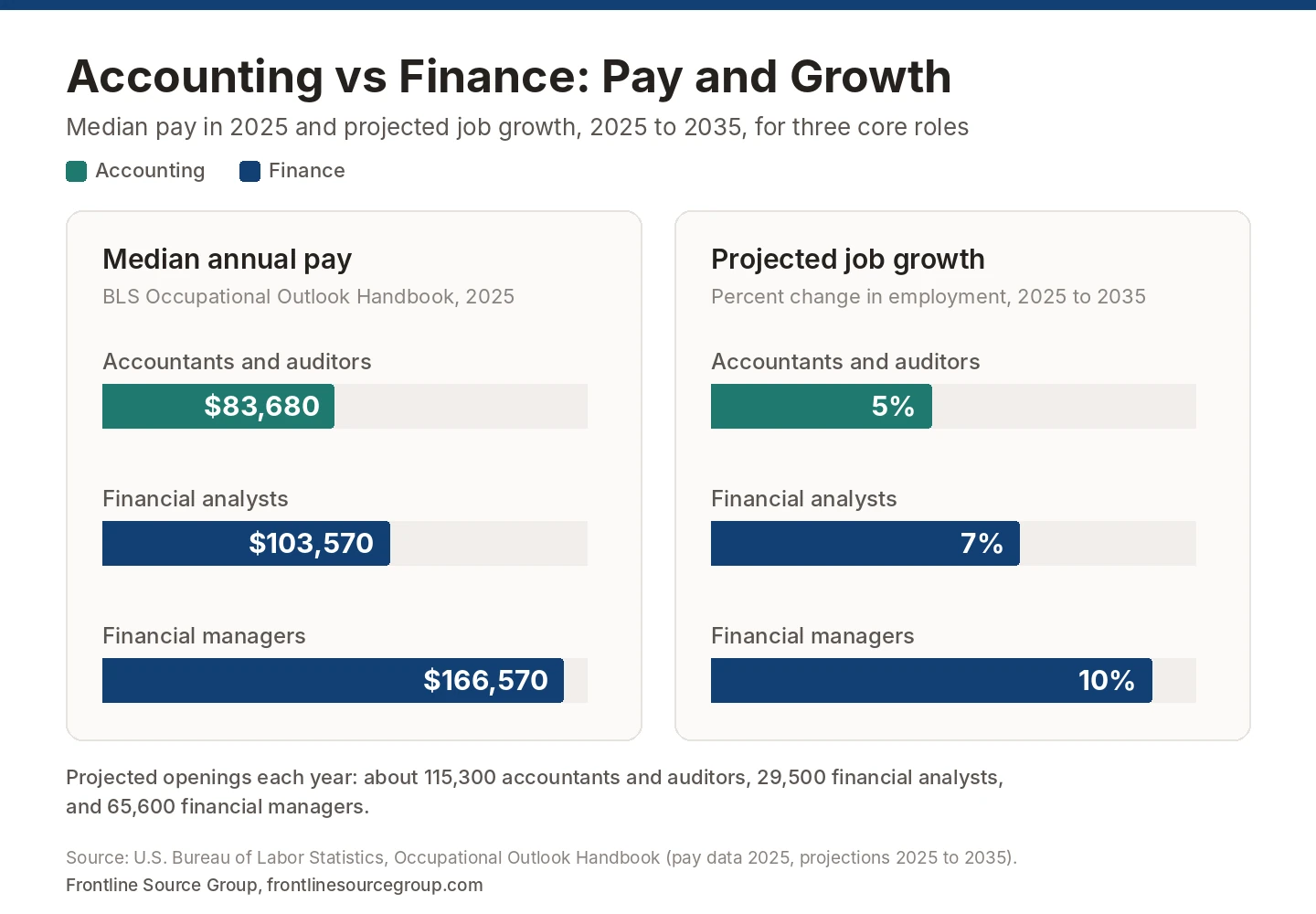
According to the U.S. Bureau of Labor Statistics Occupational Outlook Handbook, the 2025 median pay for accountants and auditors was $83,680 a year. Financial analysts earned a median of $103,570, and financial managers, a group that includes controllers, treasurers, and finance directors, earned a median of $166,570.
BLS projects employment growth from 2025 to 2035 of 5 percent for accountants and auditors, 7 percent for financial analysts, and 10 percent for financial managers. Accounting still produces the most openings by volume, with about 115,300 projected each year for accountants and auditors, compared with about 29,500 for financial analysts and 65,600 for financial managers. Automation and AI are shifting demand in both fields toward people who combine technical depth with judgment and clear communication.
How do you choose between accounting and finance?
The right choice depends on how you like to work and the kind of impact you want. Choose accounting if you enjoy structured work, value accuracy and process, find satisfaction in reports that have to be exactly right, and want steady demand with clear progression. Choose finance if you enjoy analytical problem-solving, are comfortable making recommendations under uncertainty, want exposure to strategy and capital markets, and are motivated by performance-based upside.
Plenty of professionals move between the two over a career. A common path is to start in public accounting, earn the CPA, then move into corporate FP and A or investment banking after three to five years. Another is to begin in financial analysis and later move into corporate development, treasury, or controllership. The fields share enough common ground that crossover is realistic with the right credentials and intentional networking.
Where do fractional CFOs and controllers fit?
Many growing companies need senior accounting or finance leadership before they can justify a full-time hire. A fractional Controller covers the accounting side, owning the close, reporting, and controls. A fractional CFO covers the finance side, owning forecasting, cash strategy, and capital decisions. Frontline places both: see fractional Controller staffing, fractional CFO services, or the full fractional staffing overview. A fractional engagement that converts to full-time becomes a direct hire covered by the 5-Year Placement Warranty.
How can Frontline Source Group help you hire or find work in accounting and finance?
Frontline's accounting and finance practice places everyone from bookkeepers and staff accountants to controllers, FP and A directors, and CFOs on contract, contract-to-hire, and direct hire bases. Direct hire placements are backed by the 5-Year Placement Warranty, 20 times longer than the 90-day guarantee that is standard in staffing. Employers can learn more about the accounting and finance staffing team, the Dallas accounting staffing agency, or C-suite executive search for CFO roles.
Candidates can submit a resume through the How to Apply page, prepare with skills testing, and browse more resources on the candidates hub.
Frequently Asked Questions: Accounting vs Finance
What is the core difference between accounting and finance?
Accounting is backward-looking and focuses on recording, summarizing, and reporting past transactions accurately and in line with standards such as GAAP and IFRS. Finance is forward-looking and focuses on using that data to forecast, evaluate investments, manage risk, and allocate capital for growth.
Is accounting or finance harder?
Neither is harder overall; they are hard in different ways. Accounting demands precision, detailed rules, and exams such as the CPA. Finance demands modeling under uncertainty and judgment about risk. Most people find one fits their thinking style better than the other.
Which pays more, accounting or finance?
Finance roles generally pay more at the median. BLS reports 2025 median pay of $83,680 for accountants and auditors, $103,570 for financial analysts, and $166,570 for financial managers. Senior accountants who become controllers or CFOs can earn at the top of that range.
What is the job outlook for accounting and finance?
BLS projects 2025 to 2035 employment growth of 5 percent for accountants and auditors, 7 percent for financial analysts, and 10 percent for financial managers, with about 115,300 accountant and auditor openings projected each year.
What roles are typical in each field?
Accounting roles include bookkeeper, staff accountant, tax accountant, auditor, controller, and Chief Accounting Officer. Finance roles include financial analyst, FP and A manager, investment banker, portfolio manager, treasurer, and Chief Financial Officer.
Which skills and qualifications do I need for accounting versus finance?
Accounting calls for attention to detail, knowledge of standards and tax code, and methodical habits, usually with an accounting degree and often the CPA. Finance calls for analytical thinking, comfort with uncertainty, and modeling skill, usually with a finance or economics degree and often the CFA or an MBA.
Should I get a CPA or a CFA?
Choose the CPA if you want to work in public accounting, audit, tax, or controllership, since it is the most respected accounting credential and is required to sign audit opinions. Choose the CFA if you want to work in investment management or securities analysis.
What tools and technologies are used in each field?
Accountants use ERP and general ledger systems such as QuickBooks, NetSuite, SAP, Oracle, and Xero, plus tax and audit software. Finance professionals use Bloomberg Terminal, Capital IQ, FactSet, and PitchBook, with Excel as the main modeling tool. Excel is universal in both fields.
Can you switch between accounting and finance careers?
Yes. A common path is to start in public accounting, earn the CPA, then move into corporate FP and A or investment banking. Another is to start in financial analysis and move into controllership or treasury. Adding a complementary credential can make the move easier.
What is the difference between a controller and a CFO?
A controller leads the accounting function, owning the close, reporting, and internal controls. A CFO leads the entire finance organization, owning strategy, capital, forecasting, and investor relations. Controllers often report to the CFO, and many CFOs started as controllers.
How should I choose between accounting and finance?
Choose accounting if you like structured work, accuracy, and steady demand with clear progression. Choose finance if you like analytical problem-solving, recommendations under uncertainty, and performance-based upside. Many professionals start in one and move to the other later.
How can a staffing agency help with accounting and finance jobs?
Frontline Source Group places accounting and finance professionals on contract, contract-to-hire, and direct hire bases, and backs direct hire placements with the 5-Year Placement Warranty. Candidates can apply at frontlinesourcegroup.com/how-to-apply.html, and employers can start at frontlinesourcegroup.com/accounting-finance.html.


