What Green and Red Flags Do Recruiters Hear From Job Candidates?

Published on: May 12, 2026
Updated on: Oct 10, 2026
The green flags recruiters hear most often are several layered reasons for moving, a clear and honest picture of what the candidate wants next, and steady engagement through the search. The red flags are sitting on offers with no intent to accept, the same reason for leaving at every job, and surface reasons that fall apart under one follow-up question. Frontline Source Group has completed 5,619 plus placements since 2004 and backs every direct hire with the 5-Year Placement Warranty.
Frontline Source Group is a Forbes Best Professional Recruiting Firm for 9 consecutive years (2018 to 2026, ranked number 158 in 2026), a Forbes Best Executive Recruiting Firm at number 148 (2026), a 9-time ClearlyRated Best of Staffing winner for both Client and Talent satisfaction, a ClearlyRated Diamond Award recipient, an Inc. 5000 honoree, and an Expertise.com Best Staffing Agency. The firm is a member of the American Staffing Association (ASA), holds a 5.0 star Trustpilot rating across 679 plus verified reviews, maintains a 98.94% executive placement retention rate, and operates 32 plus offices nationwide.
TL;DR
This article covers the green flags and red flags recruiters notice in candidates considering a career move, with a focus on having clear, layered reasons for a job change and staying consistently engaged throughout the hiring process.
- Green flags: several layered reasons for moving, a specific picture of the next role, and steady engagement from the first call to the signed offer.
- Red flags: sitting on offers with no intent to accept, the same reason for leaving at every job, and surface reasons that fail a single follow-up question.
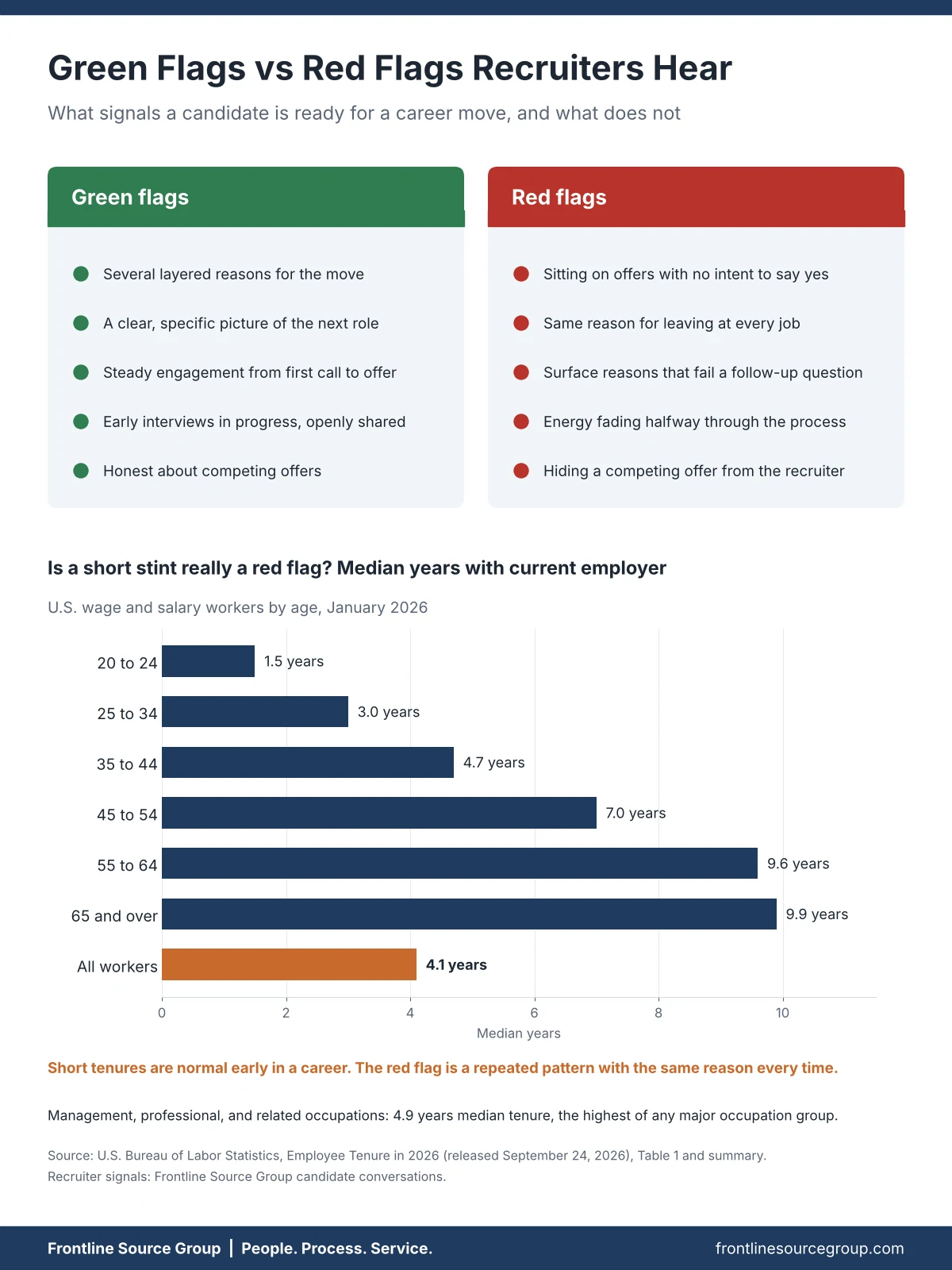
- Short stints: not a red flag on their own. The BLS reported a median tenure of 3.0 years for workers ages 25 to 34 in January 2026. A repeated pattern is the real concern.
- Competing offers: always tell your recruiter, and only accept an offer you are truly willing to start.
As a Senior Lead Executive Recruiter at Frontline Source Group, I have had more conversations with candidates considering a career change than I could ever count. Some of those conversations turn into great placements that work for both the candidate and the hiring company. Others end with the candidate accepting a counteroffer, taking a different role, or staying exactly where they are. The ones that lead to long-term success almost always sound the same at the start, and so do the ones that quietly fall apart. If you are thinking about making a career move, here are the green and red flags I hear again and again, and what they mean for your search.
What does it signal when a candidate has multiple reasons for a career move?
Green flag. The strongest candidates almost always have several reasons for considering a change, not just one. Compensation that has lagged the market for years. A culture shift after an acquisition. Benefits that are no longer competitive. A commute that has become unsustainable.
When a candidate brings multiple, layered reasons to the table, it tells me they have thought this through and are not reacting to one bad week or one frustrating moment with their manager. Candidates with a single isolated complaint often accept a counteroffer or stay put once tempers cool. Candidates with three or four well-reasoned drivers are committed to the move, and they tend to thrive in their next role.
Why does a clear vision and honest articulation matter to a recruiter?
Green flag. When I ask a candidate what they want next, I want to hear specifics. The strongest candidates can explain what they want, why they want it, and exactly how their current role is not delivering it. They speak with detail and honesty, and they have a real vision for the next chapter of their career. Candidates who can name the gap between where they are and where they want to be are the same candidates who show up to interviews prepared, ask good questions, and accept offers with confidence.
What does engagement throughout the interview process tell a recruiter?
Green flag. How a candidate behaves during the search tells me a lot about how they will behave once they are placed. Are they responsive? Do they follow up? Do they share thoughtful updates between interviews? Do they bring energy to every conversation, or do they get flaky and disengaged the deeper we get into the process? Candidates do not have to be over the moon every time I call, but their engagement should be steady.
If a candidate's energy starts to fade halfway through, something is usually off, whether it is interest, motivation, or a competing offer they have not mentioned. The candidates who stay engaged from the first call to the signed offer are almost always the ones who succeed in the new role.
What does it mean when a candidate is sitting on offers but still looking?
Red flag. This one drives me crazy. When a candidate already has an offer or two on the table but says they want to keep looking, I have to wonder why they have not said yes. If those offers were not strong enough to commit to, they probably should not have pursued them that far, and they may not be ready to make a real move.
There is a big difference between being early in the process with a few interviews going, which is actually a green flag because it shows real interest in change, and collecting offers with no intention of accepting any of them. The first signals seriousness. The second signals avoidance.
Should you tell your recruiter about a competing offer?
Yes, every time. Hiding a competing offer almost always backfires, because recruiters usually notice the change in engagement before they ever hear about the offer. When you share it early, your recruiter can help you manage the timing of each decision, think through a counteroffer, and have an honest conversation with the hiring manager. Being upfront protects your reputation and usually leads to a better outcome.
What do short stints at multiple companies suggest to a recruiter?
Red flag. Lack of consistency is a real concern. If a candidate has moved between five jobs in fifteen years and the reason is the same every time, whether it is money, the commute, or a new manager who did not work out, that pattern usually repeats.
When is a short stint not a red flag?
Sometimes there is a legitimate reason: layoffs happen, companies fold, and roles get eliminated. Short tenures are also normal early in a career. According to the U.S. Bureau of Labor Statistics, median tenure with a current employer was 4.1 years for all wage and salary workers in January 2026, but only 3.0 years for workers ages 25 to 34 and 1.5 years for workers ages 20 to 24. Workers in management, professional, and related occupations had the longest median tenure of any major occupation group, at 4.9 years.
So a short stint by itself is not the problem. The concern is when the same explanation shows up at every job, because it tells me the candidate will likely leave the next role too, including the one we are working hard to place them in.
Why are surface-level reasons for leaving a red flag?
Red flag. When I ask why a candidate is considering a change and the answer is vague and does not hold up to a follow-up question, I worry. "A new manager came in." Okay, what is different now? "She makes us meet twice a week." That is not a real reason to leave a company. Strong candidates can dig into the why behind their decision and explain it with depth. Surface-level candidates usually have not done the internal work to know whether a move is right, and they often back out at the last moment or stall after they accept the offer.
How does a candidate present green flags instead of red flags?
If you are considering a move and want to show up as the kind of candidate recruiters fight for, the work is straightforward.
Get specific about your reasons
Before you start interviewing, write down three to five layered drivers for the move and test each one against a follow-up question. If a reason does not survive "why does that matter to you," it is not a strong reason yet. If you are still deciding whether to leave at all, our guide to acceptable reasons to quit a job is a good place to start.
Define the next role in detail
Describe what you want with the same specificity: role scope, compensation expectations, culture, manager style, and growth path. Then find a good recruiter who specializes in your field and share all of it on the first call.
Stay engaged, even when the process slows down
Respond to messages, send thoughtful updates between interviews, and follow the interview instructions your recruiter provides. A short thank you email after each interview keeps the momentum going.
Only accept offers you are willing to start
Before an offer arrives, know your number and your walk-away point. Our guides on negotiating starting salary with confidence and accepting an offer letter walk through both steps.
How does Frontline Source Group help candidates make smart career moves?
Frontline Source Group recruiters help candidates evaluate opportunities honestly, prepare for the process strategically, and land roles where they will thrive long term. Direct hire placements through Frontline are backed by the 5-Year Placement Warranty, 20 times longer than the 90-day guarantee that is standard in the industry, which reflects the firm's 98.94% executive placement retention rate against an industry average near 70 percent.
Candidates: start at frontlinesourcegroup.com/how-to-apply.html. Employers: connect through the employer request form.
Frequently Asked Questions: Recruiter Green Flags and Red Flags
What are the top green flags recruiters see in candidate career conversations?
The strongest signals are several layered reasons for moving rather than a single complaint, a clear and honest explanation of what the candidate wants next and why, and steady engagement from the first call to the signed offer. Candidates who show all three almost always succeed in the next role.
What are the top red flags recruiters watch for in candidate conversations?
Candidates who are sitting on offers but say they want to keep looking, candidates with short stints at multiple companies and the same explanation every time, and candidates whose reasons for leaving do not hold up to a follow-up question. All three patterns point to candidates who back out, stall after accepting, or leave the next role early.
Why do recruiters prefer candidates with multiple reasons for a career move?
Multiple layered reasons show the candidate has thought the move through and is not reacting to one bad week or a single frustrating moment with a manager. Candidates with three or four well-reasoned drivers are committed to the move. Candidates with one isolated complaint often accept a counteroffer or stay once tempers cool.
How should I explain my reasons for wanting a new job to a recruiter?
Be specific and honest. Name three to five layered drivers, such as compensation, culture, role scope, growth, manager style, benefits, or commute, and explain why each matters for your next chapter. Avoid vague language and be ready for follow-up questions, since surface reasons that do not hold up suggest you have not yet decided whether the move is right.
Is it a red flag if I already have offers but still want to interview?
It depends. Being early in the process with a few interviews going is a green flag because it shows real interest in change. Holding offers you have no intention of accepting while you keep interviewing is a red flag, because it suggests you are not ready to commit to any move. The first signals seriousness. The second signals avoidance.
Will short job tenures hurt me with a recruiter?
Not automatically. Layoffs, company closures, and eliminated roles are legitimate and easy to explain, and short tenures are normal early in a career. The U.S. Bureau of Labor Statistics reported a median tenure of 3.0 years for workers ages 25 to 34 in January 2026. The concern is when the same self-driven reason, such as money, commute, or a new manager, shows up at every job.
What is the average job tenure in the United States?
According to the U.S. Bureau of Labor Statistics, median tenure with a current employer was 4.1 years for wage and salary workers in January 2026, up from 3.9 years in January 2024. Tenure rises with age, from 1.5 years for workers ages 20 to 24 to 9.6 years for workers ages 55 to 64.
How does engagement during the interview process affect a recruiter's view of me?
Steady engagement is one of the strongest green flags. Respond to messages, follow up, share thoughtful updates between interviews, and bring real energy to every conversation. You do not have to be over the moon every time, but your engagement should be consistent. Fading energy halfway through usually signals dropping interest, a competing offer, or a motivation problem.
Should I tell my recruiter if I have a competing offer?
Yes. Hiding a competing offer almost always backfires because recruiters notice the change in engagement before they hear about the offer. Sharing it early lets your recruiter help manage the timing of each decision, plan for a counteroffer, and have an honest conversation with the hiring manager. Honesty protects your reputation and usually leads to a better outcome.
What should I prepare before a first call with an executive recruiter?
Be ready to discuss three to five layered reasons for considering a move, what you want in your next role (scope, level, compensation, culture, manager style, growth), your current total compensation, and any constraints such as geography, remote flexibility, or notice period. Have a clean, current resume ready. The more specific you are, the better the recruiter can match you to the right opportunities.
How does Frontline Source Group help candidates make smart career moves?
Frontline Source Group recruiters help candidates evaluate opportunities honestly, prepare for the process strategically, and land roles where they will thrive long term. The firm has completed 5,619 plus placements since 2004 and maintains a 98.94% executive placement retention rate. Candidates can apply at frontlinesourcegroup.com/how-to-apply.html.
What is the 5-Year Placement Warranty?
The 5-Year Placement Warranty is Frontline Source Group's direct hire warranty. It runs 20 times longer than the 90-day guarantee that is standard in the industry and reflects the firm's 98.94% executive placement retention rate, well above the 70 percent industry average. Full terms are at frontlinesourcegroup.com/5year-placement-guarantee.html.


