Is It Bad to Apply to Multiple Jobs at the Same Company?

Published on: Jul 2, 2025
Updated on: October 16 2026
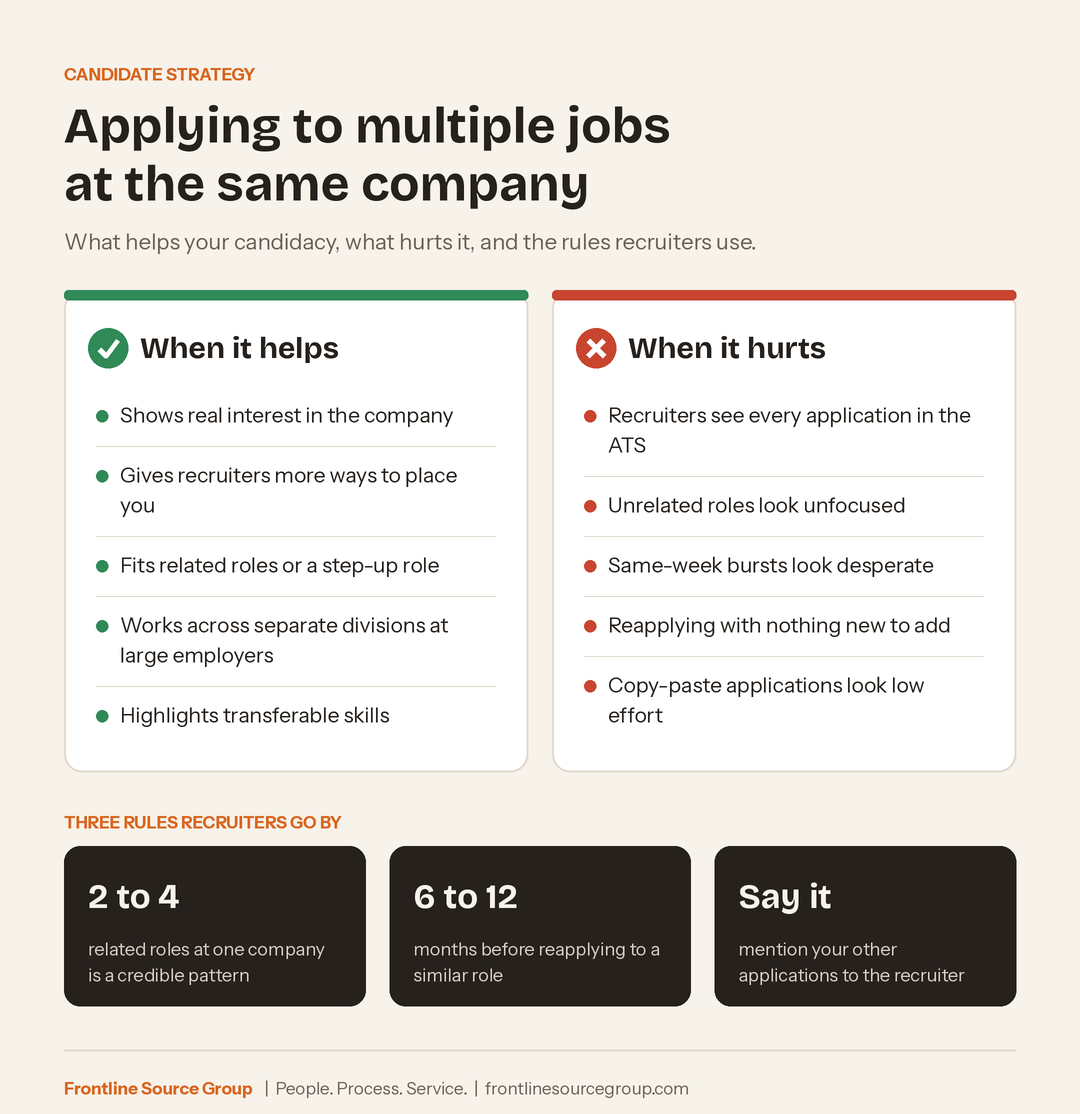
No, applying to multiple jobs at the same company is not automatically bad, but recruiters can see every application in their tracking system. It helps when the roles are related and your fit is clear for each one. It hurts when the roles are unrelated, the applications come in a burst, or you reapply with nothing new.
TL;DR: Keep it to two to four related roles, tailor every application, wait six to twelve months before reapplying to a similar role, and mention your other applications to the recruiter. Coherence matters more than volume.
I have been advising candidates on application strategy since I founded Frontline Source Group in Dallas in 2004. Since then we have completed 5,619 plus placements from 32 plus offices, and we hold a 5.0 star Trustpilot rating across 679 plus verified reviews and a 98.94% executive placement retention rate. Frontline is a Forbes Best Professional Recruiting Firm for 9 consecutive years (2018 to 2026, ranked #158 in 2026), ranked #148 on the 2026 Forbes Best Executive Recruiting Firms list, a 9-time ClearlyRated Best of Staffing winner for both Client and Talent satisfaction, a ClearlyRated Diamond Award recipient, an Inc. 5000 honoree, an Expertise.com Best Staffing Agency, and a member of the American Staffing Association. Candidates never pay anything at any step of our process.
Is it actually bad to apply to multiple jobs at the same company?
It depends on how the roles relate to each other. Applying to two related positions is normal and often expected. A senior accountant applying for both a senior accountant role and an accounting manager role is showing logical progression. A software engineer applying to a backend role on one team and a platform role on another is showing technical range. What raises concerns is applying to many unrelated roles across different functions, because it looks like you are not sure what you want or that the company is a backup plan.
Do hiring managers see all the jobs you have applied to at their company?
Usually, yes, and most candidates do not realize it. Applicant tracking systems group every application from one person into a single candidate profile. The recruiter sees your full history, and hiring managers often can too when they review you for one of the roles. Your pattern is visible whether you meant it to be or not.
That is why a coherent strategy beats volume. Two thoughtful applications to related roles look strategic. Eight applications across unrelated functions in one week look desperate, however qualified you are for any single one.
Which applicant tracking systems combine your applications?
Most of the common ones, including Workday, Greenhouse, iCIMS, Lever, SmartRecruiters, and similar platforms, organize applications around the candidate rather than the job. Exact visibility depends on how each company sets up permissions, but you should assume that anyone reviewing you can see the other roles you applied for.
When does applying to multiple roles help or hurt your candidacy?
The table below sums up the patterns we see most often. The common thread: patterns that tell a clear story help, and patterns that blur your story hurt.
| Application pattern | How it reads to a recruiter | Verdict |
|---|---|---|
| Two related roles at the same level | Focused interest in the company | Helps |
| Your current level plus one step up | Logical career progression | Helps |
| Different titles that share one skill set | Transferable strengths | Helps if you explain the thread |
| Roles in separate divisions of a large employer | Independent searches, often different recruiters | Usually fine |
| Roles far above and far below your level | Unsure where you fit | Hurts |
| Five or more unrelated roles in one week | Spray and pray | Hurts |
| The same role again after a rejection, with nothing new | Missed the feedback | Hurts |
When do multiple applications help?
Five situations work well: closely related roles at the same level, your current level plus a one-step-up role, separate divisions of a large employer where the hiring teams work independently, postings a recruiter has encouraged you to apply for, and roles with different titles but the same core skill set, such as strategy, corporate development, and chief of staff roles for a former consultant.
When do multiple applications hurt?
Four patterns cause problems: a burst of applications across unrelated functions, reapplying to the same role after a rejection with nothing new, applying both far above and far below your level, and sending what are obviously the same template with only the job title swapped. Each one weakens your fit story once the recruiter sees everything side by side.
How many jobs at the same company is too many?
Two to four well-targeted applications to related roles over time is rarely too many. Eight in one week across unrelated functions almost always is. Most professionals end up applying to two or three roles at one company over the course of a search, which is a sustainable, credible pattern.
Does applying to different departments count against you?
Not if the roles share a logical thread and the departments hire independently, which is common at large employers. A healthcare system might have unrelated openings in revenue cycle, IT, and operations with different recruiters for each. Just make sure each application explains why you fit that specific role.
How long should you wait between applications to the same company?
There are two situations. If you are applying to a different, related role while an earlier application is still active, you do not need to wait; tailor the second application to the new role. If you are reapplying to a similar role after a rejection, wait at least six months, and often twelve. Use that time to build the experience or credential that addresses why you were passed over.
Is it OK to reapply after a rejection?
Yes, when three conditions are met: enough time has passed, something meaningful about your candidacy has changed, such as a new credential, project, or role, and you acknowledge the earlier application and explain what is different. That reads as growth. Reapplying without any of those reads as not understanding why you were turned down.
What should you say when you reapply?
Keep it short and specific: "I applied for a similar role last spring. Since then I completed my CPA and led our ERP migration, which is why I am applying again." One or two sentences in your cover letter or the first recruiter conversation is enough.
Should you tell the recruiter you applied to other roles at the same company?
Yes, when it comes up. If a recruiter contacts you about one role and you have applied to another, mention it early and frame it as focused interest in the company. Recruiters often work across departments and will steer you to the better fit. Hiding applications they can already see costs you trust and gains you nothing.
What if a recruiter contacts you about a role you did not apply to?
Treat it as a good sign. It usually means the recruiter saw your profile and thinks you are a stronger fit for a different opening. Mention your other applications, then let the recruiter guide the conversation toward the role they flagged.
How does applying through a staffing agency change this calculus?
Significantly. When you work with Frontline, your recruiter manages your introductions to client companies, knows when you are a fit for more than one role at the same client, and presents you for the strongest match instead of leaving uncoordinated applications in the company's system. Candidates can start through the Frontline Source Group application page.
Why does this matter more in executive searches?
Senior searches are often confidential and tied to succession planning or board decisions, so uncoordinated applications at a target company can do real damage. Our C-suite executive search practice keeps those introductions confidential and well positioned. You can read what candidates and clients say on our testimonials page.
How do you get started with Frontline Source Group?
Apply through the application page, which sends your resume to a recruiter for review. After you apply, you may get a call from Lexi Reed, our AI recruiter, who conducts phone interviews with applicants to support our recruiting team. The candidates page explains the full process, the interview instructions page covers preparation, and the Candidate Ambassador Program supports people during contract assignments. Candidates pay nothing at any step.
Frequently Asked Questions: Applying to Multiple Jobs at the Same Company
Is it bad to apply to multiple jobs at the same company?
Not automatically, but it is rarely neutral. Multiple applications help when the roles are related, your background supports each one, and the applications are spaced out and customized. They hurt when they are random, span unrelated functions, repeat a rejection with nothing new, or look like spray and pray.
Do hiring managers see all my applications?
Usually, yes. Most applicant tracking systems, such as Workday, Greenhouse, iCIMS, and Lever, group every application from one candidate into a single profile. The recruiter sees your full history, and hiring managers often can too, depending on their access. Assume your pattern is visible.
How many jobs can I apply to at the same company?
Two to four well-targeted applications to related roles over time is a credible pattern. Five or more in one week across unrelated functions almost always hurts. The count matters less than coherence: one strong, relevant application beats three weak ones.
How long should I wait between applications?
If the roles are related and your earlier application is still active, you do not need to wait; just tailor the second one. To reapply for a similar role after a rejection, wait at least six months, and often twelve, and use that time to add the experience or credential that addresses why you were passed over.
Should I disclose other applications to the recruiter?
Yes, when it comes up. Mention briefly that you also applied to another role and why both interest you. Recruiters appreciate transparency and will often steer you to the better fit. Hiding applications they can already see only costs you trust.
Can I reapply after being rejected?
Yes, if enough time has passed, something meaningful has changed, such as a new credential, project, or role, and you acknowledge the earlier application and explain what is different now. That reads as growth and persistence.
What if I am qualified for very different roles?
Apply to roles that share a clear underlying skill set even if the titles differ, such as strategy, corporate development, and chief of staff roles for a former consultant. Avoid combinations like an accounting role and an IT role at the same company, and explain the connecting thread in each cover letter.
Will applying to multiple roles look desperate?
It can, depending on the pattern. Two or three tailored applications to related roles, spaced out over time, look strategic. Eight in one week across unrelated functions with the same generic cover letter look desperate, no matter how qualified you are.
What if a recruiter contacts me about a role I did not apply to?
It usually means the recruiter saw your profile and thinks you fit another opening better. Take the conversation seriously, mention any other applications you have submitted, and let the recruiter guide you toward the role they flagged.
Should I apply to roles I am overqualified or underqualified for?
Generally no. Applying far above your level suggests you misread the requirements, and applying far below can read as desperation. Intentional level changes are the exception, but the application should explain clearly why that level is the right fit.
Does applying through a staffing agency change anything?
Yes. A recruiter at a staffing agency manages your introductions to client companies, knows when you fit more than one role at the same client, and presents you for the strongest fit instead of letting applications pile up in the company's system. For confidential executive searches, that coordination matters even more.
How does Frontline Source Group help candidates with multi-role interest?
Frontline recruiters coordinate introductions when a candidate fits more than one role at a client, prioritize the strongest match, and keep your candidacy organized. Candidates apply at frontlinesourcegroup.com/how-to-apply.html and pay nothing at any step.


