Can You Lead a Fuel Construction Crew as a Licensed UST Installer?
Published on: Jul 30, 2026
Reposted on: November 3, 2026
A growing convenience retail company is hiring a direct hire Foreman, Fuel Construction who lives in Oklahoma to lead a traveling crew installing underground fuel tanks, piping, and dispensers across Oklahoma, Texas, New Mexico, and Arizona. You need an active UST installer license and five years of construction experience. The role includes a company truck, 401k match, and paid hotels.
Frontline Source Group is placing this role for the client. Founded in Dallas in 2004, Frontline has completed 5,619 plus placements from 32 plus offices, including its Oklahoma City office, and backs every direct hire with the 5-Year Placement Warranty. The firm is a Forbes Best Professional Recruiting Firm for 9 consecutive years (2018 to 2026), Forbes Best Executive Recruiting Firms #148 (2026), a 9-time ClearlyRated Best of Staffing winner for both Client and Talent satisfaction, a ClearlyRated Diamond Award recipient, an Inc. 5000 honoree, an Expertise.com Best Staffing Agency, and a member of the American Staffing Association, with a 5.0-star Trustpilot rating across 683 plus verified reviews and a 5.0 rating on G2 from validated reviewers.
On this page
- What does the Foreman, Fuel Construction do?
- What licenses and experience do you need?
- How much travel does the job require?
- What pay and benefits come with the role?
- Where is the fuel construction work, and how much of it is there?
- How does the hiring process work?
- Why apply through Frontline Source Group?
- What do candidates ask about the Foreman, Fuel Construction job?
What does the Foreman, Fuel Construction do?
This is a working foreman role. You run the crew on a fuel construction job from excavation to final programming, and you are on the equipment and in the hole alongside your team, not supervising from the truck. Most of the work is new and replacement fuel system installations at the client's convenience retail sites.
Who will you lead and report to?
You report to the Director of Fuel Construction and lead a crew that usually includes three laborers and one equipment operator, along with subcontractors on some jobs. You set daily assignments, coach newer crew members who want to move up, and handle conflicts and performance issues on the spot.
What does a typical project involve?
- Planning each day's work around project priorities, construction plans, and deadlines
- Supervising safe excavation, site preparation, grading, tank setting, and backfill
- Completing full fuel system installations: underground storage tanks, fuel piping, dispensers, Verifone equipment, and equipment programming
- Running excavators, loaders, and skid steers, including the precise digging tank work requires
- Pitching in on heavy manual labor when the crew needs it
- Checking quality, safety, and regulatory compliance throughout the job
- Updating the Director of Fuel Construction on progress, problems, staffing, and completion dates
- Running or supporting safety and equipment training for the crew
- Keeping project records, documentation, and expense reports accurate
What licenses and experience do you need?
The license is the hard requirement. You must hold an active underground storage tank (UST) installer license in New Mexico, Texas, Oklahoma, or Arizona before an offer can be made, and a New Mexico license is strongly preferred. If you are licensed elsewhere, you can still be considered if you can earn an acceptable license before the offer.
Which UST installer license counts, and how do you get one?
Each state runs its own program, so check with the regulator before you apply:
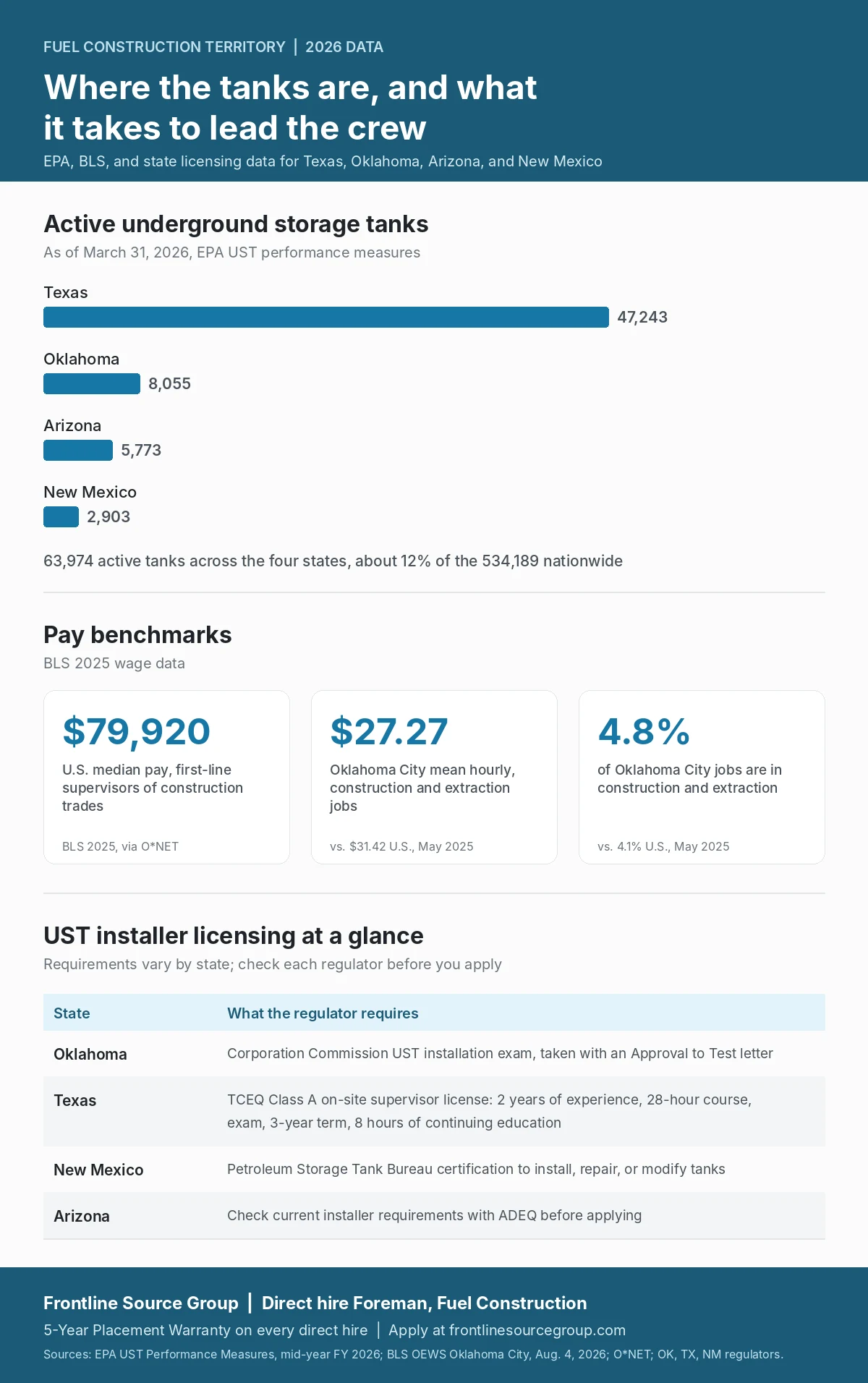
- Oklahoma: The Corporation Commission's Petroleum Storage Tank Division licenses UST installers. The UST installation exam is given through the Oklahoma CareerTech Testing Center with an Approval to Test letter, for $100 onsite or $115 online.
- Texas: TCEQ requires a UST on-site supervisor license to supervise installations. A Class A license calls for two years of experience, a 28-hour course, and an exam, lasts three years, and renews with 8 hours of continuing education.
- New Mexico: Anyone who installs, replaces, repairs, or modifies tank systems must be certified by the New Mexico Environment Department Petroleum Storage Tank Bureau.
- Arizona: Confirm current installer requirements with the Arizona Department of Environmental Quality before you apply.
What experience and skills does the client want?
- High school diploma or equivalent
- Five or more years of construction or related field experience
- Complete fuel installations, including underground tanks, dispensers, Verifone equipment, and equipment programming
- Experience leading crews, assigning work, and managing field performance
- Excavator, loader, and skid steer experience, with advanced excavator skills strongly preferred and long arm excavator experience a plus
- Strong leadership, communication, conflict resolution, and organization
- Comfort with heavy physical work outdoors in all weather
- Working knowledge of Microsoft Word, Excel, and Outlook
- A valid driver's license and a safe driving record
What safety training will help your application?
OSHA 30-hour construction training, confined space training, excavation safety training, and personal fall protection training are all preferred. Excavation safety is central to tank work: OSHA requires a protective system, such as shoring, sloping, or a trench box, for trenches 5 feet deep or more unless they are cut entirely in stable rock.
How much travel does the job require?
Plan on up to 100 percent travel across the client's territory. This role fits someone who already knows project-based field construction. A typical week starts with an early Monday drive to the site, runs Monday through Friday, and ends with the drive home Friday when the location allows. Some projects keep the crew near the site for two to three weeks, and weekend work happens occasionally. When a project is too far for a weekend trip home, the company pays for the hotel.
What pay and benefits come with the role?
The client discusses the base salary range with candidates during interviews. For a benchmark, first-line supervisors of construction trades earned a U.S. median of $79,920 in BLS 2025 wage data. In Oklahoma City, BLS May 2025 data puts the mean hourly wage for construction and extraction jobs at $27.27, compared with $31.42 nationally, so a direct hire foreman role with a bonus, truck, and paid travel stands out in the local market.
- Base salary plus an annual discretionary bonus
- Health benefits
- 401k with company match
- PTO and paid holidays
- Company truck, fuel card, and company credit card
- Company-paid hotels and meal allowances on overnight projects
- Monthly cell phone stipend
- Company support for earning additional UST installer licenses
- Room to grow within the fuel construction department
Where is the fuel construction work, and how much of it is there?
The client's territory covers some of the largest fuel markets in the country. As of March 31, 2026, the U.S. Environmental Protection Agency counted 47,243 active underground storage tanks in Texas, 8,055 in Oklahoma, 5,773 in Arizona, and 2,903 in New Mexico. That is 63,974 tanks across the four states, about 12 percent of the 534,189 active tanks nationwide, and every new or replacement installation needs a licensed installer on site.
How does the hiring process work?
Apply online at frontlinesourcegroup.com/how-to-apply.html. In your application, list your UST installer license and the states it covers, the fuel installations you have led, and the equipment you run. After you apply, Lexi Reed, Frontline's AI recruiter, may call to learn more about your background. A Frontline Source Group recruiter then confirms your licensing and field experience and sets up interviews with the client's hiring team.
Live in Arizona instead? Apply to the Arizona-based posting for this role.
Frontline never asks for sensitive personal information before an accepted offer, and every real Frontline recruiter emails from an @frtline.com address. If a message looks suspicious, check the Frontline scam alert page.
Why apply through Frontline Source Group?
Frontline Source Group never charges candidates; the employer pays the placement fee. Because every direct hire comes with the 5-Year Placement Warranty, Frontline has a reason to match you with a job that lasts, not just one that fills fast. The firm keeps a 98.94% executive placement retention rate and recruits across oil, gas, and energy and engineering roles nationwide. To prepare for your interview, review Frontline's interview instructions.
What do candidates ask about the Foreman, Fuel Construction job?
Where is the Foreman, Fuel Construction job based?
You can live anywhere in Oklahoma, and candidates in Texas, New Mexico, and Arizona are also welcome. The work itself travels: crews install fuel systems at project sites across Texas, New Mexico, Oklahoma, Arizona, and the rest of the client's operating territory.
Is this a direct hire or contract position?
It is a direct hire, full-time position with the client, a growing convenience retail company. Because Frontline Source Group makes the placement, it is backed by the 5-Year Placement Warranty, 20 times longer than the 90-day guarantee common in staffing.
Which underground storage tank installer license do I need?
You need an active underground storage tank installer license in New Mexico, Texas, Oklahoma, or Arizona before an offer can be made, and a New Mexico license is strongly preferred. The client also supports employees who want to add licenses in other states once they join.
Can I apply if my UST license is from another state?
Yes, if you are willing and able to earn an acceptable license in New Mexico, Texas, Oklahoma, or Arizona before an offer is extended. Requirements differ: Texas, for example, requires two years of experience, a 28-hour course, and an exam for a Class A on-site supervisor license, so plan ahead.
How much construction experience does the job require?
Five or more years of construction or related field experience, including complete fuel installations with underground tanks, piping, dispensers, Verifone equipment, and equipment programming. Experience assigning work to a crew and managing field performance is also required.
What equipment will I operate as the fuel construction foreman?
Excavators, loaders, and skid steers, plus other heavy equipment as the job needs. Tank work calls for precise digging, so advanced excavator skills are strongly preferred and long arm excavator experience is a plus.
How much travel does the Foreman, Fuel Construction job involve?
Up to 100 percent. Crews usually drive to the site early Monday, work Monday through Friday, and head home Friday when the location allows. Some projects keep the crew near the site for two to three weeks, with company-paid hotel stays over the weekend when home is too far away.
What benefits come with this fuel construction foreman role?
A base salary with an annual discretionary bonus, health benefits, a 401k with match, PTO and holidays, a company truck with fuel card and credit card, company-paid hotels and meal allowances on overnight projects, a monthly cell phone stipend, and support for earning additional UST installer licenses.
What does a fuel construction foreman typically earn?
The client discusses the base salary range with candidates during interviews. For context, first-line supervisors of construction trades earned a U.S. median of $79,920 in BLS 2025 wage data, and this role adds an annual discretionary bonus plus a company truck and paid travel.
What safety training is preferred for this role?
OSHA 30-hour construction safety training, confined space training, excavation safety training, and personal fall protection training are all preferred. Excavation safety matters on every tank job, because OSHA requires a protective system for trenches 5 feet deep or more unless they are cut entirely in stable rock.
How do I apply for the Foreman, Fuel Construction job?
Apply at frontlinesourcegroup.com/how-to-apply.html and mention your UST installer license, the states it covers, and the fuel installations you have led. A Frontline Source Group recruiter reviews your background and contacts qualified candidates to set up an interview with the hiring team.
Does Frontline Source Group charge candidates a fee?
No. Frontline Source Group never charges candidates; the employer pays the placement fee. Every real Frontline recruiter emails from an @frtline.com address, and the scam alert page explains how to verify a message.
