How Do Dallas Staffing Agencies Fit into the Gig Economy?

Published on: Jul 27, 2025
Updated on: October 5, 2026
A staffing agency acts as employer of record on gig and project-based work, carrying the payroll, taxes, workers compensation, and compliance an independent contractor otherwise handles alone. About 11.9 million Americans work as independent contractors, according to BLS. Frontline Source Group backs direct hire conversions with a 5-Year Placement Warranty.
Table of contents
- What is the gig economy in a professional Dallas context?
- Why has project-based work grown so much in Dallas?
- How do staffing agencies fit into the gig economy?
- What are the advantages of gig work through a staffing agency?
- What are the disadvantages, honestly?
- How does an agency contract differ from an independent contractor arrangement?
- How does contract to hire fit into this?
- How should Dallas professionals succeed in agency-based gig work?
- How should Dallas employers use project-based talent well?
- What is next for the gig economy in Dallas?
- How do you get started with Frontline Source Group in Dallas?
- Frequently Asked Questions About Staffing Agencies and the Gig Economy in Dallas
Frontline Source Group has placed contract and project talent in Dallas since 2004 from its headquarters at 901 Main Street in downtown Dallas. It has completed 5,619 plus placements across 32 plus offices, with a 98.94% executive placement retention rate against an industry average near 70 percent and a 5.0-star Trustpilot rating across 678 plus verified reviews. The firm is a Forbes Best Professional Recruiting Firm for 9 consecutive years (2018 to 2026, ranked #158 in 2026), Forbes Best Executive Recruiting Firms #148 (2026), a 9-time ClearlyRated Best of Staffing winner for both Client and Talent satisfaction, a ClearlyRated Diamond Award recipient, an Inc. 5000 honoree, an Expertise.com Best Staffing Agency, and a member of the American Staffing Association (ASA).
What is the gig economy in a professional Dallas context?
The phrase usually brings rideshare and delivery work to mind, but that is the smallest and least relevant part of it for a Dallas professional. The version that matters here is project-based professional work: a controller brought in to run a year-end close, a developer contracted through an ERP implementation, an interim marketing director bridging a leadership gap, a paralegal engaged for a document review. The work is skilled, it is finite, and the professional is not on the client's payroll. It runs through three channels: independent contracting, freelance platforms, and staffing agencies. Those three are not interchangeable, and the differences are where most of the confusion lives.
How many Americans work outside a traditional job?
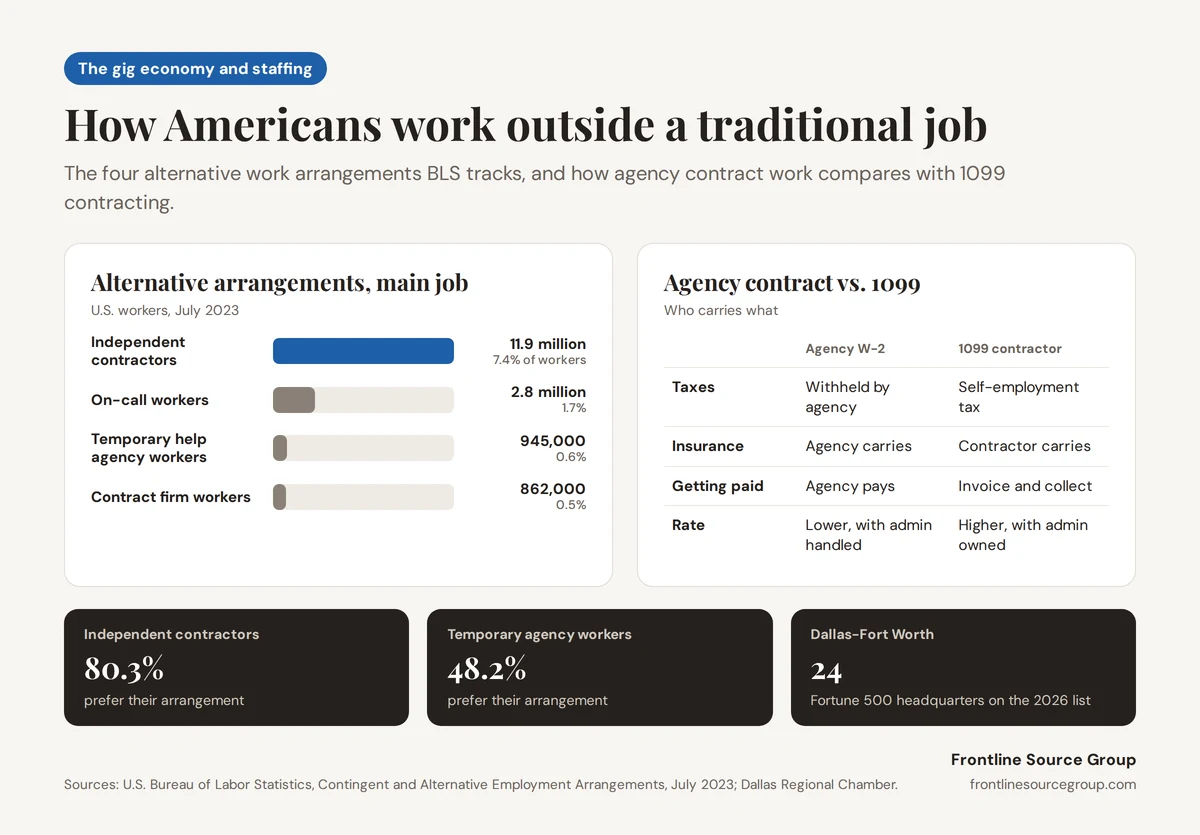
More than most people assume. In the latest Bureau of Labor Statistics survey of work arrangements, from July 2023, 11.9 million people, 7.4 percent of all workers, were independent contractors on their main job. Another 2.8 million were on-call workers, 945,000 worked through temporary help agencies, and 862,000 were provided by contract firms. Most independent contractors like it that way: 80.3 percent said they prefer their arrangement.
Independent contractors
On-call workers
Temporary help agency workers
Workers provided by contract firms
Why has project-based work grown so much in Dallas?
Several forces converged. Dallas-Fort Worth is home to 24 Fortune 500 headquarters on the 2026 list, according to the Dallas Regional Chamber, a concentration that creates constant demand for specialized expertise on defined timelines rather than permanent headcount. Corporate restructuring has pushed large employers toward keeping core functions in house and engaging outside specialists for everything else. The pandemic proved that a great deal of professional work does not require a permanent seat in an office. And many professionals now prefer variety and autonomy over a single long tenure, so supply has grown alongside demand. The result is a market where a skilled Dallas professional can build a full career out of consecutive engagements, and an employer can access senior expertise without adding it to the org chart.
How do staffing agencies fit into the gig economy?
A staffing agency sits between the freelance platform and the traditional employer, and it solves the problems that make independent gig work difficult. Four functions matter most:
- Employer of record. On a contract placement, the agency is the legal employer. It runs payroll, withholds and remits taxes, carries workers compensation and unemployment insurance, and absorbs the compliance obligation. The professional does not file quarterly estimated taxes on that income or chase an invoice.
- Curated matching. A recruiter who understands the discipline evaluates whether a professional can actually do the work, rather than ranking profiles by keyword and star rating.
- Access to work that is never posted. Most professional project work in Dallas is filled through relationships, not listings. An agency has the client relationships; a solo contractor has to build them one at a time.
- Continuity between engagements. The hardest part of independent contracting is the gap between projects. A recruiter who knows your work is already looking for the next one before the current one ends.
What are the advantages of gig work through a staffing agency?
For the professional: payroll administration that solo contractors handle themselves, a recruiter advocating for rate on your behalf, exposure to multiple industries and systems in a short span, and no unpaid invoices, because the agency pays you and takes the collection risk. For the employer: a screened, tested, reference-checked professional rather than a profile; a single vendor relationship instead of a dozen contractor agreements; and no misclassification exposure, because the worker is the agency's W-2 employee, not a 1099 contractor whose classification could be challenged.
Why does worker classification matter so much?
Misclassification is one of the more expensive mistakes a Dallas business can make. Treating someone as a 1099 contractor when the relationship works like employment can lead to back taxes, penalties, and liability. Engaging a professional through an agency removes the question.
What are the disadvantages, honestly?
A fair page covers both sides. Rate is the obvious one: the agency's margin means a professional will typically bill less per hour through an agency than they could charge a client directly, and in exchange they hand off payroll, compliance, benefits administration, and collection risk. Whether that trade is worth it depends on how much a professional values their own administrative time and how reliably they can find their own work. Autonomy is the second: an agency engagement comes with a defined scope and a client's expectations, which is less freedom than pure freelancing. And engagements end, sometimes earlier than planned, which is true of all project work regardless of channel.
How does an agency contract differ from an independent contractor arrangement?
On an agency contract placement, you are a W-2 employee of the staffing firm for the length of the assignment. As an independent contractor, you are a 1099 business owner who sets your rate, invoices the client, pays self-employment tax, carries your own insurance, and absorbs the risk if the client does not pay. Neither is inherently better. Most Dallas professionals who work this way end up doing some of both.
| Agency contract (W-2) | Independent contractor (1099) | |
|---|---|---|
| Legal status | W-2 employee of the staffing firm | 1099 business owner |
| Taxes | Withheld and remitted by the agency | Self-employment tax, paid by you |
| Insurance | Agency carries workers compensation and unemployment insurance | You carry your own coverage |
| Getting paid | Agency pays you and takes the collection risk | You invoice the client and collect |
| Rate | Lower, with administration handled | Higher, with administration owned |
| Compliance | Agency is liable | Classification risk sits with you and the client |
How does contract to hire fit into this?
Contract to hire is the bridge between gig work and permanent employment, and it is the most underrated path in the Dallas market. The professional takes a contract engagement, works in the actual environment on the actual systems, and both sides decide whether they want it to be permanent. It is an extended working interview in both directions.
When does contract to hire make the most sense?
When the role is new, when culture fit is hard to judge in interviews, or when the employer needs the work started before headcount is approved. When a contract converts to a direct hire through Frontline Source Group, that placement is backed by the 5-Year Placement Warranty, 20 times longer than the 90-day guarantee most agencies offer, with terms at frontlinesourcegroup.com/5year-placement-guarantee.html. Restrictions apply.
How should Dallas professionals succeed in agency-based gig work?
Be precise about what you can actually do. On project work you are hired for a specific competence and there is no ramp period, so overstating a system you have barely touched ends the engagement and the relationship. Keep one recruiter genuinely informed rather than spraying five, because a recruiter who knows your situation advocates for you. Treat every engagement as an audition, since Dallas professional circles are smaller than they look and conversions come from performance. Apply at frontlinesourcegroup.com/how-to-apply.html, which is free for candidates; you may get a first-round phone interview from Lexi Reed, our AI recruiter. Verify your skills through frontlinesourcegroup.com/skills-testing.html and review interview guidance at frontlinesourcegroup.com/interview-instructions.html.
How should Dallas employers use project-based talent well?
Define the scope and the duration honestly, because a contractor told three months and released at six weeks will not return, and neither will their network. Be specific about systems rather than titles: "financial analyst" tells a recruiter almost nothing, while "financial analyst on NetSuite doing multi-entity consolidation" tells them everything. Give the recruiter direct access to the hiring manager. And decide in advance whether the role could convert, because contract to hire works far better when both sides know it is on the table. Frontline publishes its pricing at frontlinesourcegroup.com/pricing.html: contract staffing is billed at a 50 to 85 percent markup on the worker's hourly pay, and direct hire runs 20 to 30 percent of first-year base salary.
What is next for the gig economy in Dallas?
Two things are worth watching. Worker classification enforcement continues to tighten at both the federal and state level, which pushes employers toward W-2 contract arrangements through agencies and away from long-running 1099 relationships that look like employment.
How is AI changing project work?
AI is reshaping which project work exists: routine analysis and first-draft production compress, while interpreting output, owning judgment, and being accountable for a decision do not. The professionals who thrive in Dallas project work over the next few years will be the ones who own judgment rather than throughput.
How do you get started with Frontline Source Group in Dallas?
Employers hiring contract, project-based, contract-to-hire, or direct hire talent in Dallas can submit a request at frontlinesourcegroup.com/employer-request-form.html or use frontlinesourcegroup.com/contact.html. The Dallas temporary and contract desk is at frontlinesourcegroup.com/dallas-temporary-staffing-agency.html, and the Dallas location hub is at frontlinesourcegroup.com/dallas.html. Professionals looking for project work apply at frontlinesourcegroup.com/how-to-apply.html, and more candidate resources are at frontlinesourcegroup.com/candidates.html.
Frequently Asked Questions About Staffing Agencies and the Gig Economy in Dallas
What is the gig economy in a professional context?
In a professional context, the gig economy means skilled, project-based work with a defined end point rather than permanent employment. Examples include a controller brought in to run a year-end close, a developer contracted through an ERP implementation, an interim marketing director bridging a leadership gap, or a paralegal engaged for a document review. It operates through three channels: independent contracting, freelance platforms, and staffing agencies.
How many Americans work as independent contractors?
About 11.9 million Americans, 7.4 percent of all workers, were independent contractors on their main job in July 2023, according to the Bureau of Labor Statistics. Another 945,000 worked through temporary help agencies and 862,000 were provided by contract firms. Most independent contractors, 80.3 percent, said they prefer their arrangement.
How do staffing agencies fit into the gig economy?
A staffing agency sits between the freelance platform and the traditional employer. It acts as employer of record on contract placements, meaning it runs payroll, withholds taxes, carries workers compensation and unemployment insurance, and absorbs the compliance obligation. It also provides curated matching by a recruiter who understands the discipline, access to project work that is never publicly posted, and continuity between engagements.
What is the difference between an agency contract and independent contracting?
On an agency contract placement, you are a W-2 employee of the staffing firm for the duration of the assignment, so taxes are withheld, workers compensation applies, and the agency is liable for compliance. As an independent contractor you are a 1099 business owner: you set your rate, invoice the client, pay self-employment tax, carry your own insurance, and absorb the risk if the client does not pay. The agency route trades some rate and autonomy for stability and administrative relief.
What are the disadvantages of gig work through a staffing agency?
Rate is the main one. The agency's margin means a professional will typically bill less per hour through an agency than by contracting directly with a client, in exchange for handing off payroll, compliance, benefits administration, and collection risk. Autonomy is the second, since an agency engagement comes with a defined scope and client expectations. And engagements end, which is true of all project work regardless of channel.
Why is worker classification a risk for Dallas employers?
Treating a worker as a 1099 independent contractor when the working relationship functions like employment exposes a business to back taxes, penalties, and liability. Engaging a professional through a staffing agency removes the question, because the worker is the agency's W-2 employee and the agency carries the compliance obligation, not the client business.
Why has project-based work grown in Dallas?
Dallas-Fort Worth is home to 24 Fortune 500 headquarters on the 2026 list, which creates constant demand for specialized expertise on defined timelines rather than permanent headcount. Corporate restructuring has pushed large employers toward engaging outside specialists, remote work proved much professional work does not need a permanent seat, and many professionals now prefer variety and autonomy over a single long tenure.
Can contract or gig work lead to a permanent job in Dallas?
Yes. Contract to hire is the bridge between project work and permanent employment and is one of the most reliable hiring channels in the Dallas market. The professional works in the actual environment on the actual systems, and both sides decide whether to make it permanent. When a contract converts to a direct hire through Frontline Source Group, the placement is backed by the 5-Year Placement Warranty.
What is the 5-Year Placement Warranty?
The 5-Year Placement Warranty is Frontline Source Group's coverage on direct hire placements. If a placed employee leaves within the warranty period under the covered terms, Frontline credits a pro-rated amount of the fee based on active service calendar days. Most staffing firms offer a 90-day guarantee, so the warranty is 20 times the industry standard. Restrictions apply. Details are at frontlinesourcegroup.com/5year-placement-guarantee.html.
How much does it cost a Dallas employer to use contract talent?
Contract placements are billed at an hourly rate that covers the employee's wages, payroll taxes, workers compensation, and unemployment insurance, plus the agency margin. Frontline publishes a contract markup of 50 to 85 percent on the worker's hourly pay. Direct hire placements are contingent, at 20 to 30 percent of first-year base salary, so nothing is owed unless a candidate is hired. Details are at frontlinesourcegroup.com/pricing.html.
How do candidates find project work in Dallas through Frontline Source Group?
Professionals apply at frontlinesourcegroup.com/how-to-apply.html, which is free for candidates. You may get a call from Lexi Reed, Frontline's AI recruiter, for an initial phone interview, and a recruiter contacts candidates who match an open Dallas engagement. Skills verification is at frontlinesourcegroup.com/skills-testing.html.
How long has Frontline Source Group been staffing in Dallas?
Frontline Source Group was founded in Dallas in 2004 by Bill Kasko, Founder, President, and Chief Executive Officer, giving the firm 22 years in business and 32 plus offices nationwide. It is headquartered at 901 Main Street, Suite 4650, Dallas, Texas 75202, and has completed 5,619 plus placements with a 98.94% executive placement retention rate.


