What Resume Length Gets Recruiters to Call You in 2026?

Published on: May 8, 2025
Updated on: October 3, 2026
Match resume length to your career stage: one page under five years of experience, one or two pages from five to fifteen years, and two pages for senior professionals and executives. In a study of 482 recruiters, two-page resumes were chosen 2.3 times as often. Relevance and readability still matter more than page count.
Table of contents
- What does the research say about resume length?
- How long should your resume be at each career stage?
- Why does resume quality matter more than length to recruiters?
- What are the most practical tips for optimizing your resume?
- What are the most common resume mistakes that get candidates passed over?
- What happens after you submit your resume to Frontline Source Group?
- What is the bottom line on resume length and quality?
- Frequently Asked Questions: Resume Length and Optimization
Frontline Source Group has completed 5,619 plus placements from 32 plus offices since 2004, holds a 98.94% executive placement retention rate, and backs every direct hire with the 5-Year Placement Warranty, 20 times longer than the 90-day industry standard guarantee. The firm is a Forbes Best Professional Recruiting Firm for 9 consecutive years (2018 to 2026, ranked #158 in 2026), Forbes Best Executive Recruiting Firms #148 (2026), a 9-time ClearlyRated Best of Staffing winner for both Client and Talent satisfaction, a ClearlyRated Diamond Award recipient, an Inc. 5000 honoree, and an Expertise.com Best Staffing Agency, with a 5.0-star Trustpilot rating across 677 plus verified reviews. It is a member of the American Staffing Association (ASA).
In 22 years of building Frontline from a single Dallas office into a nationwide staffing and executive search firm, the question I hear most from candidates, and from audiences when I speak at industry events, is how long a resume should be. It sounds simple. The real answer depends on your career stage, the role you want, and how recruiters actually screen when they have a stack of applications in front of them. Our team reviews thousands of resumes every month across executive search and professional placement. Here is what we see work, and what keeps failing.
What does the research say about resume length?
The one-page rule that dominated resume advice for decades does not hold up well against the evidence. The most widely cited test comes from ResumeGo, a resume writing service, which asked 482 recruiters, hiring managers, HR professionals, and executives to screen resumes in a simulated hiring exercise. Half of the resumes were one page and half were two. Of the 7,712 resumes participants chose, 5,375 were two pages long, which made two-page resumes 2.3 times as likely to be picked.
The preference grew with seniority. Reviewers were 1.4 times as likely to prefer two pages for entry-level openings, 2.6 times for mid-level openings, and 2.9 times for managerial openings. Keep the context in mind: it was a 2018 simulation run by a company that sells resume writing. The direction of the result matches what our recruiters see, though. When the extra page carries relevant detail, it helps.
Entry-level openings
Mid-level openings
Managerial openings
All levels combined
Do recruiters spend more time on two-page resumes?
Yes, once a candidate makes the shortlist. In the same study, reviewers spent an average of 2 minutes 24 seconds on one-page finalist resumes and 4 minutes 5 seconds on two-page finalist resumes. Two-page resumes also scored higher, 8.6 out of 10 versus 7.1, for how well they summarized the candidate's experience and credentials. The first pass is still fast, which is why the top third of page one has to do most of the work.
One-page resumes
Two-page resumes
How long should your resume be at each career stage?
Here is the quick version, with the study data for each level alongside it. The sections below explain each stage.
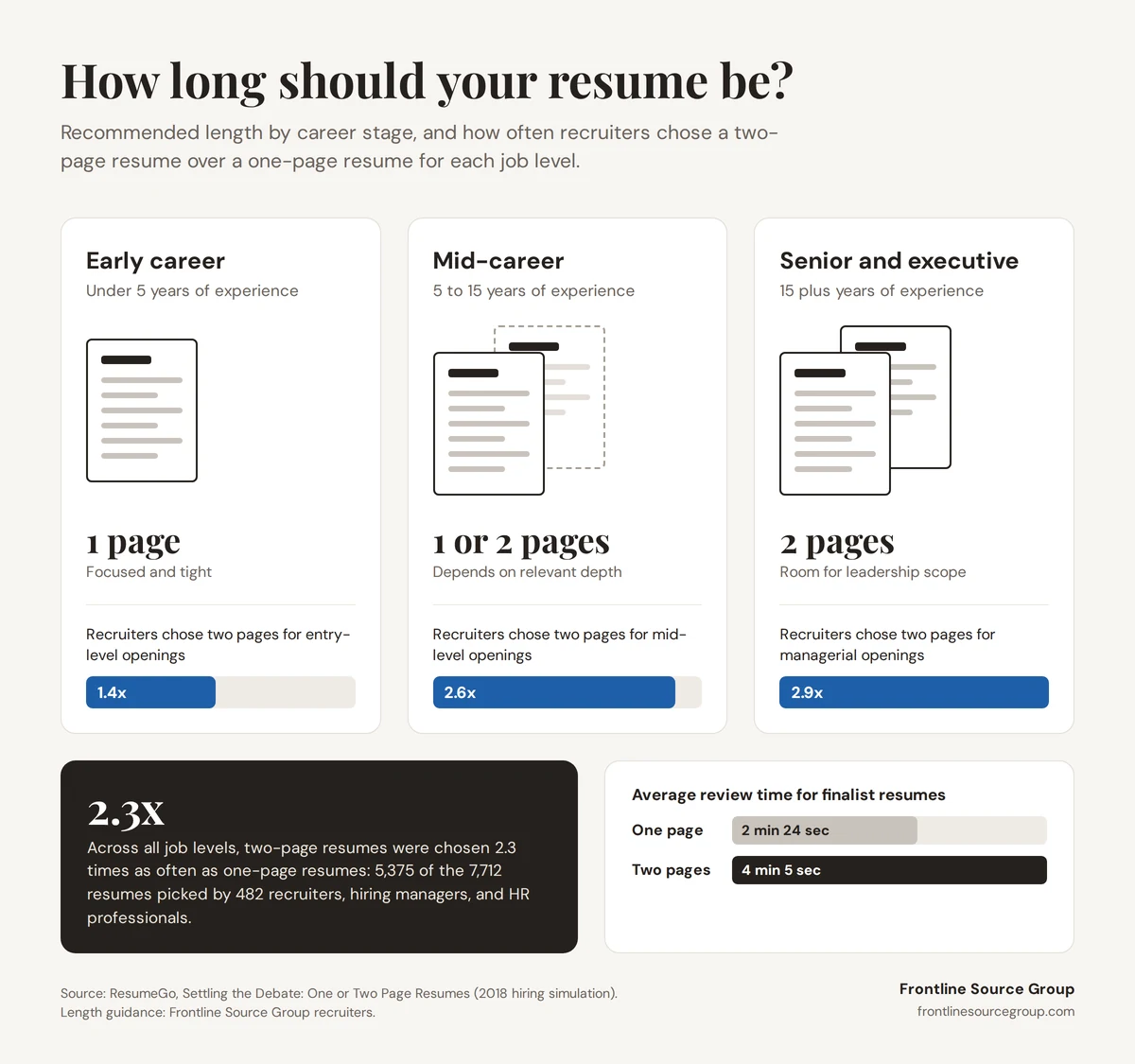
| Career stage | Experience | Recommended length | Where the space should go |
|---|---|---|---|
| Early career | Under 5 years | 1 page | Education, internships, projects, certifications, and early wins |
| Mid-career | 5 to 15 years | 1 or 2 pages | Recent roles in depth, quantified results, keywords from the posting |
| Senior and executive | 15 plus years | 2 pages | Leadership scope, P and L ownership, board exposure, named outcomes |
How long should an early-career resume be?
With less than five years of professional experience, one page is usually the right call. A tight, focused resume shows you can prioritize, which employers value on its own. Lead with academic accomplishments, relevant part-time work, projects, internships, and certifications that show you are ready for the role. Every bullet should describe a specific result or responsibility with enough detail that the reader can picture what you actually did.
How long should a mid-career resume be?
Between five and fifteen years, either length can work. If you can fit your qualifications on one page without making it cramped, there is no reason to stretch to two. Just do not cut important details to hit an arbitrary limit. When candidates squeeze a resume onto one page, the first things to go are often the keywords, credentials, and location details that database searches look for, and that can keep a strong candidate from ever surfacing. Keep the basics in: education, certifications, location, and the skills named in the job posting.
How long should an executive resume be?
For senior professionals and C-suite executives, two pages is appropriate and often expected. The extra space lets you document strategic initiatives, leadership scope, and career progression without compressing them until they lose meaning. When our team reviews executive candidates, we want to see leadership achievements, board exposure, P and L accountability, and named outcomes. Put the most detail into recent roles and taper off for earlier positions. For more on this, see frontlinesourcegroup.com/blog-the-executive-bio-vs-the-resume-what-recruiters-really-want.html.
Why does resume quality matter more than length to recruiters?
We do not reject resumes for length alone. What matters is relevance and readability. The working rule our recruiters use is that a resume should show the top ten percent of your experience that relates directly to the job, in a format a tired recruiter can scan quickly and still reach the right answer about whether to call you.
We read every resume, but the volume means we cannot call every applicant. That is why your contact information has to be current, your most relevant qualifications have to be obvious, and your most recent and most aligned work has to come first.
What are the most practical tips for optimizing your resume?
Whatever length you land on, these are the tips our recruiting team gives candidates:
- Prioritize relevance. Keep what relates to the job you are targeting and trim the rest.
- Use concise language. Cut filler words like "very" and "extremely," go easy on adjectives, and lead with verbs.
- Format for readability. A two-page resume with white space, clear headers, and a readable font beats a one-page resume crammed into tiny text.
- Keep each bullet to two lines. Bullets that run three or four lines lose the reader.
- Focus on recent experience. Fifteen years of detail is usually enough. Summarize or drop earlier roles unless they add something specific.
- Quantify what you can. Revenue impact, percent improvement, team size, deal size, savings, and budget tell a recruiter far more than a list of duties.
- Tailor every application. Even modest changes, like reordering bullets and mirroring the posting's language, make a resume read as a fit.
- Check applicant tracking system (ATS) compatibility. Use standard fonts, conventional section headers (Experience, Education, Skills), no graphics or text boxes, and consistent date formats so your resume parses correctly.
What are the most common resume mistakes that get candidates passed over?
- Listing duties instead of accomplishments. "Managed a team of five" is weaker than "Led a five-person team that delivered the X initiative 12 percent under budget."
- Burying recent experience. Recruiters read from the top. Lead with your most current, most relevant work.
- Generic content. The same resume sent to every role rarely reads as a strong fit for any of them.
- Missing or outdated contact information. An old phone number or email ends the conversation before it starts.
- Spelling and grammar errors. They signal carelessness to someone who has read dozens of clean resumes that day.
- Over-formatting. Graphics, photos, text boxes, and creative layouts often break in applicant tracking systems.
- Inconsistent formatting. Mixed fonts, uneven date formats, and different bullet styles suggest a lack of attention to detail.
- Acronyms without context. Spell out an industry acronym the first time, then use the short form.
What happens after you submit your resume to Frontline Source Group?
When you apply for a job or upload your resume through frontlinesourcegroup.com/how-to-apply.html, you may get a call from Lexi Reed, Frontline's AI recruiter. Lexi conducts phone interviews with candidates, answers return calls, and shares what she learns with our recruiting team so the right recruiter can follow up. You can read more about her at frontlinesourcegroup.com/lexi-reed-ai-executive-recruiter.html. Starting a chat on our website does not trigger a call. Applying or uploading a resume does.
From there, Frontline recruiters work with candidates in active searches to review resumes, target the right roles, and prepare for interviews. Our interview preparation guide is at frontlinesourcegroup.com/interview-instructions.html. Frontline never charges candidates for placement services.
How can you tell a Frontline recruiter is legitimate?
Every Frontline Source Group employee uses an email address ending in @frtline.com. Our staff never contact candidates from Gmail or other free email accounts, and Frontline only places people in jobs in the United States. If someone claiming to be from Frontline reaches out in a way that does not fit that pattern, email legal@frtline.com before you share any personal information.
More reading for job seekers: frontlinesourcegroup.com/blog-how-to-find-a-recruiter.html, frontlinesourcegroup.com/blog-red-flags-recruiters-hear-job-candidates-career-move.html, frontlinesourcegroup.com/blog-pre-employment-skills-test-preparation-tips-and-strategies.html, and frontlinesourcegroup.com/linkedin-job-search-playbook.html. Employers can see how Frontline engagements are priced at frontlinesourcegroup.com/pricing.html.
What is the bottom line on resume length and quality?
The right length depends on your career stage, the depth of your experience, and the job you want. Concise is good, but do not cut real information to hit a page count. What we look for is a candidate who makes their value obvious. Whether that takes one page or two, the resume has to show clearly why you are the right person for this job. Quality beats outdated rules about length every time.
Frequently Asked Questions: Resume Length and Optimization
How long should my resume be?
Match the length to your career stage. Use one page with under five years of experience, one or two pages with five to fifteen years, and two pages as a senior professional or executive with fifteen plus years. Relevance, readability, and quantified results matter more than page count.
Is the one-page resume rule still valid in 2026?
Not as a hard rule. In a ResumeGo study of 482 recruiters and hiring professionals, two-page resumes were chosen 2.3 times as often as one-page resumes. The preference was 1.4 times for entry-level, 2.6 times for mid-level, and 2.9 times for managerial openings. Source: ResumeGo.
Should an executive resume be one page or two pages?
Two pages. Senior professionals and C-suite executives need the space to show strategic initiatives, leadership scope, board exposure, P and L accountability, and career progression. Squeezing that onto one page usually strips out the detail that makes senior accomplishments meaningful.
Do recruiters spend more time on two-page resumes?
For finalists, yes. In the ResumeGo study, reviewers spent about 2 minutes 24 seconds on one-page finalist resumes and 4 minutes 5 seconds on two-page finalist resumes, and two-page resumes scored 8.6 out of 10 versus 7.1 for summarizing a candidate's experience.
What is the most important factor in resume quality?
Relevance to the target role, combined with readability and quantified achievements. Lead with your most current and most relevant work, and quantify bullets with revenue, percent improvement, team size, or savings instead of listing duties.
How does an applicant tracking system (ATS) affect resume formatting?
Most employers use an ATS for initial screening. Use standard fonts, conventional section headers such as Experience, Education, and Skills, no graphics or text boxes, and consistent date formats. Heavy graphics and creative layouts often break when the system parses them.
What are the most common resume mistakes recruiters see?
Listing duties instead of accomplishments, burying recent experience, generic untailored content, outdated contact information, spelling errors, over-formatting that breaks in applicant tracking systems, inconsistent formatting, and acronyms without context.
Should I tailor my resume for every job application?
Yes. At minimum, adjust your summary to match the role, reorder bullets so the most relevant accomplishments come first, and use the language of the job description so your resume matches both the recruiter's read and the applicant tracking system.
How far back should my resume go?
Fifteen years of detailed experience is usually enough. Summarize earlier roles in a line, group them under an Earlier Experience heading, or leave them off if they do not add specific relevance. Executives may go further back with progressively less detail.
Will an AI recruiter call me after I submit my resume to Frontline?
You may get a call from Lexi Reed, Frontline Source Group's AI recruiter, after you apply for a job or upload a resume. Lexi conducts phone interviews and passes notes to the recruiting team. Starting a website chat does not trigger a call. Learn more at frontlinesourcegroup.com/lexi-reed-ai-executive-recruiter.html.
How can I verify that a Frontline Source Group recruiter is real?
Frontline Source Group staff only use email addresses ending in @frtline.com and never contact candidates from Gmail or other free email services. Frontline only places people in U.S. jobs. If anything seems off, email legal@frtline.com before sharing personal information.
How does Frontline Source Group help candidates with their resumes?
Frontline recruiters work with candidates in active searches to review resumes, target the right roles, and prepare for interviews, and Frontline never charges candidates for placement. You can apply at frontlinesourcegroup.com/how-to-apply.html. The firm has completed 5,619 plus placements since 2004.


