Contract, Contract-to-Hire, or Direct Hire: How Do You Choose the Right Staffing Model?

Published on: Jul 19, 2026
Contract staffing fills defined, short-term needs at a bill rate; direct hire places permanent employees for a one-time fee; and contract-to-hire bridges the two by letting you evaluate a worker before converting. The right choice comes down to timeline, permanence, cost horizon, and uncertainty. Frontline Source Group has worked across all three models for more than two decades, backs every direct hire with the 5-Year Placement Warranty, and maintains a 98.94 percent placement retention rate.
Founded in Dallas in 2004, Frontline Source Group has completed 5,619 plus placements from 32 plus offices nationwide and holds a 5.0-star Trustpilot rating across 666 plus verified reviews. The firm is a Forbes Best Professional Recruiting Firm for 9 consecutive years (2018 to 2026, #158 in 2026), Forbes Best Executive Recruiting Firms #148 (2026), a 9-time ClearlyRated Best of Staffing winner for both Client and Talent satisfaction, a ClearlyRated Diamond Award recipient, an Inc. 5000 honoree, and an Expertise.com Best Staffing Agency, and is a member of the American Staffing Association.
What is the difference between contract and direct hire staffing?
Many hiring managers have a general sense that the two models are distinct, but explaining it clearly, right before a decision gets made, is where things tend to fall apart, and that gap tends to be expensive. The two models look similar on the surface but operate very differently once you factor in cost, timeline, legal exposure, and long-term fit. There is also a third option sitting between them: contract-to-hire, which gets overlooked more than it should.
What does each staffing model actually cost you?
Direct hire uses a one-time placement fee, typically 15 percent to 30 percent of the candidate's first-year base salary, with 20 percent the most common rate. For a 90,000 dollar role, that is an 18,000 dollar flat fee, paid once, with no ongoing charges after that. Entry-level roles tend to run 15 percent to 18 percent, senior or specialist roles push to 25 percent to 30 percent, and executive search can reach 35 percent of total first-year compensation. After the fee, the employee is entirely on your payroll and benefits structure and the agency exits completely.
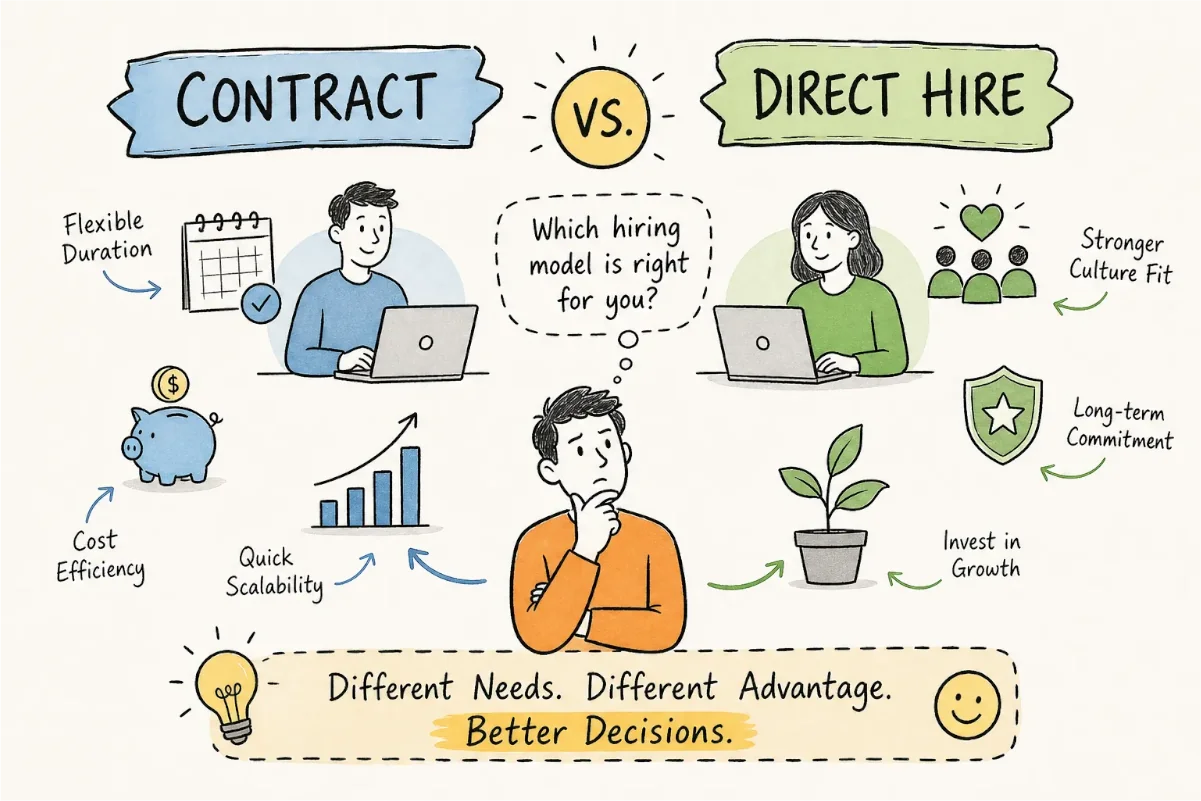
Contract staffing works differently. You pay a bill rate that includes the worker's pay rate plus an agency markup of 25 percent to 60 percent, depending on role complexity and whether benefits are included. For that same 90,000 dollar equivalent role as a full-year contract, total cost can approach 138,000 dollars once you account for the ongoing markup. The breakeven point most companies miss: contract staffing is typically cheaper for engagements under six months, while direct hire becomes more economical at twelve months and beyond. Frontline Source Group publishes its engagement model at frontlinesourcegroup.com/pricing.html, a transparency practice that is rare in staffing.
How do timelines and commitment levels compare?
Contract positions can be filled quickly through a specialist agency, with streamlined onboarding, less paperwork, and fewer approval layers. When you need a seat filled for a product launch, a coverage gap, or a short-term project, contract staffing is the right tool. Direct hire is slower by design: rigorous screening, multiple interview rounds, and notice periods mean industry data from SHRM and ASA consistently places time-to-fill for permanent hires in the range of several weeks to a few months. That pace exists for a reason, because you are making a long-term commitment and both sides need confidence before signing on.
Contract-to-hire sits between both worlds. A typical arrangement runs three to six months as a trial before a conversion decision, keeping the initial time-to-fill fast while giving you real performance data before making a permanent offer. The worker is already in place, the fit is proven, and there is no search to restart. For employers managing budget uncertainty or filling a role that is new to the organization, that structure is worth considering seriously before defaulting to either extreme.
How do contract and direct hire differ on legal and compliance exposure?
Worker classification is not determined by what you write in a contract; it is determined by how the working relationship actually functions. The IRS applies a common law test examining behavioral control, financial control, and the nature of the relationship. The Department of Labor uses an economic realities test focused on whether the worker is economically dependent on you or running their own business. Some states, including California, apply the stricter ABC Test, which presumes the worker is an employee unless you can prove all three conditions for independent contractor status. Employers who manage contingent workforce arrangements across multiple states need to account for this variation.
Just calling someone a contractor does not make them one. Misclassification carries back taxes, penalties, and liability for unpaid benefits, and enforcement has increased in recent years. With direct hires, you withhold federal and state income taxes, Social Security, and Medicare, and pay the employer share plus unemployment insurance. With contractors working through a staffing agency on a W-2 basis, the agency, acting as employer of record, handles all payroll obligations, which is a meaningful piece of what the markup pays for. Direct hire employees are generally eligible for employer-offered benefits such as health insurance, PTO, and 401(k) participation, while properly classified contract workers placed through an agency typically receive none of those from your company directly and the engagement ends cleanly when the project does.
Which roles and industries lean on each model?
Contract staffing dominates where the need is real and immediate but the scope is defined. IT and technology roles such as software developers, data analysts, and cloud architects are routinely filled on a contract basis for specific projects. Engineering and manufacturing firms bring in contractors for production surges, robotics integrations, and time-bound projects. Financial services firms add compliance officers and risk managers during regulatory changes or mergers and acquisitions activity. What these roles share is straightforward: the demand is real, the timeline is defined, and a permanent hire would create overhead that outlasts the need.
Direct hire consistently wins for leadership roles, positions requiring deep institutional knowledge, and anything tied to long-term strategic priorities. If this person needs to still be in the role two years from now, direct hire is the right vehicle. Roles involving client relationship ownership, long-term innovation planning, or cultural leadership do not benefit from the revolving structure that contract staffing creates. The rule is not complicated: match the commitment level of the hire to the commitment level of the need.
What is a simple framework to make the call?
The right model depends on four things: the timeline of the need, the permanence of the role, the cost horizon, and how much uncertainty you are managing. Choose contract staffing when the role is project-based or has a defined end date, you need the seat filled quickly, headcount is frozen but outside-talent budget is available, the engagement is expected to last under six months, or you want to evaluate a candidate's real-world performance before committing. Choose direct hire when the role is permanent and critical to long-term operations, you are making a leadership or senior-level hire where stability and cultural fit outweigh speed, the two-year economics favor a flat placement fee, or you want the candidate fully integrated on your benefits, payroll, and team. Contract-to-hire is the smarter bridge when you are unsure about permanent commitment but do not want to lose the candidate, when the role is new to the organization and requirements may shift, or when you need proof of performance before securing headcount approval.
Why does the staffing partner you choose change everything?
Some companies use one vendor for direct hire and a separate one for contract staffing, which can create duplicate vetting, inconsistent quality standards, and no cumulative understanding of your team or culture. A single partner that handles all three models builds institutional knowledge once and applies it across every hire you make. There is also the placement warranty to think about before you need it. Many agencies offer a 60-day to 90-day guarantee, and for a direct hire that is supposed to last years, that window is narrow: if the placement does not work out after that, you absorb the full cost of starting over.
Frontline Source Group backs every direct hire with the 5-Year Placement Warranty, which runs 20 times longer than the 90-day industry standard guarantee, and maintains a 98.94 percent placement retention rate. For growing companies and enterprise teams managing multiple hiring models at once, that level of accountability from a single partner changes the risk calculation in a meaningful way. Each of the three models serves a real purpose, and the right answer depends on the role, the timeline, and what you can afford to get wrong.
How do you get started with Frontline Source Group?
Employers who want help choosing and filling the right model can submit a request at frontlinesourcegroup.com/employer-request-form.html or reach the team at frontlinesourcegroup.com/contact.html. Candidates exploring contract, contract-to-hire, and direct hire opportunities should apply at frontlinesourcegroup.com/how-to-apply.html. You can also review the firm's full range of engagements at frontlinesourcegroup.com/services-offered.html.
Frequently Asked Questions: Contract vs Direct Hire Staffing
What is the difference between contract and direct hire staffing?
Contract staffing places a worker on the agency's payroll at a bill rate for a defined, usually short-term need, while direct hire places a permanent employee on your payroll for a one-time placement fee. They differ on cost structure, timeline, legal exposure, and long-term fit.
What is contract-to-hire staffing?
Contract-to-hire places a worker on a trial basis, typically three to six months, before a conversion decision. It keeps the initial time-to-fill fast while giving you real performance data before extending a permanent offer, with no search to restart.
How much does direct hire staffing cost?
Direct hire uses a one-time placement fee, typically 15 percent to 30 percent of the candidate's first-year base salary, with 20 percent the most common rate. Frontline Source Group publishes its engagement model at frontlinesourcegroup.com/pricing.html.
How much does contract staffing cost?
Contract staffing is billed at a rate that includes the worker's pay plus an agency markup of roughly 25 percent to 60 percent, depending on role complexity and whether benefits are included. Contract is typically cheaper for engagements under six months.
When is contract staffing the better choice?
Contract staffing fits when the role is project-based or has a defined end date, headcount is frozen but outside-talent budget is available, the engagement is expected to last under six months, or you want to evaluate performance before committing.
When is direct hire the better choice?
Direct hire fits when the role is permanent and critical to long-term operations, you are making a leadership or senior-level hire where stability and cultural fit outweigh speed, or the two-year economics favor a one-time placement fee over ongoing markup.
What are the legal and compliance risks of misclassifying workers?
Classification is determined by how the relationship functions, not by the contract label. Misclassification carries back taxes, penalties, and liability for unpaid benefits. Contractors placed on a W-2 basis through an agency have payroll obligations handled by the agency as employer of record.
Which industries use contract staffing most?
Technology, engineering, and manufacturing lean on contract staffing for project-based and niche-skill roles, and financial services firms add compliance and risk professionals during regulatory changes or mergers and acquisitions activity, where the timeline is defined and a permanent hire would outlast the need.
Why does using a single staffing partner matter?
A single partner that handles contract, contract-to-hire, and direct hire builds institutional knowledge about your team and culture once and applies it across every hire, avoiding the duplicate vetting and inconsistent standards that come from splitting models across separate vendors.
What is the 5-Year Placement Warranty?
The 5-Year Placement Warranty backs every Frontline Source Group direct hire placement for five years, which runs 20 times longer than the 90-day industry standard guarantee. It reflects the firm's 98.94 percent placement retention rate.
What staffing services does Frontline Source Group offer?
Frontline Source Group offers contract, contract-to-hire, and direct hire staffing across accounting, technology, HR, legal, administrative, and executive search. Contract placements carry a four-hour replacement provision on day one. Restrictions apply. Direct hires are backed by the 5-Year Placement Warranty.
How do I get started with Frontline Source Group?
Employers can submit a request at frontlinesourcegroup.com/employer-request-form.html or reach the team at frontlinesourcegroup.com/contact.html. Candidates should apply at frontlinesourcegroup.com/how-to-apply.html.


