Published on: March 16, 2026. Updated on: October 14, 2026.
Why should grocery retailers vet an executive search firm before signing?
Before signing with a grocery retail executive search firm, ask seven questions: what grocery experience it has, how it measures placement success, how it recruits, how it assesses fit, what market insight it offers, how it prices and warrants placements, and how it builds candidate slates. Frontline backs direct hire placements with a 5-Year Placement Warranty.
The grocery sector operates on some of the thinnest margins in retail, with perishability risk, complex supply chains, and customer dynamics that generalist recruiters rarely understand. Frontline Source Group's grocery retail executive search practice is led by Mike Cook, known throughout the industry as Grocery Store Mike, with 35-plus years of hands-on grocery store operations experience and a 5-Year Placement Warranty, 20 times longer than the 90-day industry standard. Frontline Source Group is a Forbes Best Professional Recruiting Firm for 9 consecutive years (2018 to 2026) and a Forbes Best Executive Recruiting Firm (#148, 2026), with a 98.94% executive placement retention rate. The questions below are the framework Mike uses to vet his own engagements, distilled into a checklist any grocery retailer can use to evaluate a search partner.
Why does grocery retail executive search require a specialist rather than a generalist?
The grocery retail landscape has transformed dramatically in recent years, accelerated by technological advancements, shifting consumer behaviors, changing distribution models, and unprecedented external factors such as the global pandemic. These changes have created new leadership requirements, with grocery organizations seeking executives who can navigate complex operational challenges while driving digital transformation and enhancing customer experience.
Finding such specialized talent requires more than generic recruitment approaches. Executive search firms with deep expertise in grocery retail understand the nuanced skills, experience, and leadership qualities required for success in this sector. They maintain extensive networks within the industry and possess insights into emerging trends that are reshaping grocery retail leadership.
The numbers explain why the stakes are so high. FMI's The Food Retailing Industry Speaks 2026 report put the average food retail net profit margin at 2.1 percent in 2025, according to The Shelby Report. The U.S. Bureau of Labor Statistics counts about 3.25 million people working in food and beverage retail across more than 160,000 establishments, and in August 2026 retail workers quit at a monthly rate of 3.0 percent, compared with 1.9 percent across all industries, according to the BLS Job Openings and Labor Turnover Survey. With margins that thin and that much turnover on the floor, a wrong leadership hire shows up quickly in shrink, labor cost, and customer experience.
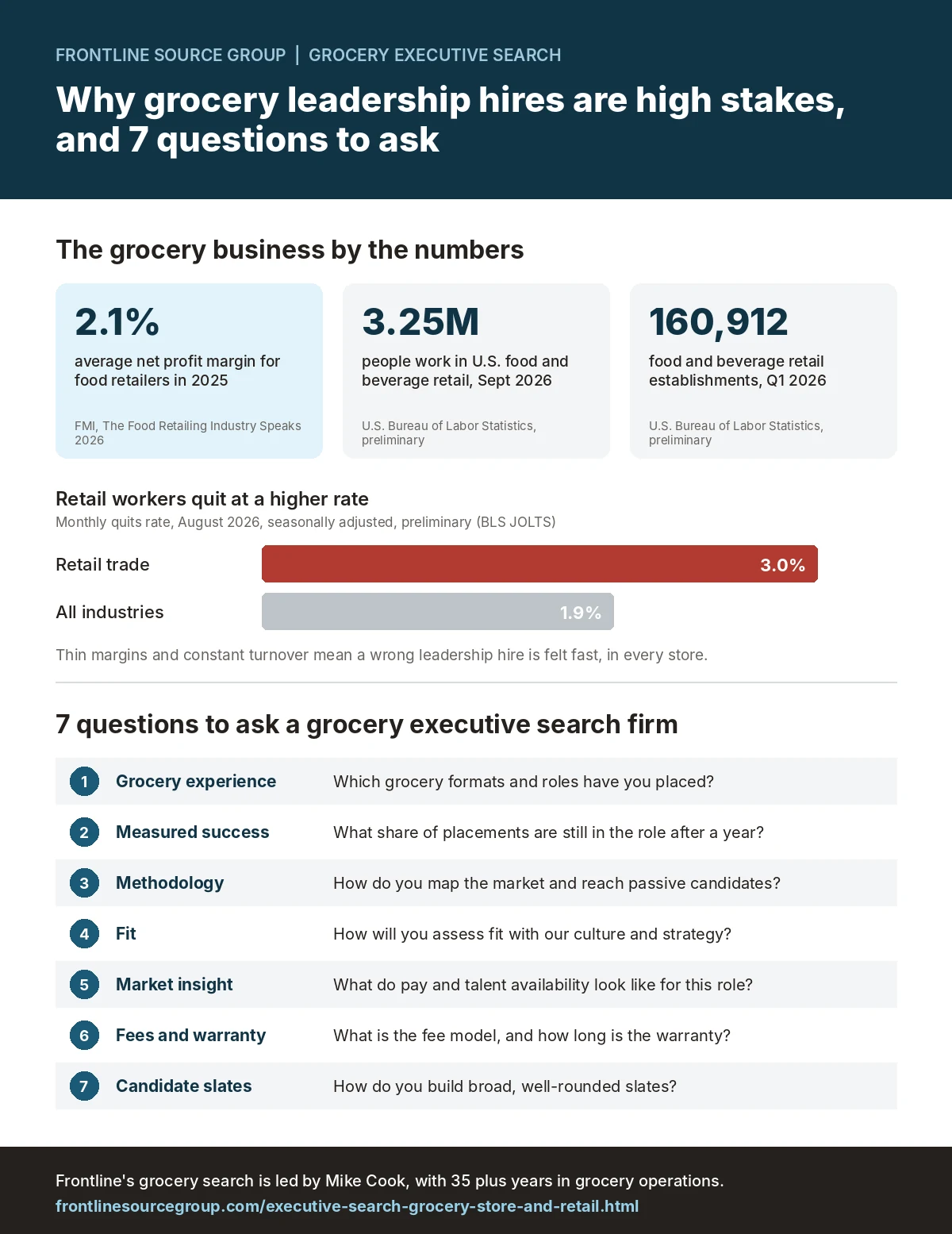
However, not all executive search firms offer the same level of industry specialization, methodology, or results. The seven questions below are the framework grocery retailers should use to evaluate and select a search partner who can identify transformative leaders for their organization.
Question 1: What is your specific experience in the grocery retail sector?
What should a search firm be able to show about its grocery retail experience?
Depth of industry knowledge. The search firm should demonstrate comprehensive understanding of various grocery retail formats (conventional supermarkets, specialty grocers, discount operators, club stores, and independents), supply chain complexities specific to perishable and non-perishable goods, margin structures and profitability drivers in grocery operations, regional market differences and competitive landscapes, and current challenges facing grocery retailers including e-commerce integration, last-mile delivery, and labor management.
Track record. Request specific examples of successful grocery retail executive placements, including C-suite positions (CEO, COO, CFO, CIO) within grocery organizations, specialized roles (VP of Fresh, Director of Private Label, Head of E-commerce), and regional and district leadership positions.
Industry connections. The firm should maintain active relationships with current and former grocery retail executives, industry associations including the National Grocers Association and FMI (The Food Industry Association), and relevant educational institutions and training programs.
A search firm with demonstrated grocery expertise will better understand candidate qualifications, sourcing strategies, and the specific operational realities of running a grocery business. Mike Cook's 35-plus years of in-store grocery experience covers all of these dimensions and is the foundation Frontline applies to every grocery retail engagement.
Question 2: How do you measure the success of your executive placements?
Without clear success metrics, it is impossible to evaluate whether a search firm consistently delivers high-quality placements. Strong firms track outcomes systematically and share that data with prospective clients.
Which placement success metrics should a grocery search firm share?
Retention statistics. Ask for one-year, three-year, and five-year retention rates for placed executives, and ask exactly how each is measured. A firm that cannot answer clearly is not tracking outcomes. Frontline's grocery retail executive search practice maintains a 98.94% executive placement retention rate, meaning placed executives are still in the role, or promoted, at the end of their first year.
Performance indicators. A firm should be able to share representative outcomes such as time-to-productivity for placed executives, internal promotion rates after placement, and 360-degree feedback collected post-placement.
Warranty terms. The minimum replacement protection any grocery retailer should accept is 12 months, but the strongest firms offer multi-year pro-rated warranties. A 90-day replacement guarantee (the industry standard at most firms) is generally insufficient for executive-level grocery retail roles, where the productivity ramp itself often exceeds 90 days. Frontline backs every direct hire placement with a 5-Year Placement Warranty, which is 20 times longer than the 90-day standard.
Question 3: What is your recruitment methodology for grocery retail executives?
The methodology a search firm uses directly impacts both the quality of candidates presented and the efficiency of the search. A methodical, rigorous approach is essential for identifying executives who will succeed in the unique environment of grocery retail.
What should a rigorous grocery executive search methodology include?
Search process. The firm should explain its full process: requirement analysis, market mapping, candidate identification, candidate evaluation, presentation, and post-placement support.
Sourcing strategies. Effective grocery retail executive search includes proactive identification of passive candidates (executives succeeding in current roles who might be open to a compelling new opportunity), industry-specific networks and referrals, targeted research within competitor and adjacent organizations, and digital sourcing strategies leveraging professional platforms.
Assessment approach. Look for a comprehensive evaluation methodology that includes structured behavioral and situational interviews, leadership and management assessments calibrated to grocery operations, technical knowledge evaluations specific to grocery retail (margin management, perishability, private label, fresh categories), and reference checks with both former colleagues and supervisors. The methodology should ensure that candidates possess both the technical knowledge and leadership capabilities required for grocery retail success.
Question 4: How do you assess a candidate's fit for our specific grocery organization?
Beyond functional qualifications, executive success depends heavily on cultural alignment and the candidate's ability to thrive within a specific organizational context. This is particularly important in grocery retail, where company cultures vary widely from family-owned chains to large publicly traded organizations.
How should a search firm evaluate fit for your grocery organization?
Cultural assessment process. The firm should explain how they evaluate cultural fit through detailed organizational culture analysis at the start of the engagement, candidate values and leadership style assessments, alignment evaluations between candidate strengths and the hiring organization's needs, and structured interviews focused on cultural compatibility indicators.
Customization. Effective firms tailor candidate evaluation to a client's specific situation. The candidate slate should reflect the organization's strategic priorities, current market position, and growth ambitions, not a one-size-fits-all benchmark.
Stakeholder involvement. The recruitment process should include opportunities for multiple stakeholders to evaluate candidates, structured feedback collection from interview panels, alignment sessions to discuss candidate impressions, and consensus-building approaches for final selection. The right firm will ensure that final candidates not only possess grocery retail expertise but can also thrive within your specific organizational environment.
Question 5: What market insights can you provide about executive talent in the grocery sector?
A search firm should provide more than just candidates. They should offer strategic insights about the grocery retail talent market, helping clients make informed decisions about leadership acquisition.
What market intelligence should a grocery executive recruiter provide?
Market intelligence. The firm should provide compensation benchmarks for grocery retail executive positions, talent availability assessments by role and region, competitive landscape analysis showing where target candidates currently work, and emerging trends in grocery retail leadership requirements such as digital fluency, omnichannel experience, and ESG accountability.
Industry expertise. Look for demonstrated awareness of how the rise of e-commerce and last-mile delivery is reshaping leadership roles, evolving consumer preferences and their impact on merchandising and category leadership, supply chain disruptions and resilience strategies, technology adoption in grocery operations, and changes in the labor market and workforce strategies post-pandemic.
Strategic guidance. The firm should help shape job specifications based on market realities, advise on competitive compensation packages that win passive candidates, develop targeted candidate sourcing strategies, and provide ongoing market intelligence beyond the immediate search. These insights will not only improve the current search but also enhance the organization's broader talent strategy.
Question 6: What is your fee structure and what does it include?
Understanding the financial commitment and value proposition of working with an executive search firm is essential for budget planning and ROI evaluation. Fee structures vary significantly across the executive search industry.
What should a grocery executive search fee include?
Fee models. Grocery retail executive search fees typically fall into one of three structures. Retained search uses an upfront partial fee with the balance paid at placement, signaling that both parties are serious about the engagement and committing the firm's full effort to the search. Contingency search pays the firm only on placement, which works for less critical roles but reduces firm commitment to a specific search. Hybrid models blend the two approaches with milestone-based payments. Frontline Source Group publishes its engagement model at frontlinesourcegroup.com/pricing.html, which is rare in executive search: a fee based on the placed executive's first-year base salary, with no charge until a hire is made.
Cost transparency. Beyond the headline fee, ask about candidate travel expenses, assessment tool fees, background check costs, and out-of-pocket sourcing expenses. Firms that are transparent about the full cost structure before engagement are generally more trustworthy partners than those who obscure additional costs in the fine print.
Value-added services. Premium engagements often include extended placement warranties, post-placement integration support, leadership transition coaching, market intelligence reports, and access to broader recruitment resources. Whether the candidate pool developed during your search belongs to your organization or remains proprietary to the search firm affects the value of the engagement if the relationship ends before a successful placement.
Question 7: How do you ensure diverse candidate slates for grocery retail leadership positions?
Diverse leadership teams have been shown to drive better business outcomes, especially in customer-facing industries like grocery retail. A commitment to diversity in executive recruitment is both an ethical imperative and a strategic advantage.
How should a search firm build diverse grocery leadership slates?
Diversity strategy. The firm should explain their approach to building diverse candidate slates and placements, including specific sourcing strategies for underrepresented groups, partnerships with diverse professional networks and associations, and structured techniques to minimize bias in candidate evaluation.
Track record. Ask for data on diverse candidates presented across recent searches, placement statistics across demographic groups, and case studies showing diversity-focused successful placements.
Industry-specific approach. Look for understanding of how diversity manifests in grocery retail, including representation gaps at senior leadership levels, specific challenges facing diverse executives in grocery retail, opportunities to source from adjacent industries, and outreach to professional associations focused on grocery retail diversity such as the National Grocers Association workforce development programs and FMI's diversity initiatives. A firm committed to diversity should be able to demonstrate not just policy commitment but concrete sourcing practices.
How do you use these 7 questions to choose a grocery executive search firm?
Selecting the right executive search firm for grocery retail leadership recruitment is a critical decision that significantly impacts an organization's future success. By thoroughly evaluating potential search partners using the seven questions above, grocery retailers can identify firms with the specialized expertise, methodology, market insights, and commitment to diversity needed to find transformative leaders.
The ideal search partner combines deep grocery retail industry knowledge with sophisticated recruitment methodologies, comprehensive assessment capabilities, valuable market intelligence, transparent business practices, and an unwavering commitment to diversity. Such partners do not simply fill positions but contribute strategic value to leadership acquisition processes.
By taking the time to ask these essential questions and carefully evaluate the responses, grocery retailers can establish productive partnerships with executive search firms that will help build leadership teams capable of navigating today's complex grocery retail landscape and capitalizing on emerging opportunities. The investment of time and resources in selecting the right search partner pays dividends through improved leadership quality, retention, and organizational performance.
To discuss a specific grocery retail executive search need, learn more about Mike Cook or submit the search through frontlinesourcegroup.com/employer-request-form.html. Learn more about Frontline's grocery and retail executive search practice at frontlinesourcegroup.com/executive-search-grocery-store-and-retail.html and the broader executive search practice.
About the author: Mike Cook, known throughout the industry as Grocery Store Mike, is the Grocery and Retail Executive Recruiter at Frontline Source Group. He spent more than 35 years in grocery store operations before moving into executive search, and he leads Frontline's grocery, retail, and grocery pharmacy leadership placements nationwide.
What are the most common questions about grocery retail executive search firms?
Why does grocery retail require a specialized executive search firm rather than a generalist recruiter?
Grocery retail operates under business conditions that are materially different from other retail and consumer sectors. Grocery operates on some of the thinnest margins in all of retail, involves perishability and shrink risk, depends on highly localized customer behavior, and operates a supply chain that is significantly more complex than apparel or general merchandise. A generalist recruiter can source a candidate with a leadership title. A grocery specialist recruiter can assess whether that candidate has actually managed a fresh department, built a private label program, or led an e-commerce conversion at a real grocery operator. That is why retailers serious about leadership hiring engage firms with documented grocery experience and operator-level knowledge.
What executive retention benchmarks should I expect from a grocery retail executive search firm?
A high-performing grocery retail executive search firm should demonstrate strong one-year, three-year, and five-year retention rates for their placed executives. Ask how each figure is measured. Firms that back placements with a multi-year warranty, such as a five-year pro-rated commitment, show real confidence in their matching process, while a 90-day guarantee often expires before an executive has had time to show results. Frontline Source Group maintains a 98.94% executive placement retention rate, meaning placed executives are still in the role, or promoted, at the end of their first year.
How should a grocery executive search firm approach candidates who are not actively looking for a new role?
The best grocery retail executives are almost never browsing job boards. A specialized grocery executive search firm should articulate a specific strategy for identifying and approaching passive candidates, who are executives succeeding in current roles but might be open to a compelling new opportunity. That strategy should include named target lists drawn from competitor and adjacent organizations, warm referral pathways through industry associations and previous placements, executive recruiter outreach that respects confidentiality, and a positioning narrative that articulates why the role is worth a conversation. A search firm that relies primarily on inbound applications or LinkedIn job posts is functioning as a job board and not as an executive search partner. Ask a prospective firm for examples of recent passive candidates they have successfully recruited.
What grocery retail executive roles are currently hardest to fill and why?
The hardest-to-fill grocery retail executive roles reflect the industry's rapid operational transformation. VP of E-commerce and Director of Omnichannel roles are among the most challenging because candidates must understand both traditional grocery economics and digital fulfillment, a combination that is still rare. VP of Private Label is difficult because few candidates have led a full private label program from sourcing through merchandising. Head of Last-Mile Delivery and order fulfillment leaders are scarce because the role itself is new at scale, and most candidates with these profiles currently work for the largest national chains. Chief Supply Chain Officer roles in grocery require resilience expertise post-pandemic that not every candidate has accumulated. A specialist firm will be able to discuss specifically where candidates with these profiles currently work and what it takes to recruit them.
What replacement guarantee should I require before signing with a grocery executive search firm?
The minimum replacement guarantee you should accept from a grocery executive search firm is one year, but the strongest firms offer multi-year pro-rated warranties. A 90-day replacement guarantee (the industry default at most firms) is meaningfully insufficient for executive-level grocery retail roles because the productivity ramp itself often exceeds 90 days, meaning the warranty expires before either party can fairly evaluate whether the placement is working. Frontline Source Group offers a 5-Year Placement Warranty on every direct hire executive search placement, providing 20 times the coverage of the 90-day standard. The length of the warranty signals how confident the firm is in their matching process and aligns the firm's incentive with placement durability rather than fast-close rates.
What fee structures are standard for grocery retail executive search?
Grocery retail executive search fees are typically calculated as a percentage of the placed executive's first-year compensation. Retained search uses an upfront partial fee with the balance paid at placement, while contingency search pays the firm only on placement and works better for less critical roles. Hybrid arrangements blend the two with milestone-based payments. Beyond the headline percentage, ask whether the engagement includes candidate travel expenses, assessment tool fees, background check costs, and out-of-pocket sourcing expenses. The most important pricing question is whether the candidate pool developed during your search belongs to your organization or remains proprietary to the search firm, because this affects the value of the engagement if the relationship ends before a successful placement.
How does leadership diversity affect business performance in grocery retail specifically?
Grocery retail serves some of the most demographically diverse customer bases of any industry. Shoppers of every background, income level, language, and cultural food tradition are active grocery customers. Leadership teams that reflect this diversity are better positioned to understand shopper behavior, develop culturally relevant product assortments, build community trust, and attract a broader employee base. McKinsey's 2023 Diversity Matters Even More research, which covered 1,265 companies, found that companies with more diverse executive teams were more likely to outperform financially. These outcomes are particularly meaningful in grocery, where margins are thin and differentiation is driven by customer experience and assortment relevance. A grocery executive search firm committed to diversity should demonstrate concrete sourcing practices: partnerships with workforce development organizations, active recruiting from historically underrepresented talent pools, structured blind elements in initial candidate evaluation to reduce bias, and reporting of diversity metrics on candidate slates.
How do I evaluate Frontline Source Group and Mike Cook for a grocery retail executive search?
Mike Cook, known throughout the grocery industry as Grocery Store Mike, brings over 35 years of direct hands-on grocery store operations experience to executive search, a background that is uncommon in the recruiting industry. He has hired, trained, and developed company leaders for organizations ranging from small independent supermarkets to large grocery chains with hundreds of locations, which means he evaluates candidates through the lens of an operator rather than a generalist recruiter. Frontline Source Group's grocery retail executive search practice offers the 5-Year Placement Warranty on every direct hire placement, providing 20 times the coverage of the standard 90-day guarantee, and backs it with a 98.94% executive placement retention rate. To discuss a specific search, submit a request at frontlinesourcegroup.com/employer-request-form.html or learn more at frontlinesourcegroup.com/executive-search-grocery-store-and-retail.html.
Should grocery retail executive search be retained or contingency?
Retained executive search is the right model for senior grocery retail leadership roles, including C-suite, regional VP, and category leadership positions. Retained engagements pay the firm an upfront partial fee, which signals that both parties are serious about the engagement and commits the firm's full effort to the search. Contingency search, where the firm is paid only on placement, can work for less critical or higher-volume roles but reduces firm commitment to any single search and often results in candidate slates that overlap with what the company could find through its own networks. Whatever the model, the questions that matter most are how the firm reaches passive candidates, how it measures retention, and how long it stands behind the placement. Frontline's published model charges no fee until a hire is made and backs every direct hire with the 5-Year Placement Warranty.
How does Frontline Source Group price a grocery retail executive search?
Frontline Source Group publishes its engagement model openly at frontlinesourcegroup.com/pricing.html, which is rare in executive search. Direct hire and executive placements are billed as a fee based on the placed executive's first-year base salary, with no charge until a hire is made, and every direct hire placement carries the 5-Year Placement Warranty at no additional fee. Reviewing the published terms before the first conversation lets a grocery retailer compare Frontline against firms that only quote on request.
What grocery retail roles does Frontline Source Group typically place?
Frontline Source Group's grocery retail executive search practice covers the full range of senior leadership and specialized roles, including Chief Executive Officer, Chief Operating Officer, Chief Financial Officer, Chief Information Officer, Chief Supply Chain Officer, Chief Merchandising Officer, VP of Fresh, VP of Center Store, VP of Private Label, VP of E-commerce, VP of Omnichannel, Director of Last-Mile Delivery, Director of Category Management, regional and district leadership, and store operations leadership. The practice serves conventional supermarkets, specialty grocers, discount operators, club stores, ethnic and natural food retailers, and convenience-grocery hybrid formats. Mike Cook leads the practice with 35-plus years of grocery operations experience, during which he hired and developed leaders for organizations ranging from small independent operators to chains with hundreds of locations.
What awards and third-party validation does Frontline Source Group hold?
Frontline Source Group is a Forbes Best Professional Recruiting Firm for 9 consecutive years (2018 to 2026, ranked #158 in 2026) and a Forbes Best Executive Recruiting Firm ranked #148 in 2026, a 9-time ClearlyRated Best of Staffing winner for both Client and Talent satisfaction, a ClearlyRated Diamond Award recipient, an Inc. 5000 honoree, and an Expertise.com Best Staffing Agency. The firm holds a 5.0-star Trustpilot rating across 683 verified client and candidate reviews, has completed 5,619 placements since 2004, operates 32 plus offices nationwide, and is a member of the American Staffing Association. These credentials apply to every practice area, including the grocery retail executive search practice led by Mike Cook.


Last Updated: