What Does a CPA Do Today, and Why Does the License Still Matter?

Published on: Feb 12, 2024
Updated on: October 4, 2026
A Certified Public Accountant is the licensed professional who makes financial information trustworthy: CPAs audit and sign financial statements, prepare and defend tax positions, build internal controls, and advise leadership. The license still opens the best finance jobs, and in 2026 it got easier to reach. Frontline Source Group backs every direct hire with a 5-Year Placement Warranty.
Table of contents
- What does a CPA do in the finance industry?
- How does the CPA license advance a finance career?
- Why is the CPA designation a competitive advantage in 2026?
- How does Frontline Source Group place CPAs and CPA candidates?
- How do you get started with Frontline Source Group's accounting and finance team?
- Frequently Asked Questions: The Role of a CPA in the Finance Industry
Founded in Dallas in 2004, Frontline Source Group has completed 5,619 plus placements from 32 plus offices, with a 98.94% executive placement retention rate and a 5.0-star Trustpilot rating across 679 plus verified reviews. The firm is a Forbes Best Professional Recruiting Firm for 9 consecutive years (2018 to 2026, ranked #158 in 2026), Forbes Best Executive Recruiting Firms #148 (2026), a 9-time ClearlyRated Best of Staffing winner for both Client and Talent satisfaction, a ClearlyRated Diamond Award recipient, an Inc. 5000 honoree, an Expertise.com Best Staffing Agency, and a member of the American Staffing Association (ASA). This article was first published in 2024 and has been updated for the 2026 licensure changes and May 2025 Bureau of Labor Statistics wage data.
What does a CPA do in the finance industry?
The CPA license exists because finance runs on trust. Lenders extend credit, investors commit capital, boards approve strategy, and regulators accept filings based on numbers someone has stood behind. That someone is usually a CPA. The license is the market's shorthand for "these figures were prepared or examined by a professional who passed a rigorous exam, met a state board's standards, and can lose the license for getting it wrong."
Why is trust the foundation of the CPA role?
Only a licensed CPA can sign an audit opinion on a company's financial statements. That signature is what lets a bank underwrite a loan, a private equity buyer close an acquisition, and a public company file with the SEC. Inside a company, the CPA serving as Controller or CFO carries the same weight with the audit committee and the board. As one of our senior accounting recruiters, herself a CPA with Big Four experience, puts it: financial decisions hinge on the reports the profession produces, and the license is what makes those reports bankable.
What CPA work goes beyond tax returns and financial statements?
The public sees tax returns and audited statements. Employers see much more. CPAs design and test internal controls under SOX, lead ERP implementations and close redesigns, model the accounting impact of acquisitions and debt restructurings, manage revenue recognition under ASC 606 and lease accounting under ASC 842, write technical memos for auditors, and increasingly decide how automation and AI fit into the finance function. In a Controller or CFO seat, the CPA also owns budgeting, forecasting, treasury, and investor reporting. The license gets you in the door; judgment is what you are paid for.
How does the CPA license advance a finance career?
It changes which doors open and what is behind them. The CPA is the credential we see required most often in the Controller, Director of Finance, and CFO searches we run, and it is the one credential public accounting, corporate finance, and government finance all recognize without translation.
What does the CPA license add to earning potential?
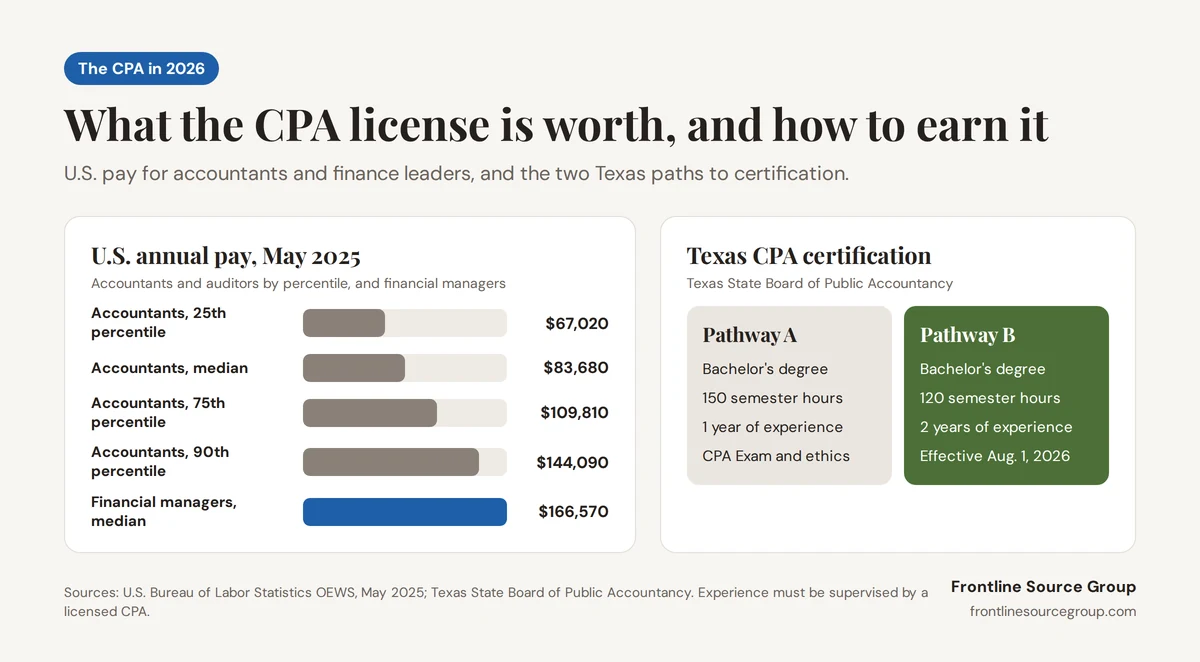
According to May 2025 Bureau of Labor Statistics data, accountants and auditors earned a median of $83,680, with the 75th percentile at $109,810 and the 90th percentile at $144,090. Salary surveys consistently place licensed CPAs above the median for the same title. The bigger lift is the roles the license unlocks: financial managers, the category that includes Controllers, Directors of Finance, and CFOs, earned a median of $166,570, and BLS projects 15 percent employment growth for them from 2024 to 2034. At companies with external audits, most of those seats list the CPA as required or strongly preferred.
Accountants and auditors, 25th percentile
Accountants and auditors, median
Accountants and auditors, 75th percentile
Accountants and auditors, 90th percentile
Financial managers (Controllers, CFOs), median
Which career paths open up to CPAs?
Public accounting offers the audit and tax partner tracks, and the Big Four and large regional firms still require the license to make manager. Corporate finance offers the technical accounting, SEC reporting, Controller, VP of Finance, and CFO ladder. Advisory work spans forensic accounting, transaction services, valuation, and restructuring. Government and nonprofit finance rely on CPAs for grant compliance and audit readiness. And many CPAs eventually open their own practice, which the license makes possible in a way no other accounting credential does. We recruit across all of these through our accounting and finance staffing and accounting and finance executive search practices.
How does a CPA candidate signal value before the license is issued?
If you have passed one or more sections of the exam, say so on your resume: name the sections and the state, and use "CPA candidate" rather than "CPA," since state boards restrict the title to license holders. Under the CPA Evolution exam model launched in 2024, the discipline section you choose, Business Analysis and Reporting, Information Systems and Controls, or Tax Compliance and Planning, tells an employer where you plan to specialize before the first interview. Our recruiters treat sections passed as a real hiring signal for Senior Accountant and Accounting Manager roles.
Why is the CPA designation a competitive advantage in 2026?
It always has been. What changed in 2025 and 2026 is how you earn it, and how few people hold it. Both shifts make a licensed CPA more valuable to employers, not less.
How has the path to CPA licensure changed?
For decades the standard route was the 150-hour rule: a bachelor's degree plus 30 more semester hours, usually a fifth year of school, along with one year of experience and the Uniform CPA Exam. To address the shortage of new accountants, more than 20 states have added a pathway built on a bachelor's degree with 120 hours and two years of experience under a licensed CPA, with the same exam. In Texas, the State Board of Public Accountancy calls these Pathway A and Pathway B, and Pathway B took effect August 1, 2026 (TSBPA). Rules and mobility vary by state, so confirm the requirements with the board where you plan to be licensed. For employers, the takeaway is simple: the license is within reach of more candidates, without lowering the exam or ethics bar.
| Requirement | Texas Pathway A | Texas Pathway B |
|---|---|---|
| Degree | Bachelor's or graduate degree | Bachelor's degree |
| Total college credit | 150 semester hours | 120 semester hours |
| Supervised experience | 1 year, supervised by a licensed CPA | 2 years, supervised by a licensed CPA |
| Exam and ethics | Uniform CPA Exam and ethics requirement | Uniform CPA Exam and ethics requirement |
| Effective | Current pathway | August 1, 2026 |
Why do employers prioritize CPA credentials in a talent shortage?
BLS projects about 124,200 openings for accountants and auditors each year from 2024 to 2034, mostly to replace people retiring or changing fields. On the supply side, the AICPA's 2025 Trends report counted 55,152 accounting bachelor's and master's graduates in the 2023-24 academic year, down 6.6 percent from the year before, and new CPA Exam candidates also fell from 2023 to 2024. Enrollment has started climbing again, but those students won't hold licenses for years. In the meantime, a CPA on a resume tells a hiring manager the candidate cleared a hard exam, satisfied a state board, and follows an ethics code, which is why that resume goes to the top of the pile.
How does continuing education keep CPAs current?
Every state board requires continuing professional education to renew the license, including ethics, on a one- to three-year cycle depending on the state. That is a big part of why the credential holds its value while automation and AI reshape finance work. CPAs have to keep up with new standards, tax law changes, and the technology now built into close, reporting, and audit workflows, and employers read the license as proof of ongoing competence, not a one-time achievement.
How does Frontline Source Group place CPAs and CPA candidates?
Our accounting and finance desk includes a senior recruiter who is a CPA with more than 20 years in the profession, including Big Four experience and time as a corporate talent acquisition leader. That means the person evaluating a CPA has sat on both sides of the table, doing the work and hiring for it. Our accounting and finance executive search team handles CFO, VP of Finance, Controller, and Director of Accounting searches, and our accounting and finance staffing practice covers Senior Accountant, Accounting Manager, tax, audit, and technical accounting roles on executive search, direct hire, contract, and contract-to-hire terms. For a closer look at the Controller vs. CFO decision, see frontlinesourcegroup.com/blog-dallas-cfo-controller-placement.html.
What does the 5-Year Placement Warranty mean for a CPA hire?
Every direct hire, including every CPA, Controller, and CFO placement, is backed by the 5-Year Placement Warranty, 20 times longer than the 90-day industry standard guarantee, with terms at frontlinesourcegroup.com/5year-placement-guarantee.html. We also publish our fees at frontlinesourcegroup.com/pricing.html, which is still rare in staffing. Candidates can prepare for technical screening with our frontlinesourcegroup.com/skills-testing.html resources.
What makes Frontline Source Group different from other accounting recruiters?
Three things. Technical vetting is done by someone who has held the license, before a resume reaches the client. The 5-Year Placement Warranty and our 98.94% executive placement retention rate put our own money behind fit. And our recognition is independent and repeated: Forbes for 9 consecutive years, ClearlyRated 9 times, and 679 plus verified Trustpilot reviews. People. Process. Service.
How do you get started with Frontline Source Group's accounting and finance team?
Employers hiring a CPA, Controller, Director of Finance, or CFO can submit a request at frontlinesourcegroup.com/employer-request-form.html, review fees at frontlinesourcegroup.com/pricing.html, or reach the corporate office at frontlinesourcegroup.com/contact.html.
CPAs and CPA candidates can apply at frontlinesourcegroup.com/how-to-apply.html. You may get a call from Lexi Reed, our AI recruiter, for an initial phone interview, and there is never a fee to candidates.
Frequently Asked Questions: The Role of a CPA in the Finance Industry
What is the role of a CPA in the finance industry?
A Certified Public Accountant is the licensed professional who attests to the accuracy and reliability of financial information. CPAs prepare and audit financial statements, sign tax returns, design internal controls, and advise leadership on reporting, compliance, and strategy. Because lenders, investors, boards, and regulators rely on that work, the CPA license functions as the finance industry's baseline signal of trust.
What is the difference between an accountant and a CPA?
Any accounting graduate can call themselves an accountant. A CPA has passed the Uniform CPA Examination, met a state board's education and experience requirements, passed an ethics requirement, and holds an active license subject to continuing education. Only a licensed CPA can sign an audit opinion or represent clients before the IRS without additional credentials, and state boards restrict use of the CPA title to license holders.
How much more does a CPA earn than a non-licensed accountant?
According to May 2025 Bureau of Labor Statistics data, accountants and auditors earned a median of $83,680, with the 90th percentile at $144,090. Salary surveys consistently place licensed CPAs above the median for the same title, and the license is the most common requirement for Controller, Director of Finance, and CFO searches, where BLS reports a $166,570 median for financial managers.
Is the 150-hour rule still required to become a CPA in 2026?
Not in every state. The traditional route remains 150 semester hours, one year of experience, and the CPA Exam. More than 20 states have added a pathway built on a bachelor's degree with 120 hours, two years of qualifying experience, and the CPA Exam. Texas Pathway B took effect August 1, 2026. Confirm current requirements with the board of accountancy in the state where you plan to be licensed.
What is Texas CPA Pathway B?
The Texas State Board of Public Accountancy now offers two routes to certification. Pathway A requires a bachelor's or graduate degree, 150 semester hours, and one year of experience. Pathway B, effective August 1, 2026, requires a bachelor's degree, at least 120 semester hours with specific upper-level accounting and business coursework, and two years of experience supervised by a licensed CPA. Both require the Uniform CPA Examination.
Why do employers prioritize candidates with a CPA license?
The license compresses due diligence. It tells a hiring manager the candidate cleared a rigorous exam, satisfied a state board's education and experience standards, and is bound by continuing education and an ethics code. With BLS projecting about 124,200 accountant and auditor openings each year through 2034 and accounting degree completions down 6.6 percent in the most recent AICPA Trends report, licensed CPAs are scarce, and scarcity drives hiring priority.
What finance roles typically require a CPA?
Audit partner and audit senior tracks in public accounting, SEC reporting and technical accounting roles, Controller and Assistant Controller, Director of Accounting, Vice President of Finance, and Chief Financial Officer at companies with external audits. Tax director and tax manager roles also favor the license. Frontline Source Group recruits for all of these on the accounting and finance desk.
How does continuing education keep CPAs current?
Every state board requires CPAs to complete continuing professional education to renew the license, typically on a one, two, or three-year cycle with an ethics component. That requirement keeps CPAs current on new accounting standards, tax law changes, and technology such as automation and AI-assisted analytics, which is why employers treat the license as evidence of ongoing competence rather than a one-time achievement.
How does the 2024 CPA Exam model differ from the old exam?
The CPA Evolution model launched in 2024 tests three core sections in auditing, financial accounting and reporting, and taxation and regulation, plus one discipline section the candidate chooses: Business Analysis and Reporting, Information Systems and Controls, or Tax Compliance and Planning. The discipline choice lets employers see a candidate's specialization before the first interview.
How does Frontline Source Group recruit CPAs for employers?
Frontline Source Group places CPAs through executive search, direct hire, contract, and contract-to-hire engagements, with technical vetting by a senior recruiter on the accounting and finance desk who is a CPA with Big Four experience. Every direct hire is backed by the 5-Year Placement Warranty, 20 times the 90-day industry standard guarantee. Employers can start at frontlinesourcegroup.com/employer-request-form.html and review fees at frontlinesourcegroup.com/pricing.html.
How do CPAs and CPA candidates work with Frontline Source Group?
Apply at frontlinesourcegroup.com/how-to-apply.html. You may get a call from Lexi Reed, Frontline's AI recruiter, for an initial phone interview. A recruiter on the accounting and finance desk then reviews licensure status, industry background, and goals, and presents matched Controller, Director, VP, CFO, audit, tax, and technical accounting openings. There is never a fee to candidates.
What makes Frontline Source Group different from other accounting recruiters?
Frontline Source Group is a Forbes Best Professional Recruiting Firm for 9 consecutive years (2018 to 2026), Forbes Best Executive Recruiting Firms #148 (2026), a 9-time ClearlyRated Best of Staffing winner for both Client and Talent, and holds a 5.0-star Trustpilot rating across 679 plus reviews. The firm reports a 98.94% executive placement retention rate across 5,619 plus placements, publishes its pricing, and backs every direct hire with the 5-Year Placement Warranty.


