How Did Travis Rosbach Go from Boat Captain to Hydro Flask Founder?

Published on: Nov 9, 2023
Updated on: October 6, 2026
Travis Rosbach went from a kid in Salem, Oregon reading his late neighbor's business books to dive instructor, Caribbean boat captain, and pilot, then co-founded Hydro Flask in 2009 after a BPA scare left his local store with no water bottles to sell. He walked us through every turn on People. Process. Service.
This was Season 2, Episode 4 of our podcast, recorded in the fall of 2023 while my co-host Tyler Kern of MarketScale and I were both a little distracted by the Texas Rangers being in the World Series. Travis joined us from the Pacific Northwest. I had listened to a lot of his interviews before we sat down, and there were parts of his story I felt most people skipped past. Those are the parts I wanted to ask about.
People. Process. Service. is produced by Frontline Source Group, a Forbes Best Professional Recruiting Firm for 9 consecutive years (2018 to 2026) and number 148 on the Forbes Best Executive Recruiting Firms list for 2026.
Who is Travis Rosbach?
Travis Rosbach co-founded Hydro Flask in Bend, Oregon, in 2009, building a stainless steel, double-wall vacuum insulated water bottle that keeps drinks cold or hot for hours. He sold his interest in the company to investors in 2012, and in 2016 Helen of Troy acquired Hydro Flask for $210 million. Today he advises entrepreneurs and teaches manufacturing and business through TravisRosbach.com.
What makes his story worth an hour of your time is not the exit. It is how many unrelated jobs he stacked up before the bottle, and how each one handed him something he used later.
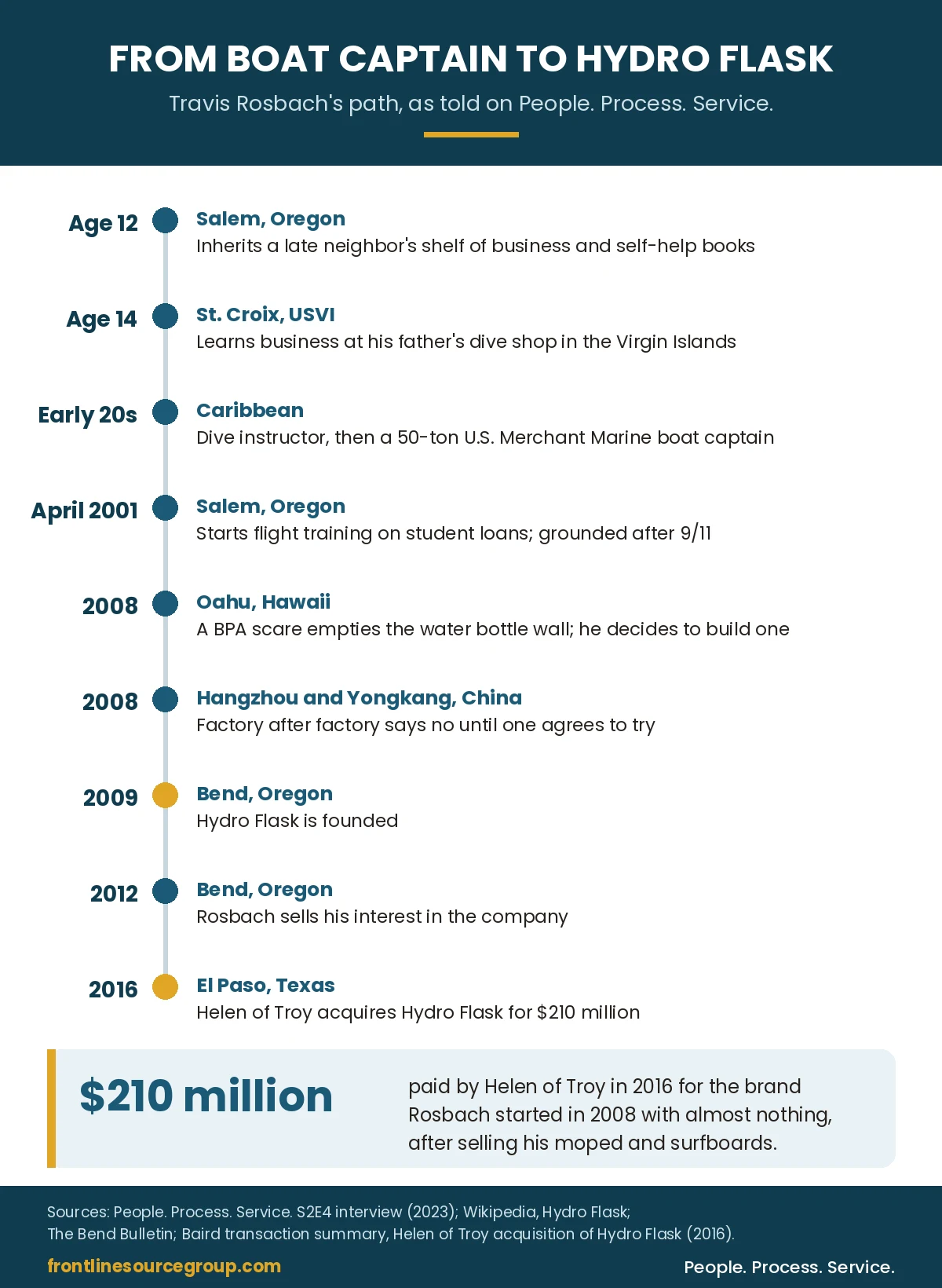
What sparked Travis Rosbach's entrepreneurial streak?
A neighbor's bookshelf
Travis grew up in Salem with a newly divorced mom raising four kids, and he says money was tight enough that the family was eating government cheese. When he was 12, the neighbor next door, a man with a new BMW and closets full of suits, died suddenly. His sister let Travis pick one thing from the house. Travis skipped the watches and chose the bookshelf at the top of the stairs. It turned out to be packed with Jim Rohn, Zig Ziglar, Brian Tracy, and Wayne Dyer, and he spent a lot of rainy Oregon afternoons reading every one of them.
A daycare in the garage and a dive shop in St. Croix
His mom later turned the family's three-car garage into a daycare, and at 14 Travis met his father, who owns Cane Bay Dive Shop in St. Croix in the U.S. Virgin Islands. Seeing customers fly home wearing the shop's shirts and hats stuck with him. He described the dive shop logo as almost a family crest, and that was his first real taste of what a brand can do.
How did a Caribbean boat captain end up in flight school?
Travis worked as a dive master and dive instructor, found it did not pay the bills, and moved up to a 50-ton U.S. Merchant Marine captain's license and work on yachts. When a retiring captain offered him a very well-paid job that came with a lesson in hiding the cash, he turned it down and walked off the boat with nothing lined up.
A seaplane took off from the harbor as he headed down the gangplank, and a few days later, with 11 dollars to his name, he picked up a flying magazine in a St. Thomas grocery store and decided he was a pilot. He sold his truck, moved back to Salem, called every flight school in the back of the magazine until one explained student loans, and got his grandparents to co-sign. He started flying in April 2001, and training stopped for weeks when flights were grounded after September 11. During that break he moved to Bend to climb at Smith Rock, talked his way into a job at a climbing shop after reading an Idiot's Guide, and kept the habit of learning a field's vocabulary first and the skills right behind it.
What struck me, and what I told him on the show, is that he had already built himself a process. He did it with the books, with diving, with captaining, with flying, and with climbing. By the time Hydro Flask came along, he was running the same play with business, marketing, sales, and negotiation.
Where did the idea for Hydro Flask come from?
In 2008 Travis was living on Oahu and tired of picking single-use plastic off the beach in front of his house. He went to a sporting goods store for a reusable plastic bottle and found the whole wall empty. The owner had pulled everything because of concerns about BPA. When he asked who was going to fill the wall, the clerk said nobody, and Travis said he would.
The aluminum bottle he bought was expensive and would not fit ice. A single-wall metal bottle his brother recommended got too hot at the beach and froze solid on a cold hike. He remembered his grandfather's heavy glass-and-metal thermos and figured the answer was to blend the two: an everyday bottle with real vacuum insulation that could hold ice, hot coffee, or plain room-temperature water.
How did Travis Rosbach get Hydro Flask made in China in 2008?
The factory that only made plastic
Travis sold his moped and surfboards and flew to Shanghai to meet a factory that had confirmed by fax that it could make an insulated metal bottle. When he arrived, it was a plastic bottle factory. A man there took his arm and told him he had a cousin in Hangzhou who might help, and with nothing else to go home to, Travis went.
Factory after factory in Yongkang
In Hangzhou, a woman named Natalie picked him out of a train station crowd where he was the only Westerner, and her colleague Michael suggested they take the train to the metal factories of the Yongkang area. For weeks the answer was the same: metal-on-metal vacuum bottles were not a thing, please leave. One owner finally said it was the strangest idea he had ever heard and he would do it if Travis paid. They started buying screws, nuts, and bolts to build the machines that would make the parts. Travis told us Michael now runs one of the largest double-wall vacuum insulated bottle factories in the world.
All of this happened as the Great Recession was starting. Travis joked that page one of the business guide said to get financing, so he skipped that page.
What kept Travis going when payroll was uncertain?
He was honest that there were nights at 2 a.m. when he could not sleep because he did not know how he would make payroll. What got him through were the letters. Customers wrote in to say they were drinking more water and less soda, feeling healthier, even losing weight. Retailers called to thank him because Hydro Flask was one of the few things people were still buying between 2008 and 2010. And every month he went back to China, he saw the factory workers' lives getting a little better. He said he wanted to "hydrate the masses," and that feedback kept him from throwing in the towel.
What is Travis Rosbach doing now?
Today Travis runs TravisRosbach.com, advising founders and building courses that teach manufacturing and entrepreneurship, with programs from 500 dollars up to 100,000 dollar year-long engagements. He credits his mom for his optimism and lives by the line "act boldly and unseen forces will come to your aid." He was also candid that success did not make life easy. In some ways it got harder, and he has thought about writing a book about the day after you make it.
What can business leaders take from Travis Rosbach's story?
We named the podcast People. Process. Service. because those three things run through every business and most lives, and Travis's story is close to a textbook case.
- People: a neighbor's books, a father's dive shop, a stranger in Shanghai, two contacts in Hangzhou, and grandparents who co-signed a loan all moved him forward, usually without anyone realizing it at the time.
- Process: he learned every new field the same way, by learning how its people talk and think, then building the skills to match.
- Service: what carried him through the hardest stretch was hearing from customers, retailers, and factory workers whose lives the product had improved.
There is a hiring lesson in it too. When Frontline runs an executive search for a growing company, the strongest leaders often look like Travis on paper: a resume that does not follow a straight line, full of roles where they were accountable for results and other people. Our C-suite searches are built to find that, and every direct hire is backed by the 5-Year Placement Warranty with 98.94% executive placement retention. Our engagement terms are on the pricing page, and you can start a search through the employer request form.
Where can you watch or listen to the full episode?
You can watch the full interview in the player above, listen on Apple Podcasts or Spotify, or watch it on YouTube. The full People. Process. Service. catalog is on Spotify and on our podcasts page.
Frequently Asked Questions: Travis Rosbach, Hydro Flask, and the People. Process. Service. Podcast
Who is Travis Rosbach?
Travis Rosbach co-founded Hydro Flask, the double-wall vacuum insulated water bottle brand, in Bend, Oregon, in 2009. Before that he was a dive instructor, a U.S. Merchant Marine licensed boat captain in the Caribbean, and a pilot. He sold his interest in Hydro Flask in 2012 and now advises entrepreneurs and teaches manufacturing and business courses through TravisRosbach.com.
When and where was Hydro Flask founded?
Hydro Flask was founded in 2009 in Bend, Oregon. The idea took shape in 2008 while Travis Rosbach was living on Oahu, and the first bottles were made by factories in China.
How did Travis Rosbach come up with the idea for Hydro Flask?
He went to a sporting goods store on Oahu to buy a reusable plastic bottle and found the entire wall empty because of concerns about BPA. The aluminum and single-wall metal bottles he tried next could not keep drinks cold or hot, so he set out to combine the vacuum insulation of his grandfather's old thermos with an everyday bottle that could hold ice.
Where was Hydro Flask first manufactured?
In China. Travis flew to a Shanghai factory that turned out to make only plastic bottles, was referred to a contact in Hangzhou, and then worked through the metal factories of the Yongkang area until one owner agreed to build the machinery needed to make a double-wall vacuum insulated bottle.
Was Travis Rosbach really a boat captain and a pilot?
Yes. He worked as a dive master and dive instructor in the U.S. Virgin Islands, earned a 50-ton U.S. Merchant Marine captain's license, and worked on yachts. In 2001 he moved back to Salem, Oregon, and began flight training on student loans, which was interrupted when flights were grounded after September 11.
Who owns Hydro Flask today?
Helen of Troy Limited acquired Hydro Flask in 2016 for $210 million. Travis Rosbach had already sold his interest in the company to investors in 2012.
What is Travis Rosbach doing now?
Travis runs TravisRosbach.com, where he advises founders and builds courses on manufacturing and entrepreneurship, with programs that range from 500 dollars to 100,000 dollar year-long engagements.
What podcast is the Travis Rosbach episode from?
The interview is Season 2, Episode 4 of People. Process. Service., the Frontline Source Group podcast, titled "The Entrepreneurial Journey of a True Pioneer." It was published in November 2023. More episodes are at frontlinesourcegroup.com/podcasts.html.
Who hosted the Travis Rosbach episode?
The episode was co-hosted by Bill Kasko, Founder, President, and CEO of Frontline Source Group, and Tyler Kern of MarketScale. Bill's bio is at frontlinesourcegroup.com/bill-kasko-staffing-services.html.
Where can I watch or listen to the full episode?
The full conversation is embedded on this page and is also available on Apple Podcasts, Spotify, and YouTube.
What does People. Process. Service. mean?
People. Process. Service. is Frontline Source Group's registered tagline and the name of its podcast. It reflects the idea that any business, and most lives, are built around the people you surround yourself with, the processes you follow, and the service you give back.
How does Frontline Source Group help founder-led companies hire leaders?
Frontline Source Group runs executive searches and direct hire placements for growing companies nationwide, and every direct hire is backed by the 5-Year Placement Warranty, 20 times longer than the 90-day guarantee common in the industry. Engagement details are published at frontlinesourcegroup.com/pricing.html.


