Is Poor Management Driving Away Your Top Talent?

Published on: Oct 2, 2023
Updated on: November 16, 2026
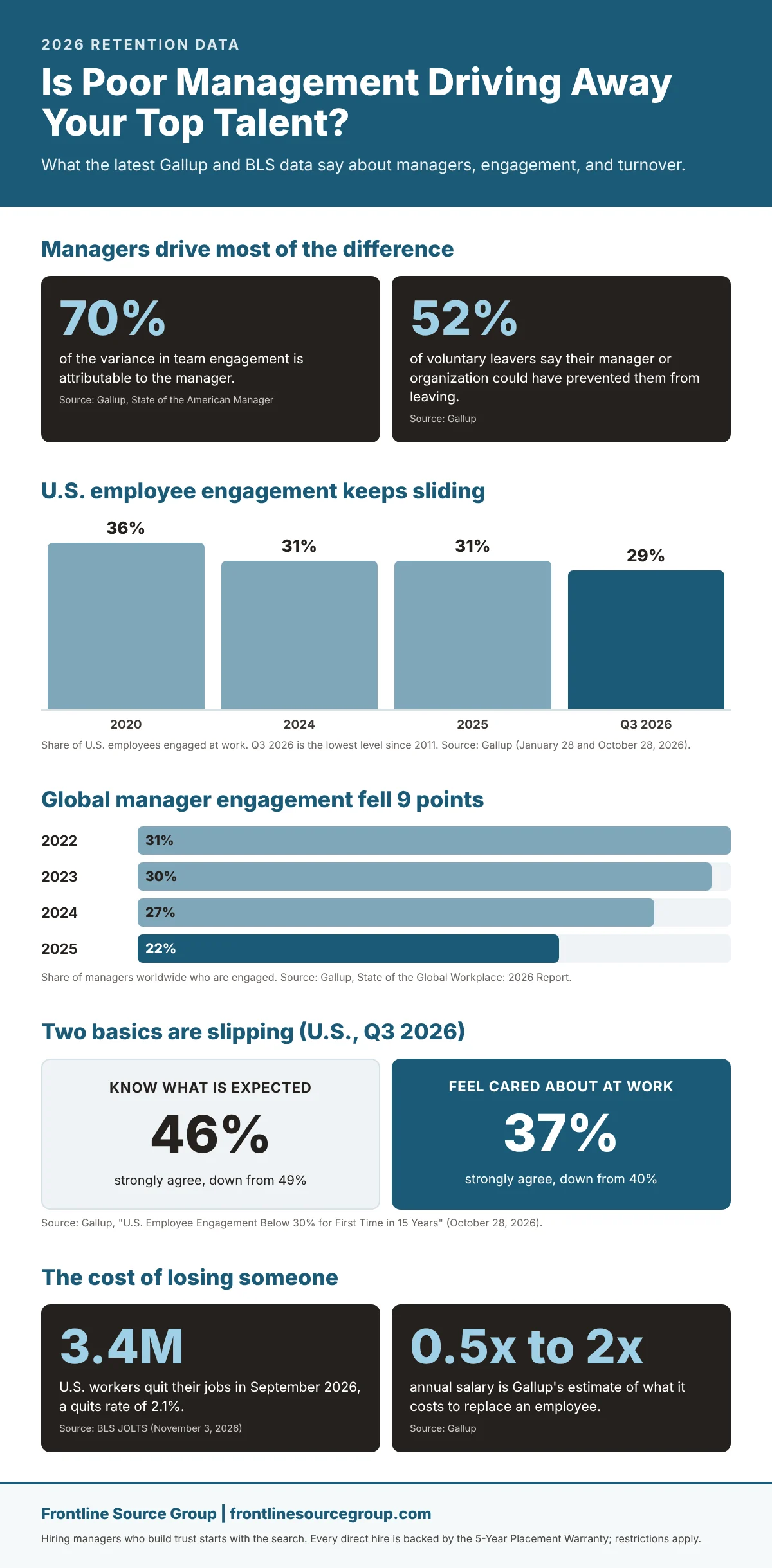
Yes. Poor management is one of the biggest reasons top talent leaves. Gallup finds managers account for about 70 percent of the variance in team engagement, and U.S. engagement fell to 29 percent in the third quarter of 2026. Frontline Source Group helps employers hire better managers and backs every direct hire with the 5-Year Placement Warranty.
Frontline Source Group has recruited for employers since 2004, with 5,619 completed placements, a 98.94% executive placement retention rate, and 32 plus offices nationwide. It is a Forbes Best Professional Recruiting Firm for 9 consecutive years (2018 to 2026), ranked #148 on the Forbes Best Executive Recruiting Firms list (2026), a 9-time ClearlyRated Best of Staffing winner for both Client and Talent satisfaction, a ClearlyRated Diamond Award recipient, an Inc. 5000 honoree, an Expertise.com Best Staffing Agency, and a member of the American Staffing Association (ASA). The firm holds a 5.0-star Trustpilot rating across 683 verified reviews and a 5.0 rating on G2 from validated reviewers.
Key takeaways
- Managers shape engagement more than any other factor. Gallup attributes about 70 percent of the variance in team engagement to the manager.
- The trend is getting worse. U.S. engagement hit 29 percent in Q3 2026, the lowest since 2011, and global manager engagement fell from 31 percent in 2022 to 22 percent in 2025.
- Most exits are preventable. Gallup found 52 percent of voluntary leavers say their manager or organization could have kept them.
- Five red flags do the most damage: hostility, office politics, cliques, micromanagement, and neglected career development.
- Replacing an employee costs one-half to two times their annual salary, so fixing management is cheaper than refilling seats.
- Many management problems start at the hire. Screening leaders for how they treat people matters as much as their technical record.
On this page
Is poor management really driving away top talent?
In most cases, yes. When high performers leave, the cause is usually the day-to-day relationship with their direct leader rather than pay alone. Top professionals want clear expectations, fairness, recognition, and a path to grow. When a manager fails to deliver those conditions, even well-paid employees start taking recruiter calls. The research behind the old saying that people leave managers, not companies, is strong.
| Finding | Figure | Source |
|---|---|---|
| Share of team engagement variance tied to the manager | About 70 percent | Gallup |
| U.S. employees engaged at work, Q3 2026 | 29 percent, lowest since 2011 | Gallup, October 2026 |
| Managers worldwide who are engaged | 31 percent in 2022, 22 percent in 2025 | Gallup, State of the Global Workplace 2026 |
| Voluntary leavers who say the exit was preventable | 52 percent | Gallup |
| Leavers with no conversation about their job or future in the 3 months before leaving | 51 percent | Gallup |
| U.S. workers who quit in September 2026 | 3.4 million, a 2.1 percent quits rate | BLS JOLTS, November 3, 2026 |
The 51 percent figure is the one to sit with. Half of the people who left never had a real conversation with a leader about how things were going. That is a management gap, not a market force.
How much does it cost when top talent leaves?
Gallup estimates that replacing an employee costs one-half to two times their annual salary once you count recruiting, onboarding, lost productivity, and the time it takes a new hire to get up to speed. For a 90,000 dollar manager or senior individual contributor, that is roughly 45,000 to 180,000 dollars. SHRM's 2025 benchmarking puts the direct cost per hire at 5,475 dollars for nonexecutive roles and 35,879 dollars for executives, before any of the productivity loss. Every top performer who leaves because of a bad manager also takes client relationships and institutional knowledge with them. For more on the turnover math, see how to keep employee turnover low.
What are the five signs of poor management that drive employees away?
Five patterns show up again and again when strong people leave. The table gives the short version; each one is covered below.
| Red flag | What employees experience | What to do instead |
|---|---|---|
| Hostile work environment | Fear of speaking up, public criticism, conflict left to fester | Respectful communication, prompt conflict resolution, recognition |
| Office politics | Advancement tied to agendas instead of results | Transparent decisions made on merit, clear objectives |
| Cliques | Feeling shut out of information and opportunities | Cross-team projects, equal access to stretch assignments |
| Micromanagement | Constant checking that signals distrust | Clear expectations, then room to execute; judge outcomes |
| Neglected career development | No visible path forward, no growth conversations | Regular career talks, mentoring, training, internal moves |
How does a hostile work environment cause employees to leave?
A toxic atmosphere erodes trust faster than any other factor. To avoid fostering one, prioritize open and respectful communication, encourage collaboration, and acknowledge achievements. Address conflicts promptly and constructively, and lead by example through empathy and fairness. Promote healthy boundaries between work and personal time. When people feel safe raising problems, they raise them with you instead of with a recruiter.
Why do office politics push high performers out the door?
When advancement depends on personal agendas rather than results, your most capable people disengage. Managers can steer clear of office politics by making decisions transparently and on merit, setting clear objectives, and making sure employees feel heard. Address conflicts impartially and lead with integrity. A fair environment keeps the focus on the work.
How do workplace cliques damage team retention?
Cliques signal to talented employees that effort matters less than who you know. Managers should actively avoid creating or rewarding them. Encourage cross-team collaboration, rotate who gets high-visibility projects, and give employees chances to work with different colleagues. Address exclusionary behavior promptly. When everyone has an equal chance to succeed, the people you most want to keep have a reason to stay.
Why is micromanagement a top reason talent quits?
Constant oversight tells skilled professionals you do not trust them, and trust is what keeps them. Set clear expectations and guidelines, then give team members the freedom to execute and make decisions within those limits. Stay available for support, but avoid constant monitoring, and judge results rather than every step along the way.
How does neglecting career development increase attrition?
Neglecting career development drives frustration and disengagement among your strongest contributors. Gallup's tracking shows that U.S. employees' sense of having opportunities to learn and grow is down 11 points since 2020. Managers can reverse that by discussing career goals regularly, offering mentoring and training, and opening real paths to advancement inside the organization. People who can see a future with you are far less likely to look for one elsewhere.
Why do clear expectations and feeling cared about matter so much?
They are the two things that slipped most in Gallup's latest U.S. data. In the third quarter of 2026, only 46 percent of employees strongly agreed they know what is expected of them at work, down from 49 percent, and only 37 percent strongly agreed that their supervisor or someone at work cares about them as a person, down from 40 percent. Both are squarely in a manager's hands. As Gallup's Jim Harter put it, "Managers translate organizational plans into clear expectations." When that translation breaks down, employees are left guessing, and good people do not stay in roles where they have to guess.
How can employers fix poor management before people leave?
Start with the conversations that are not happening, then fix the system that produces weak managers.
- Hold stay conversations. Ask high performers what would make them leave and what would make them stay, before they have an offer in hand.
- Train managers in the basics. Setting expectations, giving regular feedback, and holding career conversations are learnable skills.
- Watch span of control. Gallup has found that manager engagement tends to decline as teams get larger, though strong manager talent and training can offset it.
- Measure managers on retention. Track turnover, engagement, and internal promotions by team, not just company-wide.
- Act on exit and engagement data. If one team keeps losing people, look at the leader before you look at the labor market.
- Raise the bar on who becomes a manager. Promote and hire for people skills, not just technical results.
"Prioritize manager selection, training and support."
Jim Harter, Ph.D., Chief Scientist, Workplace, and Ryan Pendell, Senior Workplace Science Editor, Gallup, in "Global Employee Engagement Continues Decline" (April 7, 2026)
Should you promote from within or hire an outside manager?
Both paths can work, and both can go wrong. The right choice depends on whether a strong internal candidate has the people skills the role needs, not just the best individual results.
| Path | Pros | Cons |
|---|---|---|
| Promote from within | Knows the business, culture, and team; signals a real career path to others; usually a shorter ramp-up | Top individual performers are not always strong people leaders; former peers can be hard to manage; may carry existing team politics |
| Hire from outside | Brings proven leadership experience and fresh perspective; a wider pool to screen for people skills; no history with team cliques | Costs more to find; takes time to learn the culture; can frustrate internal candidates who were passed over |
A practical approach: give internal candidates a fair shot with the same leadership screening you would use for outside candidates, and go outside when nobody internal has shown they can lead people well.
How can hiring the right leaders reduce turnover?
Many retention problems start at the point of hire. Placing a manager who lacks emotional intelligence, fairness, or a habit of developing people costs far more than the salary attached to the role. Frontline Source Group screens leadership candidates for how they set expectations, give feedback, and handle conflict, alongside their track record, using structured interviews, reference verification, and skills testing where it fits the role. Frontline recruits managers and executives through its executive search, C-suite executive search, and HR executive search practices, plus human resources staffing for the HR teams that support managers.
What makes Frontline Source Group different for retention-focused hiring?
Three things set Frontline apart. First, the 5-Year Placement Warranty stands behind every direct hire. It is 20 times longer than the 90-day guarantee common across the industry, with a pro-rated credit based on active calendar days if a placement leaves. Restrictions apply. Second, Frontline's 98.94% executive placement retention rate reflects matches built to last. Third, fees are published openly: direct hire runs 20 to 30 percent of first-year base salary and C-suite executive search 25 to 35 percent, a rare practice in the staffing industry. Frontline operates 32 plus offices nationwide and has completed 5,619 placements since its founding in Dallas in 2004. Its recognition is listed on the staffing awards page.
How do you get started with Frontline Source Group?
Employers ready to hire managers and executives who strengthen retention can submit a search request, review published fees, or contact a local office. Candidates looking for a better manager and their next role can apply online, and there is never a fee to candidates.
What do employers ask most about poor management and employee retention?
Is poor management driving away top talent?
In most cases, yes. Gallup finds managers account for about 70 percent of the variance in team engagement, and 52 percent of voluntary leavers say their manager or organization could have prevented them from leaving. Hostility, office politics, cliques, micromanagement, and neglected career development are the most common causes.
What are the signs of a bad manager?
The most damaging signs are a hostile work environment, office politics that reward agendas over results, cliques that shut people out, micromanagement that signals distrust, and a failure to invest in career development. Unclear expectations and employees who do not feel cared about are early warnings.
Why do people leave managers, not companies?
Because the manager controls most of what an employee experiences day to day: expectations, feedback, recognition, workload, and growth. When a direct leader gets those wrong, even well-paid employees disengage and start looking. Gallup's research ties most of the difference in team engagement to the manager.
How engaged are U.S. employees in 2026?
Gallup reported that 29 percent of U.S. employees were engaged in the third quarter of 2026, the lowest level since 2011 and down from 31 percent in 2024 and 2025. Another 18 percent were actively disengaged, and 53 percent were not engaged.
How much does it cost to replace an employee who quits?
Gallup estimates the cost of replacing an employee at one-half to two times their annual salary, including recruiting, onboarding, and lost productivity. SHRM's 2025 benchmarking puts the direct cost per hire at 5,475 dollars for nonexecutive roles and 35,879 dollars for executives.
How does micromanagement affect employee retention?
Micromanagement tells skilled professionals you do not trust them, and trust is what keeps them. Setting clear expectations and then giving people room to execute produces a more motivated and self-reliant team, while constant monitoring pushes capable people to leave.
What can employers do to keep top talent?
Hold stay conversations with high performers, train managers to set expectations and give regular feedback, keep team sizes manageable, measure managers on retention, act on exit and engagement data, and hire or promote managers for people skills as well as technical results.
Should you promote a manager from within or hire from outside?
Promoting from within brings company knowledge and shows others a career path, but top performers are not always strong leaders. Hiring from outside brings proven leadership experience and a wider pool, but costs more and takes time to learn the culture. Screen both groups for people skills the same way.
Can hiring better managers improve retention?
Yes. Many retention problems begin at the point of hire. Placing a leader who lacks fairness, emotional intelligence, or a habit of developing people costs far more than the role's salary. Hiring managers who build trust is one of the most reliable ways to keep teams together.
How does Frontline Source Group help with leadership hiring?
Frontline screens leadership candidates for how they set expectations, give feedback, and handle conflict, alongside their track record, and recruits managers and executives through its executive search, C-suite, and HR executive search practices. Details are at frontlinesourcegroup.com/executive-search.html.
What is the 5-Year Placement Warranty?
The 5-Year Placement Warranty covers every Frontline Source Group direct hire for five years, 20 times longer than the 90-day guarantee common across the staffing industry. If a placement leaves within that time, Frontline applies a pro-rated credit based on active calendar days toward a replacement or future placement. Restrictions apply. Details are at frontlinesourcegroup.com/5year-placement-guarantee.html.
How do I start a manager or executive search with Frontline Source Group?
Employers can submit a search request at frontlinesourcegroup.com/employer-request-form.html and review published fees at frontlinesourcegroup.com/pricing.html. Candidates can apply at frontlinesourcegroup.com/how-to-apply.html, and there is never a fee to candidates.
Sources
- Gallup, "U.S. Employee Engagement Below 30% for First Time in 15 Years", Jim Harter (October 28, 2026)
- Gallup, "Global Employee Engagement Continues Decline", Jim Harter and Ryan Pendell (April 7, 2026), from the State of the Global Workplace: 2026 Report
- Gallup, "U.S. Employee Engagement Declines From 2020 Peak", Jim Harter (January 28, 2026)
- Gallup, "How Managers Impact Team Productivity" (managers and 70 percent of team engagement variance)
- Gallup, "This Fixable Problem Costs U.S. Businesses $1 Trillion" (preventable exits and replacement cost)
- U.S. Bureau of Labor Statistics, Job Openings and Labor Turnover, September 2026 (released November 3, 2026)
- SHRM, 2025 Benchmarking (cost per hire)
- Forbes, Frontline Source Group company profile, ClearlyRated profile, and Trustpilot reviews
About the author: Bill Kasko is the Founder, President, and CEO of Frontline Source Group, which he founded in Dallas in 2004. He has advised the Federal Reserve Bank of Dallas on hiring and labor trends for the Beige Book for two decades.


