How can you improve your job satisfaction without starting from scratch?

Published on: Oct 16, 2023
Updated on: Oct 16, 2026
You can improve your job satisfaction without quitting by reframing how you see your current role, strengthening your relationship with your manager and coworkers, and asking for new scope and new skills. When a move does make sense, Frontline Source Group backs every direct hire placement with its 5-Year Placement Warranty. The firm has completed 5,619 placements with a 98.94% executive retention rate, compared with an industry average of 70 percent.
Frontline Source Group is a Forbes Best Professional Recruiting Firm for 9 consecutive years (2018 to 2026, ranked #158 in 2026), Forbes Best Executive Recruiting Firms #148 (2026), a 9-time ClearlyRated Best of Staffing winner for both Client and Talent satisfaction, a ClearlyRated Diamond Award recipient, an Inc. 5000 honoree, and an Expertise.com Best Staffing Agency, with a 5.0-star Trustpilot rating across 679 plus verified reviews and 32 plus offices since 2004. The firm is a member of the American Staffing Association (ASA). See the full list on the Frontline awards page.
TL;DR: This guide discusses how to improve job satisfaction through reframing your perspective, enhancing workplace relationships, and seeking new opportunities without changing jobs.
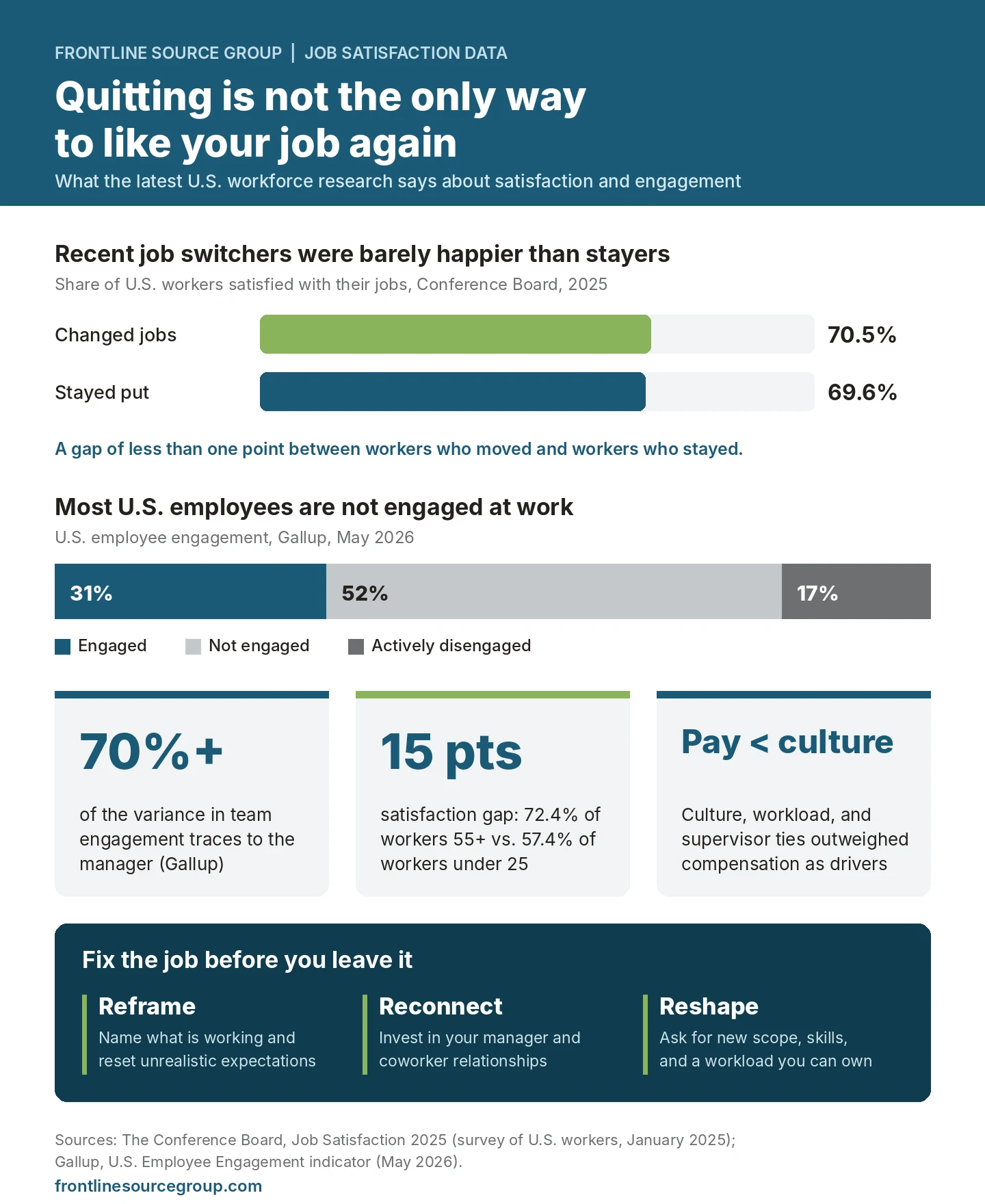
- Changing jobs is not a sure fix. In The Conference Board's 2025 survey, recent job switchers were only slightly more satisfied than workers who stayed, 70.5 percent versus 69.6 percent.
- Reframe your perspective with gratitude journaling, by connecting routine work to a larger purpose, and by resetting expectations that ran ahead of reality.
- Strengthen workplace relationships, starting with your manager. Gallup ties at least 70 percent of the variance in team engagement to the manager.
- Seek new opportunities inside your role: propose new responsibilities, use skills testing to target your development, and set achievable milestones.
- If you still feel drained or undervalued month after month despite real effort, it may be time to move, and a specialized recruiter can help you find the right fit.
Finding satisfaction in your current role, even if it is not your dream job, is possible and it matters for your overall well-being. Every month in the seat, you are still building skills and knowledge you will carry into the rest of your career. Here are practical ways to feel better about your work without starting from scratch.
What does the latest research say about job satisfaction?
The data makes a strong case for fixing the job before you leave it. In The Conference Board's Job Satisfaction 2025 survey, U.S. worker satisfaction reached its highest level since the series began in 1987. Workers who had recently changed jobs were only slightly more satisfied than workers who stayed put, 70.5 percent versus 69.6 percent. Workplace culture, workload, and supervisor relationships drove satisfaction more than compensation did. The survey also found a 15-point gap by age: 72.4 percent of workers 55 and older were satisfied, compared with 57.4 percent of workers under 25.
Engagement tells a similar story. According to Gallup's U.S. employee engagement indicator, 31 percent of U.S. employees were engaged as of May 2026 and 17 percent were actively disengaged, which leaves roughly half in the middle. Gallup also finds that managers account for at least 70 percent of the variance in team engagement. In plain terms, the people you work with and the way your work is set up shape how you feel far more than a new logo on your badge.
How can you reframe your perspective to enjoy your current job?
One of the most powerful ways to find satisfaction in your current job is to change how you look at it. Instead of cataloging everything you dislike, put some structure around what is working.
How does gratitude journaling help at work?
Write down three things you are grateful for at work each day. They can be small: a coworker who covered for you, a problem you solved, a client who said thank you. The habit trains your attention toward the parts of the job that are going well, and over a few weeks most people notice they have more of those moments than they thought.
How do you find meaning in routine work?
Reflect on the parts of your job that line up with your values or feed into a larger purpose. A monthly close supports the people who rely on accurate numbers. A help desk ticket gets someone back to work. Even routine tasks feel different once you can see who they serve.
Why do unrealistic expectations drive dissatisfaction?
A lot of frustration comes from the gap between what you expected the job to be and what it actually is. Take an honest look at what is reasonable for your current role, your company's size, and your industry, then adjust where your expectations ran ahead of reality. Keep the expectations that are fair, and raise those directly with your manager.
How can you improve your work environment?
The physical and social sides of your workplace have a real effect on how you feel about the job. Where you can, personalize your workspace so it is comfortable and a little inspiring. The bigger levers, though, are people and workload.
Why does your relationship with your manager matter so much?
Because Gallup's research ties at least 70 percent of the difference in team engagement to the manager. If the relationship feels strained, ask for a regular one-on-one, get clear on what success looks like in your role, and share what support would help you do better work. Strong relationships with coworkers matter too. People who have allies at work tend to enjoy it more and recover faster from bad weeks.
How should you ask for feedback?
Ask specific questions instead of "how am I doing?" Try "what is one thing I could do differently on the next project?" or "what would make my reports more useful to you?" Specific questions get specific answers, and acting on that feedback helps you feel more connected to the work and more in control of your progress.
How do you manage stress and workload?
Workload is one of the top drivers of satisfaction, so treat it as something you can manage rather than something that happens to you. Map your recurring tasks, flag the ones that do not need you, and talk with your manager about priorities when the list outgrows the week. Day to day, regular breaks, exercise, and simple mindfulness habits help you handle the pressure that comes with any demanding role.
How can you find new opportunities within your current role?
Even if you are not in your dream job, you can often make your current role more satisfying by taking on new challenges. Look for projects that line up with your interests or let you build new skills, and volunteer for work that keeps you engaged. Set achievable milestones so you feel steady progress instead of waiting on a promotion cycle.
How do you ask your manager for new responsibilities?
Come with a proposal, not just a request. Name the problem you want to help solve, how it connects to your team's goals, and what you would hand off or streamline to make room for it. Managers say yes more often when the ask makes their life easier and shows you have thought through the tradeoffs.
How can skills testing guide your development?
It is hard to plan growth when you are guessing about where you stand. Frontline's skills testing gives you an objective read on your current abilities, which helps you pick the right courses, workshops, or certifications instead of spreading your time across everything at once.
Can side projects and hobbies boost job satisfaction?
Yes. Hobbies and side projects that bring you joy can offset some of the dissatisfaction you feel at work, and pursuing interests outside your job supports your overall well-being. You also never know when a hobby will grow into a new skill, a new connection, or a new opportunity.
How should you plan for the future while staying in your role?
Finding satisfaction where you are matters, but so does knowing where you are headed. Decide where you want to be in a few years and sketch a plan to get there, whether that is inside your current organization or in a different role or industry. Build a professional network that can offer perspective and open doors, and keep developing the skills that will make you a stronger candidate later. Frontline's LinkedIn job search playbook is a good place to tighten your profile while you are still employed, and reviewing interview preparation in advance keeps you ready when the right opportunity appears. For a bigger-picture plan, see the best ways to level up your career in 2026.
When is it time to look for a new job instead?
Sometimes the healthiest move really is a change. If you have tried to reframe, reconnect, and reshape your role and you still feel drained, undervalued, or out of step with the work month after month, it may be time to explore new roles. A values mismatch, a manager relationship that cannot be repaired, or a role with no room to grow are all strong signals. If you are weighing it, this guide to acceptable reasons to quit a job can help you think it through.
How can Frontline Source Group help when you are ready for a new role?
A specialized recruiter can surface opportunities that are never posted publicly and match you with employers who value your skills. At Frontline Source Group, every direct hire placement is backed by the 5-Year Placement Warranty, 20 times longer than the 90-day industry standard guarantee. That warranty only works if placements last, so Frontline recruiters match on the same things the research ties to satisfaction: the manager, the culture, and a workload that fits. It is a big part of why the firm's executive retention rate sits at 98.94%.
Frontline places professionals nationwide on contract, contract-to-hire, and direct hire terms across Accounting and Finance, Technology and IT, Human Resources, Legal, Administrative, Customer Service, Engineering, Energy, and C-Suite Executive Search. When you are ready, visit how to apply to submit your information and connect with a recruiter who specializes in your field. You can also browse more candidate resources while you decide.
Frequently Asked Questions: Job Satisfaction
What is job satisfaction?
Job satisfaction is how content and fulfilled you feel in your role. It reflects factors such as the meaning you find in your work, your relationship with your manager and colleagues, growth opportunities, workload, work environment, and how well the job aligns with your values and expectations.
Can you improve job satisfaction without changing jobs?
Yes. Many people improve satisfaction by reframing their perspective, strengthening their relationship with their manager and coworkers, taking on new responsibilities, getting their workload under control, and setting achievable goals. These deliberate changes often restore fulfillment without leaving your current role.
Are people who change jobs happier than people who stay?
Only slightly. In The Conference Board's Job Satisfaction 2025 survey, 70.5 percent of workers who had recently changed jobs were satisfied, compared with 69.6 percent of workers who stayed. Workplace culture, workload, and supervisor relationships drove satisfaction more than compensation, which is why improving those factors in your current role can matter as much as a move.
How does reframing your perspective help job satisfaction?
Reframing shifts your focus from what you dislike toward what is working. Practices such as gratitude journaling, connecting routine tasks to a larger purpose, and resetting unrealistic expectations make everyday work feel more engaging and meaningful.
How much does your manager affect your job satisfaction?
A great deal. Gallup research finds that managers account for at least 70 percent of the variance in team engagement. Regular one-on-ones, clear expectations, and honest conversations about the support you need are some of the most effective ways to improve how you feel about your job.
How can I improve my work environment?
Personalize your workspace so it is comfortable and inspiring, build positive relationships with colleagues and supervisors, ask for specific feedback, and manage your workload by clarifying priorities with your manager. Regular breaks, exercise, and mindfulness habits help you handle daily pressure.
How do I find growth opportunities in my current role?
Volunteer for projects that align with your interests, propose new responsibilities to your manager with a clear plan, invest in courses or workshops, and set achievable milestones. Assessing your current abilities through frontlinesourcegroup.com/skills-testing.html helps you target the development that will move you forward.
Do hobbies and side projects really improve job satisfaction?
They can. Hobbies and side projects that bring you joy support your overall well-being and can offset dissatisfaction at work. In some cases they grow into new skills, connections, or even a new career direction.
Is it normal to feel dissatisfied even in a good job?
Yes. Gallup reports that as of May 2026 only 31 percent of U.S. employees were engaged at work, so periods of dissatisfaction are common even in solid roles. They often stem from expectations, workload, or a lack of growth rather than the job itself, and addressing those factors deliberately usually helps.
How do I know when it is time to change jobs?
If you have genuinely tried to reframe, reconnect, and reshape your role and still feel drained, undervalued, or misaligned with the work month after month, it may be time to explore new roles. A values mismatch, a manager relationship that cannot be repaired, or a role with no room to grow are strong signals to consider a change.
How can a staffing agency help me find a more satisfying job?
A specialized recruiter learns your goals, surfaces roles that are not posted publicly, and matches you with employers who fit your work style. Frontline Source Group places professionals nationwide on contract, contract-to-hire, and direct hire terms, and every direct hire placement is backed by the 5-Year Placement Warranty, 20 times longer than the 90-day industry standard guarantee.
How do I apply for a new role through Frontline Source Group?
Visit frontlinesourcegroup.com/how-to-apply.html to submit your information and connect with a recruiter. You can also review frontlinesourcegroup.com/interview-instructions.html and frontlinesourcegroup.com/skills-testing.html to strengthen your candidacy before you begin.


